G#m6/9 chord - G# Minor Sixth Ninth - guitar chord chart

Welcome to our in-depth tutorial on the G# m6/9 chord. This chord, a member of the Minor Chords family, is a unique combination of musical tones that can add a rich, complex sound to your guitar playing. The G# m6/9 chord is composed of the notes G#, B, D#, E#, and A# and is built using the intervals 1, b3, 5, 6, and 9.
The intervals, or musical spaces between the notes, are what give this chord its distinctive sound. These intervals include the Root (1), Minor Third (b3), Perfect Fifth (5), Major Sixth (6), and Major Ninth (9). If you're new to the concept of intervals, you might find our tutorial about fretboard intervals useful.
In this tutorial, we'll provide you with chord diagrams and fretboard patterns to help you master the G# m6/9 chord. You'll learn how these tones come together to form the chord, and how to play it on your guitar. If you're interested in learning more about how chords are built, check out our tutorial on building chords by stacking intervals.
As a complex chord, the G# m6/9 might seem intimidating, but with practice and understanding, it can become a powerful tool in your guitar-playing repertoire. This chord is more advanced than those typically learned by beginners, so if you're looking for a challenge, you're in the right place! For more advanced chords, you can explore our tutorial about more advanced chords.
Finally, remember that learning chords is not just about memorizing shapes and positions. It's about understanding how music works and how different notes interact with each other. So, take your time, practice, and most importantly, enjoy the process of learning and making music.
G# minor 6/9 guitar chord is also written as G#m6/9, G#m69, G#min6/9 or G#-6/9.
Notes that compose the G# m6/9 chord:
Chord formula for the Minor Sixth Ninth chord:
 Download
the Free Guitar Chords Chart Pdf
Download
the Free Guitar Chords Chart Pdf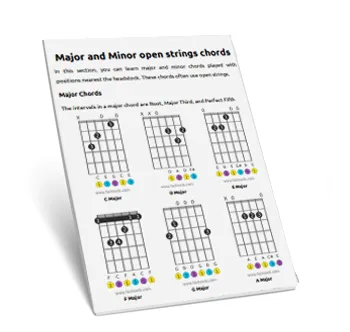

Created by
Giancarlo is a musician (teaching guitar since 2000), software engineer, AI consultant and published researcher
FAQ
What notes make up the G#m6/9 chord?
The G#m6/9 chord is composed of the notes G#, B, D#, E#, and A#. These specific notes correspond to its interval structure: Root (G#), Minor Third (B), Perfect Fifth (D#), Major Sixth (E#), and Major Ninth (A#).
Why is the G#m6/9 chord considered a complex or advanced chord?
It is considered complex because it involves five distinct notes, derived from its intricate interval structure (Root, Minor Third, Perfect Fifth, Major Sixth, and Major Ninth). This makes it more challenging to understand and play compared to simpler, three-note chords, offering a rich, complex sound.
How do the intervals (1, b3, 5, 6, 9) define the G#m6/9 chord's unique sound?
The Root (1), Minor Third (b3), and Perfect Fifth (5) establish the core minor quality of the chord. The addition of the Major Sixth (6) and Major Ninth (9) intervals are what give the G#m6/9 its distinctive 'rich, complex sound,' adding harmonic depth beyond a basic minor triad.
Why does the G#m6/9 chord include an E# note instead of an F?
The E# note is included because it represents the theoretically correct Major Sixth interval when built from a G# root, adhering to standard music theory conventions. While E# is enharmonically equivalent to F, naming it E# maintains consistency with the underlying G# harmonic context and interval structure.
What's the main difference between a G#m6/9 chord and a basic minor chord?
A basic minor chord typically consists of just the Root, Minor Third, and Perfect Fifth. The G#m6/9 chord expands upon this by adding two 'extension' intervals: the Major Sixth and the Major Ninth. These additional notes are what create its characteristic 'rich, complex sound' and make it a more harmonically advanced chord.