G#9b5 Guitar Chord | Play, Hear and Practice Interactively
Want a structured chord roadmap instead of jumping between pages?
Go to the full guitar chords tutorial.
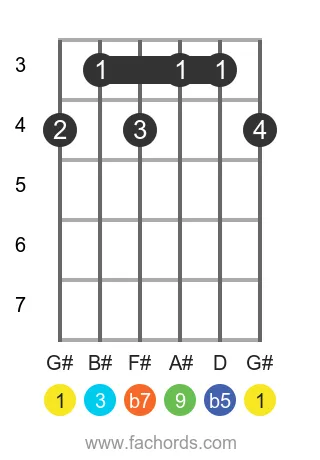
The G#9b5 chord belongs to the Dominant Chords family and is built from the notes G#, B#, D, F#, and A#. These correspond to the intervals Root (1), Major Third (3), Diminished Fifth (b5), Minor Seventh (b7), and Major Ninth (9). Use the interactive fretboard tool at the top of this page to visualize every fingering, listen to the chord played as a strum or arpeggio, and check your own playing with the real-time microphone feedback — the tool will tell you if you're hitting the notes correctly.
As a dominant chord, the G#9b5 brings a distinctive jazzy tension to progressions, making it a valuable sound for exploration. Dive deeper into the characteristics of this type of chord with our guide to Dominant Chords, and understand its construction by exploring Ninth Chords. Mastering its various fingerings involves understanding Understanding Chord Inversions, a fundamental aspect of Chord Construction.
Below, you'll discover comprehensive chord diagrams, ordered from the easiest open positions to more advanced shapes, along with detailed music theory insights, popular songs featuring the G#9b5, and the keys where this chord is commonly found. Before you delve into the diagrams, take a moment to engage with the interactive tool above. Set a rhythm with the drum and BPM tool, play the chord, and let the mic feedback guide you to perfect your finger placement. This hands-on approach is the most effective way to internalize new chords.
G# 9b5 chord Notes:
Chord Formula:
G#9b5 Guitar Chord Diagrams
Position 1
Barre
Movable
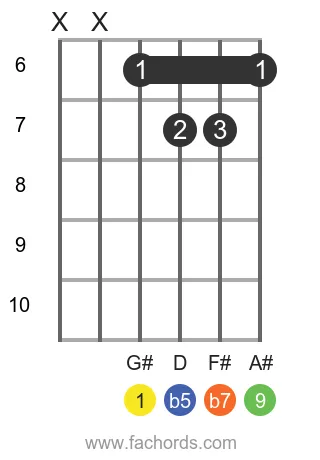
Position 2
Barre
Movable
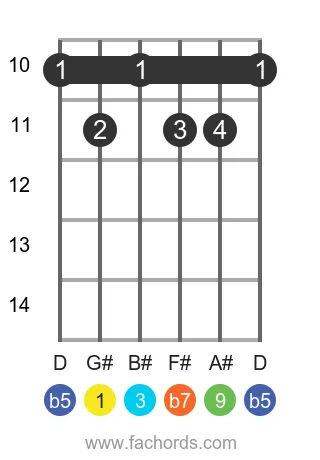
Position 3
Barre
Movable
 Find more shapes in our all guitar chords online library. If you
prefer a printable pdf, download
the Free Guitar Chords Chart Pdf
Find more shapes in our all guitar chords online library. If you
prefer a printable pdf, download
the Free Guitar Chords Chart Pdf
You can also use this accessible G#9b5 chord page, with written diagram instructions and screen-reader support for blind users.

Created by
Giancarlo is a musician (teaching guitar since 2000), software engineer, AI consultant and published researcher
FAQ
What notes are included in a G# 9b5 chord?
The G# 9b5 chord is composed of five distinct notes: G#, B#, D, F#, and A#. These notes correspond to the root, major third, diminished fifth, minor seventh, and major ninth intervals, respectively.
What makes the G# 9b5 chord a 'Dominant Chord'?
The G# 9b5 is classified as a dominant chord primarily because it contains a major third and a minor seventh interval, which are characteristic of dominant harmony. This combination creates a strong tendency to resolve to another chord, contributing unique tonal qualities.
Why is the G# 9b5 considered an intermediate chord for guitarists?
This chord is seen as intermediate because it moves beyond basic open or barre chords. It involves a five-note structure with specific intervals like the diminished fifth and major ninth, requiring a deeper understanding of the fretboard and music theory concepts to play and utilize effectively.
How does the 'b5' (diminished fifth) interval affect the G# 9b5 chord's sound?
The 'b5' or diminished fifth interval in the G# 9b5 chord creates a unique and often complex or 'tense' sound. This specific interval gives the chord its distinctive color and is crucial for its function in certain musical contexts, adding tension and interest.
When is the G# 9b5 chord typically used in music?
The G# 9b5 chord is frequently found in jazz chord progressions. Its complex and unique tonal qualities make it well-suited for adding harmonic richness, color, and tension, which are characteristic elements of jazz music.
What is the role of chord inversions when mastering the G# 9b5?
Learning chord inversions for the G# 9b5 is vital because it allows you to play the same chord using different voicings across the fretboard. This deepens your understanding of the chord's structure, helps you visualize its notes in various positions, and improves your ability to integrate it smoothly into different musical phrases.
