G#7#11 Guitar Chord | Play, Hear and Practice Interactively
Want a structured chord roadmap instead of jumping between pages?
Download the step-by-step Guitar Chord Ebook
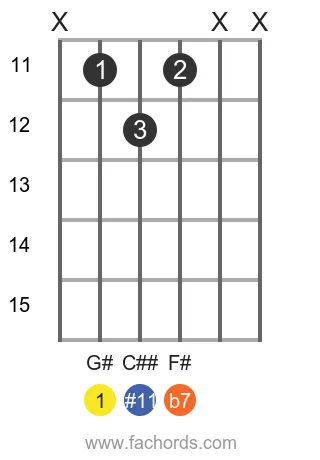
The G#7#11 chord is a sophisticated member of the Dominant Chords family, characterized by its tension and rich harmonic flavor. It's built from the notes G#, B#, D#, F#, and C##, corresponding to the intervals Root (1), Major Third (3), Perfect Fifth (5), Minor Seventh (b7), and Augmented Fourth (#11). You can visualize every fingering on our interactive fretboard tool at the top of the page, listen to the chord played as a strum or arpeggio, and even get instant validation on your playing technique with real-time microphone feedback.
This G#7#11 chord is commonly found in jazz progressions, adding a distinctive color and harmonic complexity. Understanding its unique construction, particularly the augmented eleventh, is key to mastering its sound. Explore its theoretical underpinnings further with our guide on the Dominant Chord family, and deepen your general understanding of how chords are built through our Chord Construction tutorial. For other advanced extended chords, consider our Ninth Chords tutorial. Once you're comfortable with the shape, focus on improving your chord changes for seamless playing.
Below, you'll discover a comprehensive collection of chord diagrams, organized from the simplest open positions to more complex barre shapes. We also dive into the music theory behind the G#7#11, list songs where it shines, and reveal the musical keys where you're most likely to encounter it. Before exploring these resources, take a moment to engage with the interactive tool above. Set a comfortable tempo with the drum & BPM tool, experiment with different voicings, and let the mic feedback guide you to perfect your finger placement. This hands-on approach is the most effective way to truly learn and internalize this unique chord.
Notes of the G# 7(#11) chord:
Chord structure of the Dominant Seventh Sharp Eleventh Added chord:
Guitar Patterns for the G#7(#11) chord
Position 1
Movable
 Find more shapes in our all guitar chords online library. If you
prefer a printable pdf, download
the Free Guitar Chords Chart Pdf
Find more shapes in our all guitar chords online library. If you
prefer a printable pdf, download
the Free Guitar Chords Chart Pdf
You can also use this accessible G#7(#11) chord page, with written diagram instructions and screen-reader support for blind users.

FAQ
What are the specific notes that compose the G#7#11 chord?
The G#7#11 chord is made up of the notes G#, B#, D#, F#, and C##. These notes correspond to the chord's theoretical intervals.
Why is the G#7#11 considered a 'Dominant Chord'?
The G#7#11 is part of the Dominant Chords family because it possesses a 'tense and unresolved sound'. This characteristic quality is inherent to dominant chords and their function in harmony.
What do the intervals 1, 3, 5, b7, and #11 signify in the G#7#11 chord?
These numbers represent the specific intervals from the root note (G#) that form the chord: 1 is the Root, 3 is the Major Third, 5 is the Perfect Fifth, b7 is the Minor Seventh, and #11 is the Augmented Fourth. These intervals give the chord its unique sound.
Is the G#7#11 chord suitable for beginner guitarists?
No, the G#7#11 chord is explicitly described as 'more advanced than beginner chords'. It's presented as a way to enhance your playing once you're ready to tackle more complex harmonies and techniques.
When would a guitarist typically use the G#7#11 chord in music?
The G#7#11 chord is frequently found in jazz chord progressions. It adds a specific color and tension often utilized in jazz contexts, especially alongside maj7, m7, and 7 chord types.
What does the '#11' in the G#7#11 chord name indicate?
The '#11' indicates the inclusion of an Augmented Fourth interval in the chord structure. This interval is added to the standard dominant 7th chord (Root, Major Third, Perfect Fifth, Minor Seventh), contributing to its distinct sound.