Gb7(#11) Guitar Chord | Play, Hear and Practice Interactively
Want a structured chord roadmap instead of jumping between pages?
Download the step-by-step Guitar Chord Ebook
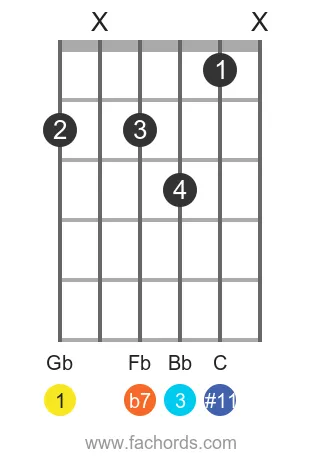
The Gb7(#11) chord is a fascinating member of the Dominant Chords family. It's built from the notes Gb, Bb, Db, Fb, and C, representing the intervals Root (1), Major Third (3), Perfect Fifth (5), Minor Seventh (b7), and Augmented Fourth (#11). Use the interactive fretboard tool at the top of this page to visualize every fingering, hear the chord played as a strum or arpeggio, and check your own playing with real-time microphone feedback.
The Gb7(#11), with its augmented fourth, adds a unique, jazzy color to progressions and can be challenging for some. Understanding its advanced construction is key; delve deeper into its origins with our guide on Dominant Chords and learn more about how notes stack up in our Chord Construction tutorial. Many shapes for this chord will involve Guitar Bar Chords, so mastering those is highly beneficial. Practice smooth transitions to make this chord shine in your playing with tips from our Improve Chords Change guide.
Scroll down to explore comprehensive music theory for the Gb7(#11), alongside chord diagrams ranging from beginner-friendly positions to advanced voicings, songs that use this chord, and common keys where it appears. Before you dive into the charts, take a moment to use the interactive tool above. Experiment with different fingerings, listen to how they sound, and get instant feedback on your accuracy. This hands-on approach will supercharge your learning and help you truly master the Gb7(#11) chord.
Notes of the Gb 7(#11) chord:
Chord Structure:
Guitar Patterns for the Gb Dominant Seventh Sharp Eleventh Added chord
Position 1
Movable
 Find more shapes in our all guitar chords online library. If you
prefer a printable pdf, download
the Free Guitar Chords Chart Pdf
Find more shapes in our all guitar chords online library. If you
prefer a printable pdf, download
the Free Guitar Chords Chart Pdf
You can also use this accessible Gb7(#11) chord page, with written diagram instructions and screen-reader support for blind users.
FAQ
What notes make up the Gb7(#11) chord?
The Gb7(#11) chord is composed of five distinct notes: Gb (Root), Bb (Major Third), Db (Perfect Fifth), Fb (Minor Seventh), and C (Augmented Eleventh).
What do the numbers and symbols '7' and '#11' signify in the Gb7(#11) chord name?
The '7' indicates the presence of a minor seventh interval (Fb) above the root, making it a dominant seventh chord. The '#11' signifies an augmented eleventh interval (C), which is the same as an augmented fourth, added to the dominant seventh structure.
Why is the Fb note used in the Gb7(#11) chord instead of E?
The Fb note is used in the Gb7(#11) chord to correctly represent the minor seventh interval in relation to the root Gb within the diatonic context. While E is enharmonically equivalent to Fb, Fb maintains the correct interval spelling for a minor seventh from Gb (which would naturally be the seventh degree of the Gb major scale flatted).
Why is the Gb7(#11) classified as a 'Dominant Chord'?
The Gb7(#11) is a dominant chord because its fundamental structure includes the root (1), major third (3), perfect fifth (5), and minor seventh (b7) intervals. These core intervals define a dominant seventh chord, with the #11 being an added extension that enhances its harmonic color.
What is the role of the #11 interval in the Gb7(#11) chord?
The #11 interval (Augmented Fourth) adds a unique harmonic tension and 'color' to the dominant seventh chord. It contributes to the sophisticated sound often found in advanced musical pieces, particularly in jazz chord progressions, opening up new musical possibilities for the player.
Why is the Gb7(#11) chord considered complex for beginners?
The Gb7(#11) chord can be complex for beginners due to the inclusion of the augmented eleventh extension and its common application in more advanced musical contexts like jazz. Understanding its specific intervals and how they stack is crucial, which often requires a solid grasp of music theory fundamentals and fretboard knowledge.