Explore the F7(#11) Guitar Chord on Our Interactive Fretboard
Want a structured chord roadmap instead of jumping between pages?
Go to the full guitar chords tutorial.
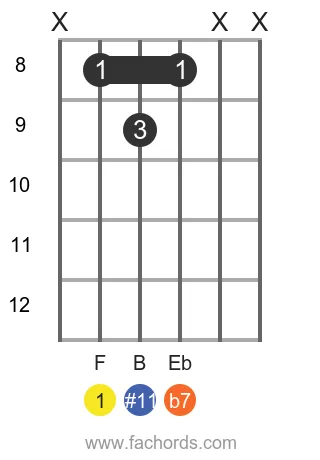
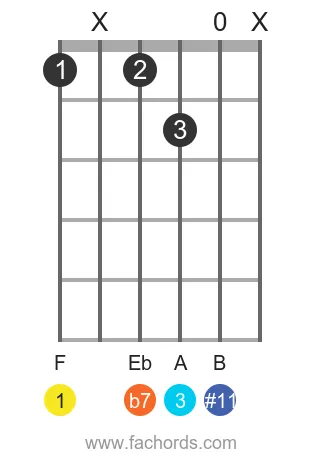
The F7(#11) chord brings a rich, complex color to jazz and advanced music styles, standing out as a distinctive member of the Dominant Chords family. This sophisticated harmony is built from the notes F, A, C, Eb, and B, corresponding to the intervals of 1 (Root), 3 (Major Third), 5 (Perfect Fifth), b7 (Minor Seventh), and #11 (Augmented Fourth). Dive into its unique sound using our virtual fretboard to play the chord and hear its arpeggio. Get immediate validation on your accuracy with real-time mic feedback, ensuring your fingers hit every note perfectly.
Understanding the intricate structure of the F7(#11) chord is a significant step in expanding your harmonic vocabulary. To fully grasp how these rich sounds are built, explore our detailed guide on Chord Construction. As you deepen your knowledge of extended harmonies, you'll find that chords like the F7(#11) share principles with other advanced structures, such as those discussed in our Ninth Chords tutorial. Continuously improving your technique, including fluid chord transitions, will enable you to seamlessly integrate these complex sounds into your playing.
Before delving into detailed theory and song examples, we recommend you spend time simply playing the F7(#11) chord using our interactive tool. Experiment with various voicings shown in the chord diagrams, ranked from easiest to hardest, across different keys. Embracing the sound through direct interaction will build your intuitive understanding, making the theoretical aspects and application in songs much clearer. Add this distinct chord to your repertoire and elevate your guitar playing.
F 7(#11) chord Notes:
Tones of the Dominant Seventh Sharp Eleventh Added chord:
Fingerings for the F Dominant Seventh Sharp Eleventh Added guitar chord
Position 1
Open
Position 2
Barre
Movable
 Find more shapes in our all guitar chords online library. If you
prefer a printable pdf, download
the Free Guitar Chords Chart Pdf
Find more shapes in our all guitar chords online library. If you
prefer a printable pdf, download
the Free Guitar Chords Chart Pdf
You can also use this accessible F7(#11) chord page, with written diagram instructions and screen-reader support for blind users.

Created by
Giancarlo is a musician (teaching guitar since 2000), software engineer, AI consultant and published researcher
FAQ
What is the F7(#11) chord composed of?
The F7(#11) chord is built from the notes F, A, C, Eb, and B. These correspond to the Root, Major Third, Perfect Fifth, Minor Seventh, and Augmented Fourth intervals, respectively.
What makes the F7(#11) a 'dominant' chord?
The F7(#11) chord is a member of the Dominant Chords family because it contains the Root (F), Major Third (A), and Minor Seventh (Eb) intervals, which define a dominant 7th chord. The #11 is an added extension that gives it a unique color.
Why is the #11 interval also referred to as an 'augmented fourth'?
The #11 interval is the Augmented Fourth because it's essentially the fourth scale degree (B natural in the key of F major) that has been raised by a half step. It's called an '11' because it's considered an extension beyond the basic 1-3-5-7 structure, representing the fourth an octave higher.
In what musical styles is the F7(#11) chord typically used?
The F7(#11) chord is known for its rich and complex sound, making it a common choice in jazz and various other advanced music styles where sophisticated harmonies are desired.
How does learning the F7(#11) chord help a guitarist's overall musical development?
Understanding and playing the F7(#11) chord is a significant step towards mastering more advanced chord structures. It broadens a guitarist's musical repertoire and deepens their understanding of complex harmony and intervals, which is crucial for exploring diverse musical genres.