F 5 Guitar Chord
Chord Diagrams, Interactive Fretboard and Chord Theory
The F power chord is also written as F5, F(no 3rd) or F(omit 3).
Position 1
Movable
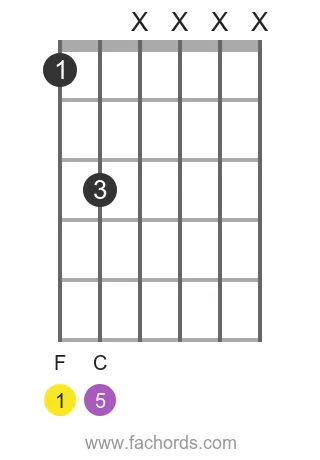
Position 2
Movable
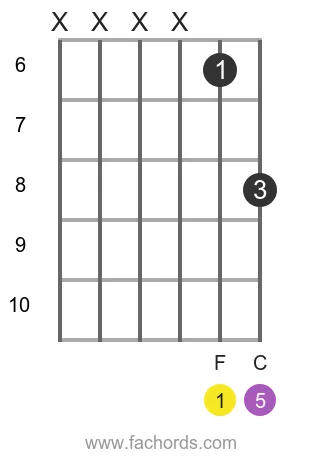
Position 3
Movable
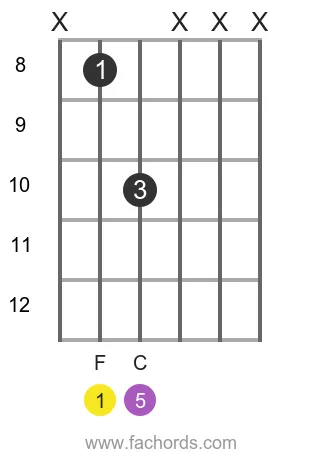
Position 4
Movable
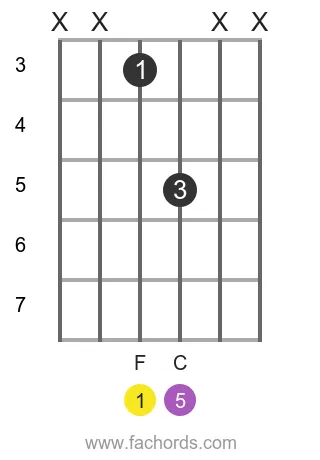
Position 5
Movable
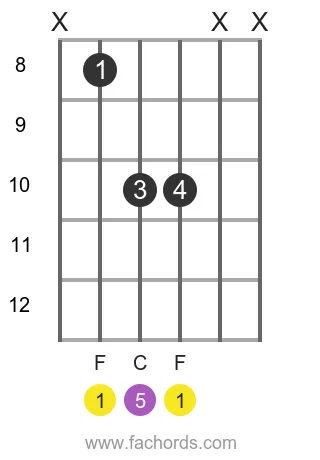
Position 6
Movable
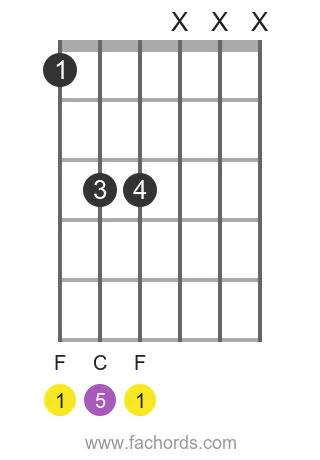
Position 7
Movable
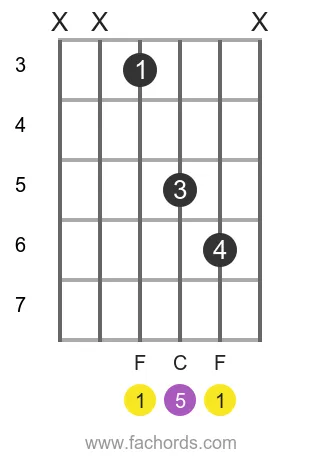
Position 8
Movable
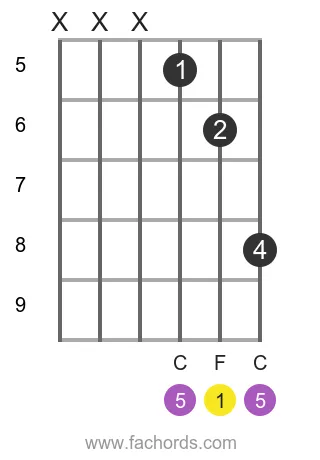
Position 9
Barre
Movable
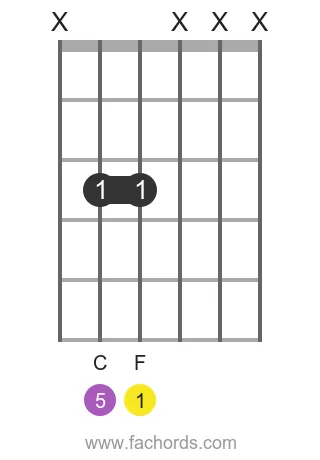
Position 10
Barre
Movable
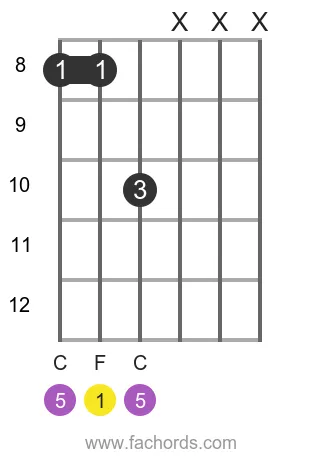
 Find more shapes in our all guitar chords online library. If you
prefer a printable pdf, download
the Free Guitar Chords Chart Pdf
Find more shapes in our all guitar chords online library. If you
prefer a printable pdf, download
the Free Guitar Chords Chart Pdf
You can also use this accessible F5 chord page, with written diagram instructions and screen-reader support for blind users.
Practice the F5 Guitar Chord with Interactive Charts
Want a structured chord roadmap instead of jumping between pages?
Go to the full guitar chords tutorial.
Are you struggling to get a clean F5 guitar chord? Our interactive fretboard is ready to help! Play along and get instant real-time mic feedback to perfect your technique. The F5 chord, a foundational power chord, consists of just two notes: F and C, representing the Root (1) and the Perfect Fifth (5). This powerful two-note structure is a staple in rock and heavy music.
Power chords, like the F5, are known for their driving sound, especially when played on an electric guitar with distortion. Their simple, open-fifth interval structure makes them versatile for creating compelling riffs and strong rhythmic foundations. Understanding how chords are built by stacking intervals can deepen your musical insight; explore our chord construction guide for more. For a deeper dive into the world of power chords and how to unleash their full potential in your playing, be sure to check out our dedicated tutorial on power chords.
As you get comfortable with the F5, scroll down to explore different fingerings and diagrams, ranked from easiest to most challenging. Don't just memorize them; use our interactive tool to test your accuracy with each shape, verifying your playing with mic feedback before diving into the theory and applying these sounds in songs and various keys. This hands-on approach will solidify your understanding faster.
Notes in the F 5 chord:
Chord formula for the Powerchord chord:
Play This Chord With Other Roots
C 5 | D 5 | E 5 | F 5 | G 5 | A 5 | B 5 | C#5 | D#5 | F#5 | G#5 | A#5 | Ab5 | Bb5 | Db5 | Eb5 | Gb5

Created by
Giancarlo is a musician (teaching guitar since 2000), software engineer, AI consultant and published researcher
FAQ
What is an F5 power chord?
The F5 power chord is a type of chord built using only two notes: the Root and the Perfect Fifth. For the F5, these notes are F (the Root) and C (the Perfect Fifth), making it a fundamental chord, especially in rock, punk, and heavy music.
What notes and intervals make up the F5 chord?
The F5 chord is constructed from the notes F and C. In terms of musical intervals, F represents the Root (1), and C represents the Perfect Fifth (5) of the chord.
Why are power chords, like the F5, considered a good starting point for beginners?
Power chords are excellent for beginners because their construction of only two notes (Root and Fifth) often results in simpler fingerings compared to full major or minor chords. This makes them easier to learn and play while still producing a full, impactful sound.
When should I use the F5 power chord in my guitar playing?
The F5 power chord is a staple in genres such as rock, punk, and heavy music due to its strong, resonant sound. It is particularly effective when played on an electric guitar with some distortion, providing a powerful foundation for riffs and rhythm guitar parts.
Why does the F5 chord only contain the Root and the Fifth?
The definition of a power chord, like the F5, is specifically that it consists only of the Root and the Perfect Fifth. This minimalist structure gives it a distinct, harmonically robust sound without implying a major or minor tonality, making it versatile across various musical styles.
