Practice & Master the F#7(#11) Guitar Chord
Want a structured chord roadmap instead of jumping between pages?
Download the step-by-step Guitar Chord Ebook
Ready to tackle a chord that adds a distinct jazzy flavor? Our interactive fretboard tool provides the perfect environment to master the F#7(#11) chord. Begin by strumming the chord and immediately verify your accuracy with real-time microphone feedback, solidifying your muscle memory. This rich member of the Dominant Chords family is constructed from the notes F#, A#, C#, E, and B#, corresponding to the intervals Root (1), Major Third (3), Perfect Fifth (5), Minor Seventh (b7), and Augmented Fourth (#11). You can visualize every fingering and hear the chord played as a strum or arpeggio.
The F#7(#11) adds a unique, jazzy flavor to the typical dominant seventh, creating tension that often resolves beautifully in various musical contexts. This augmented fourth, or #11, adds a distinct color. For a deeper dive into its harmonic role, explore our guide to the Dominant Chord family. If you're curious about how these intricate intervals build up, our Chord Construction tutorial provides excellent insights. Many advanced players explore different Understanding Chord Inversions to find new voicings for chords like this. Once you're comfortable with the fingering, focus on improving your chord changes for seamless playing.
As you scroll down, you'll discover a comprehensive collection of F#7(#11) chord diagrams, arranged from the easiest open positions to more challenging barre shapes. We also provide deeper music theory explanations, popular songs that feature this chord, and the common keys where it appears. Before you dive into the diagrams, challenge yourself with the interactive tool above. Set your tempo with the drum & BPM tool, strum the chord, and let the mic feedback guide you. This immediate feedback loop is invaluable for solidifying your muscle memory and mastering complex chords like the F#7(#11).
Notes that compose the F# 7(#11) chord:
Chord Formula:
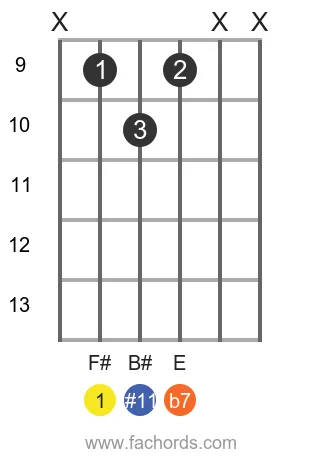
How To Play The F# Dominant Seventh Sharp Eleventh Added chord on guitar
Position 1
Movable
Position 2
Movable
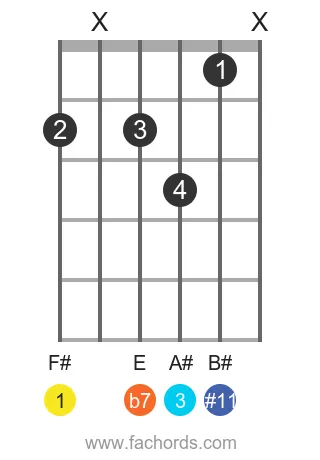
Position 3
Open
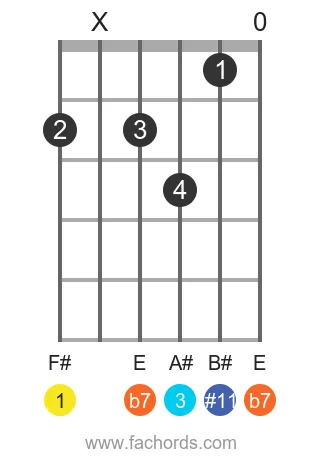
 Find more shapes in our all guitar chords online library. If you
prefer a printable pdf, download
the Free Guitar Chords Chart Pdf
Find more shapes in our all guitar chords online library. If you
prefer a printable pdf, download
the Free Guitar Chords Chart Pdf
You can also use this accessible F#7(#11) chord page, with written diagram instructions and screen-reader support for blind users.
FAQ
What are the specific notes that form the F# 7(#11) chord?
The F# 7(#11) chord is composed of five distinct notes: F#, A#, C#, E, and B#. These notes correspond to the Root, Major Third, Perfect Fifth, Minor Seventh, and Augmented Fourth intervals, respectively.
What do the intervals 1, 3, 5, b7, and #11 mean in the context of the F# 7(#11) chord?
These numbers represent the specific intervals that build the chord from its root (F#). They correspond to the Root (1), Major Third (3), Perfect Fifth (5), Minor Seventh (b7), and the Augmented Fourth (#11).
Why is the #11 interval in the F# 7(#11) chord also referred to as an 'Augmented Fourth'?
The tutorial explicitly states that the #11 interval is 'also known as the Augmented Fourth.' These terms are synonymous when referring to this specific interval within the chord structure.
What kind of chord family does the F# 7(#11) belong to, and what does this imply for its usage?
The F# 7(#11) chord belongs to the Dominant Chords family. As a dominant chord, it often finds its place in various musical genres, particularly jazz, contributing to its versatile sound.
Why is the F# 7(#11) chord considered an 'advanced' chord for guitarists?
The F# 7(#11) chord is described as 'more advanced than beginner chords.' Learning to play it marks a significant step in a guitarist's journey, indicating it requires a higher level of skill and understanding than foundational chords.
How can chord inversions be used with the F# 7(#11) chord?
Chord inversions allow you to find different ways to play the F# 7(#11) chord. By inverting the intervals, you can achieve new shapes and sounds for the same chord, expanding your playing options on the guitar.