Practice the Em(maj9) Guitar Chord with Our Interactive Fretboard
Want a structured chord roadmap instead of jumping between pages?
Download the step-by-step Guitar Chord Ebook
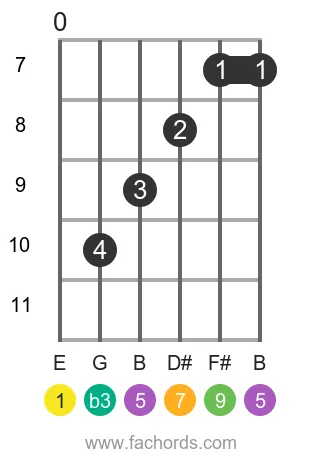
Ready to conquer the unique sound of the Em(maj9) chord? Start by testing your playing in real-time with our interactive fretboard's mic feedback. Our tool helps you verify every note as you play, ensuring accuracy from the start. Once you're confident in your execution, dive into the theory: this captivating chord belongs to the Minor Chords family and is built from the notes E, G, B, D#, and F#. Its powerful harmonic structure comes from the intervals of 1, b3, 5, 7, and 9, meaning a Root, Minor Third, Perfect Fifth, Major Seventh, and Major Ninth.
As a member of the ninth (9) guitar chords family, the Em(maj9) introduces rich, extended harmony and colorful tones often found in jazz progressions. Mastering its structure is a significant step, requiring a solid understanding of how chords are built by stacking intervals. This particular chord, with its Major Seventh and Major Ninth, exemplifies how extensions add depth and character, making it a powerful tool for advanced playing. For further exploration into these complex voicings, our guide on ninth chords offers deeper insights into their construction and musical application. Understanding these deeper concepts is key to enhancing your fretboard mastery.
After engaging with the interactive tool to solidify your playing, scroll down to explore comprehensive diagrams ranked from easiest to hardest, delve into the intricate theory behind the Em(maj9), and discover songs where this unique chord shines. Remember to use the virtual fretboard to test yourself and practice each shape; this disciplined approach will cement your understanding across various keys and musical contexts.
E m(maj9) chord Notes:
Formula of the Minor Major Ninth chord:
Fingerings for the E Minor Major Ninth guitar chord
Position 1
Barre
Open
 Find more shapes in our all guitar chords online library. If you
prefer a printable pdf, download
the Free Guitar Chords Chart Pdf
Find more shapes in our all guitar chords online library. If you
prefer a printable pdf, download
the Free Guitar Chords Chart Pdf
You can also use this accessible Em(maj9) chord page, with written diagram instructions and screen-reader support for blind users.
FAQ
What specific notes form the E m(maj9) guitar chord?
The E m(maj9) chord is constructed using five distinct notes: E, G, B, D#, and F#. These notes correspond to its root, minor third, perfect fifth, major seventh, and major ninth intervals, respectively.
What do the intervals 1, b3, 5, 7, and 9 represent in the E m(maj9) chord?
These numbers represent the fundamental intervals that define the E m(maj9) chord. They signify the Root (1), Minor Third (b3), Perfect Fifth (5), Major Seventh (7), and Major Ninth (9). Understanding these intervals is crucial for comprehending how the chord is built and how it functions musically.
Why is the E m(maj9) chord considered a more advanced or complex chord for guitarists?
The E m(maj9) chord is not typically a beginner's chord because of its complex structure. It involves five different notes and requires a solid understanding of how chords are built by stacking specific intervals, distinguishing it from simpler three or four-note chords.
What musical genres or styles commonly feature the E m(maj9) chord?
As a member of the ninth (9) guitar chords family, the E m(maj9) chord is frequently utilized in jazz progressions. Its sophisticated sound makes it suitable for adding harmonic color in such contexts.
Is the E m(maj9) chord fundamentally a minor or a major chord?
Despite the 'maj' in its name, the E m(maj9) chord is fundamentally a minor chord. Its core structure includes a Root, Minor Third (b3), and Perfect Fifth, which establishes its minor quality. The 'maj' specifically refers to the Major Seventh interval, which, along with the Major Ninth, adds to its unique, complex sound.
What is the key difference between a basic E minor chord and an E m(maj9) chord?
A basic E minor chord typically consists of only the Root, Minor Third, and Perfect Fifth (E, G, B). The E m(maj9) chord expands upon this by adding two more intervals: a Major Seventh (D#) and a Major Ninth (F#). These additional notes contribute to its richer, more complex harmonic quality.