Explore and Play the E7#11 Guitar Chord
Want a structured chord roadmap instead of jumping between pages?
Download the step-by-step Guitar Chord Ebook
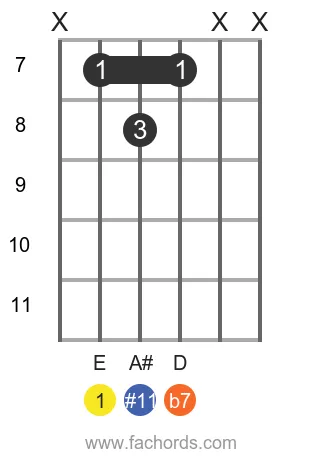
Often found adding sophisticated tension in jazz and fusion, the E7#11 chord brings a unique harmonic color to your music. This dominant chord is built from the notes E, G#, B, D, and A#, derived from the intervals 1, 3, 5, b7, and #11. Dive into its sound using our interactive fretboard, where you can instantly hear its playback, experiment with different voicings, and use real-time mic feedback to verify your accuracy as you play along.
The E7#11 extends beyond a standard dominant chord, integrating the #11 (augmented fourth) to create a distinctive, often restless sound. Understanding its construction, built on the intervals Root, Major Third, Perfect Fifth, Minor Seventh, and Augmented Fourth, is crucial. For a deeper dive into how these intervals combine to form chords, explore our guide on chord construction. This advanced voicing offers rich possibilities for melodic embellishment and harmonic movement, and can open up new pathways when you improve your chord changes within a progression.
Before delving into the theoretical intricacies, we encourage you to grab your guitar and experiment with the E7#11 chord on our virtual fretboard. Below, you'll find various diagrams, from simple to more complex voicings, along with detailed theory, suggested songs, and keys where this chord shines. Start playing, then analyze the possibilities this unique chord offers.
Notes of the E 7(#11) chord:
Chord structure of the Dominant Seventh Sharp Eleventh Added chord:
E7(#11) Guitar Chord Fingers Positions
Position 1
Movable
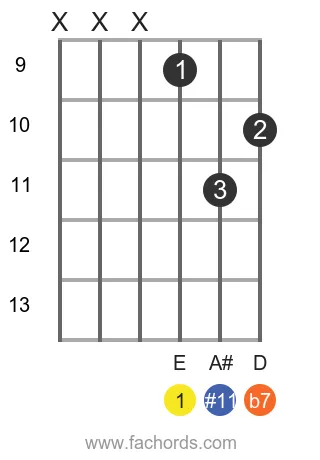
Position 2
Barre
Movable
 Find more shapes in our all guitar chords online library. If you
prefer a printable pdf, download
the Free Guitar Chords Chart Pdf
Find more shapes in our all guitar chords online library. If you
prefer a printable pdf, download
the Free Guitar Chords Chart Pdf
You can also use this accessible E7(#11) chord page, with written diagram instructions and screen-reader support for blind users.
FAQ
What are the specific notes that form the E7#11 chord?
The E7#11 chord is comprised of five distinct notes: E, G#, B, D, and A#. These notes are what give the chord its unique, rich, and complex sound.
Why is the E7#11 chord classified as a "dominant chord"?
The E7#11 chord belongs to the Dominant Chords family because its foundational structure includes the root (1), major third (3), and minor seventh (b7) intervals, which are characteristic of dominant seventh chords. The #11 is an extension added to this dominant base.
What does the "#11" signify in the E7#11 chord name?
The "#11" in E7#11 indicates the inclusion of an augmented eleventh interval. This specific interval, which is equivalent to an Augmented Fourth from the root, is added to the dominant seventh chord to create its distinctive extended sound.
How are the intervals used to build the E7#11 chord?
The E7#11 chord is built by stacking specific intervals from the root note. These intervals are the 1 (Root), 3 (Major Third), 5 (Perfect Fifth), b7 (Minor Seventh), and #11 (Augmented Fourth).
In what musical contexts is the E7#11 chord commonly used?
Due to its rich and complex sound, the E7#11 chord is often incorporated into jazz chord progressions. It can be used alongside other chord types like maj7 and m7 to create more intricate musical textures and harmonies.
Is the E7#11 a suitable chord for guitarists who are just starting out?
No, the E7#11 is considered a more advanced chord. The tutorial explicitly states it's 'more advanced than beginner chords,' implying that a solid understanding of fundamental chord theory and intervals is beneficial before tackling it.