E 7 Guitar Chord
Chord Diagrams, Interactive Fretboard and Chord Theory
E dominant 7th guitar chord is also written as E7, Edom7 or Edom.
Position 1
Open
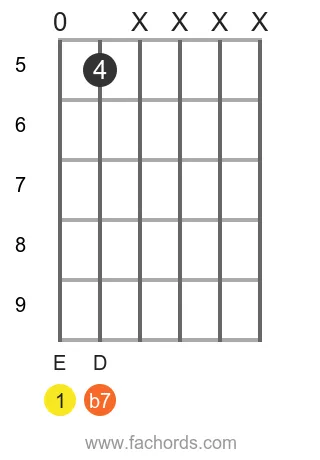
Position 2
Open
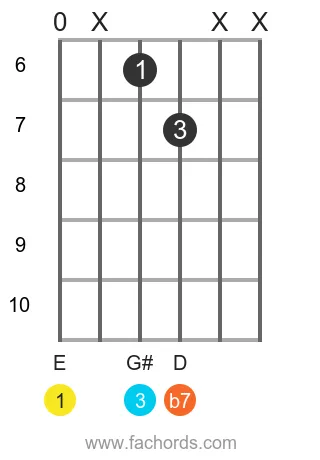
Position 3
Movable
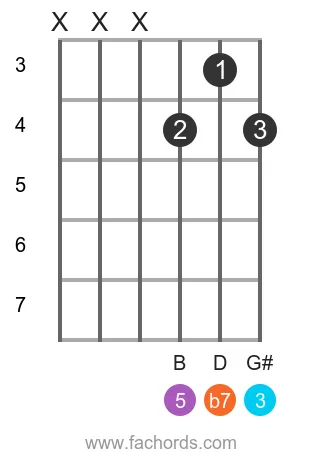
Position 4
Movable
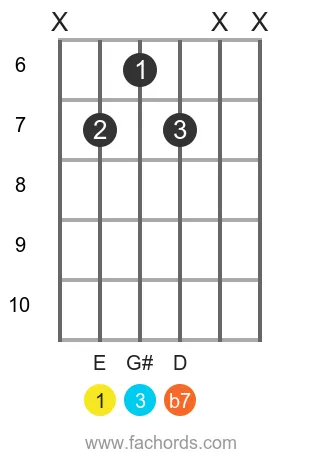
Position 5
Open
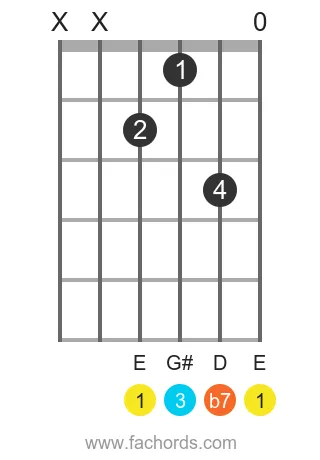
Position 6
Open
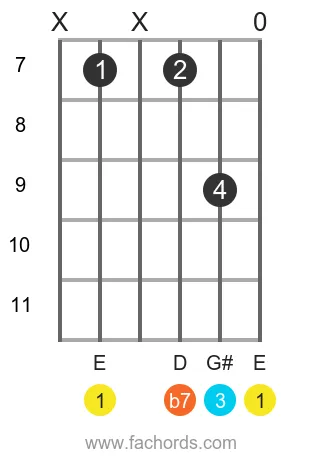
Position 7
Open
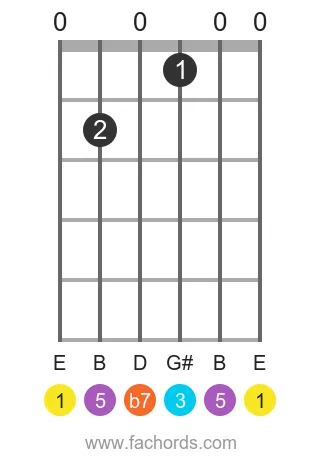
Position 8
Movable
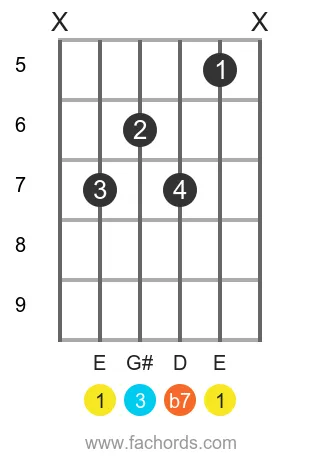
Position 9
Movable
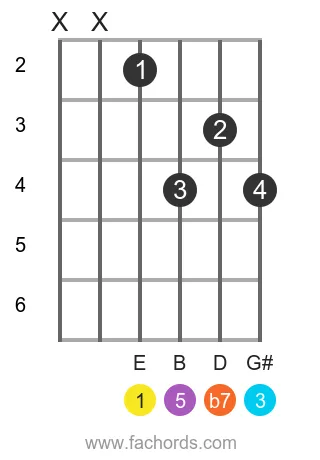
Position 10
Open
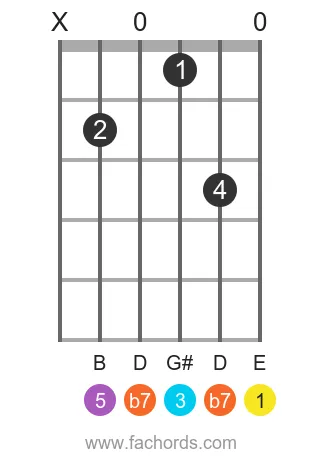
Position 11
Movable
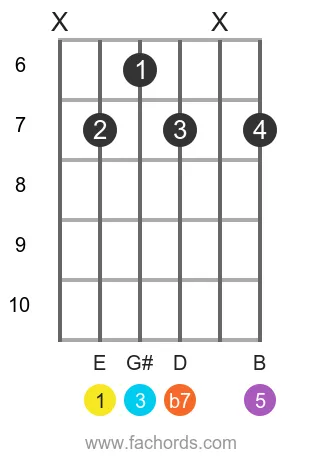
Position 12
Open
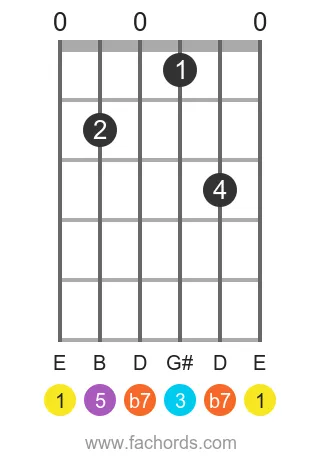
Position 13
Barre
Movable
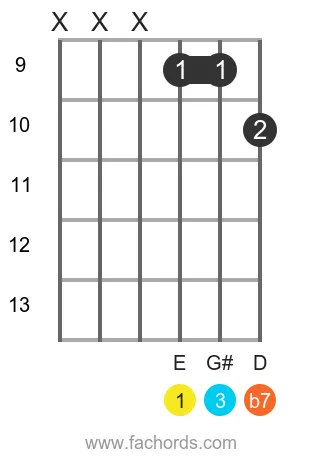
Position 14
Open
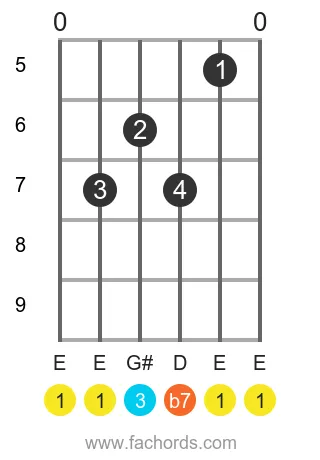
Position 15
Open
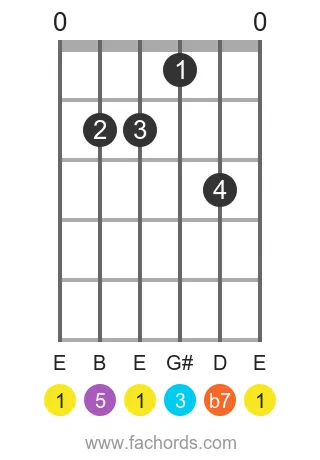
Position 16
Open
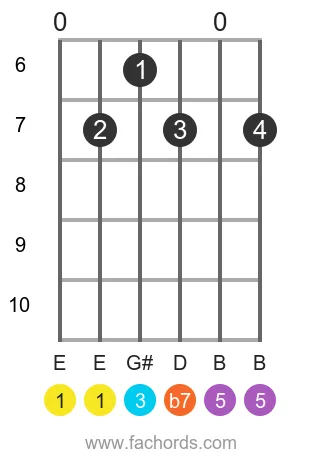
Position 17
Barre
Movable
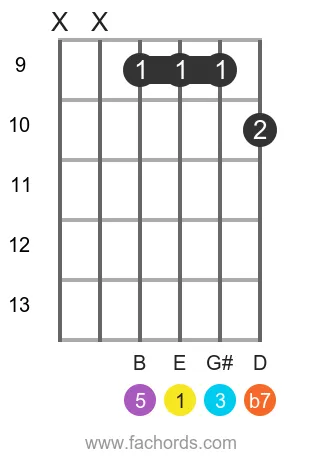
Position 18
Barre
Movable
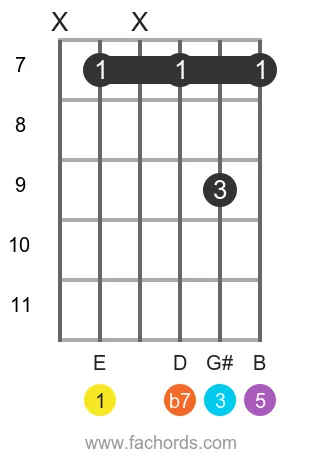
Position 19
Barre
Movable
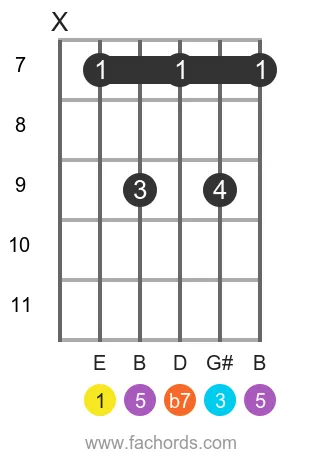
Position 20
Barre
Open
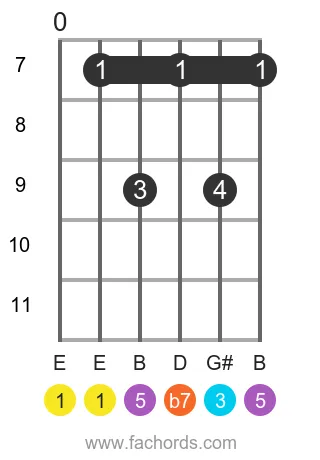
 Find more shapes in our all guitar chords online library. If you
prefer a printable pdf, download
the Free Guitar Chords Chart Pdf
Find more shapes in our all guitar chords online library. If you
prefer a printable pdf, download
the Free Guitar Chords Chart Pdf
You can also use this accessible E7 chord page, with written diagram instructions and screen-reader support for blind users.
Practice E7 Chord Forms on Guitar with Live Mic Feedback
Want a structured chord roadmap instead of jumping between pages?
Go to the full guitar chords tutorial.
Ready to conquer the E7 chord on guitar? Test your playing instantly with our interactive fretboard, providing precise real-time mic feedback to confirm each note you play. This vital Dominant Chord is built from the notes E, G#, B, and D, corresponding to the 1 (Root), 3 (Major Third), 5 (Perfect Fifth), and b7 (Minor Seventh) intervals, respectively.
The E7 chord is a cornerstone in blues, jazz, and rock, primarily serving to create tension that yearns for resolution. Its distinctive sound comes from the inclusion of the minor seventh interval, which pulls strongly towards the tonic. For a deeper understanding of how these powerful sounds are created, explore our guide on Dominant Chords. You can also delve into the fundamentals of how these chords are put together with our Chord Construction tutorial, which explains building chords by stacking intervals. To streamline your practice, consider learning 3-Note 7th Chords to simplify transitions, or refine your playing further with tips to Improve Chords Change.
Before consulting the diagrams ranked from easiest to hardest, or exploring the theoretical context, song applications, and keys this chord is used in, we highly recommend you first test yourself using our interactive fretboard. Experiment with different fingerings, listen to the chord playback, and trust the real-time feedback from your microphone. This hands-on approach is the fastest way to truly internalize the E7 chord.
Notes that compose the E 7 chord:
How the Dominant Seventh chord is built:
E7 Chord Tutorial
Remember the notes for the E major scale are:
E F# G# A B C# D#
An E major triad or chord is made up of the root, major third, and fifth note of that scale, thus E major is E G# B
How the E7 chord is built
Now an E7 is otherwise known as a dominant seventh, and to make a dominant seventh chord we use the btn rounded blue-border btn-default; root, major third, fifth, and minor seventh.
So the E7 chord will be made up of the notes E G# B D.
There are multiple seventh chords that exist and the dominant seventh is the most important of all.
Here below you find the intervals formula in the 7th dominant chord (1, 3, 5 and b7):
E7 Chord Guitar Shapes

Using the tones above we come up with some of the more popular versions of how to finger the E7 The most common E7 is the open position 020100:

Other common positions are barre chords of other 7ths. For example an open A7 chord is 002020, if we move that position up 7 frets we get an E7 that is X79797.
(This is the version of the chord that you will often see played in the funk genre.)

Another barre position is the C7 shape. C7 is X3231X, if we move that position up four frets we get another E7 that is X7675.

If we move the D7 chord (XX0212) up two frets and play it XXX434 we essentially get a rootless E7 (only made up of the notes B D G#).

Notice how some of the chords have an X, which means a muted string. If the muted string is the low or high E then it is also fine not to mute those strings.
Drill Down: To learn more about chord structure and building across all the fretboard, check my ebook Chords Domination | Play Any Chord You Want Across All The Fretboard
How to use the Dominant Chord
The main function of the dominant seventh is to lead up to a tonic resolution.
For example one very common place you will find dominant sevenths is in blues music and the seventh is often played right before the root or tonic chord.
We created an handy chords in keys pdf to help you manage this stuff.
The dominant seventh is often used in rock n roll, pop, and blues.
Try playing the progression A D E A, now play A D E7 A and you will notice how it gives it a much more bluesy and even rocking sound depending on how it is strummed.
As far as E7 chord use, it is not as common as other 7ths.
You will often find it in some folk tunes and a number of Christmas pop songs use it.
However, one genre that really loves the E7 chord is funk. You will see E7 often with E9 and E7+9 (which is known as the Jimi Hendrix chord).
In fact if you were trying out to play guitar for James Brown he would have you play E7 and E9 repetitively to give you an idea of what you would mostly be doing on stage!
In funk music we usually play the E7 higher up on the fretboard, like the positions shown above
Songs with the E7 chord
Some specific songs that use the E7 chord are:
- All About the Bass
- House of the Rising Sun
- Up on the Housetop
- Auld Lang Syne, and a ton of funk music.
Music Keys containing the E7 chord
The most common keys we will find with the E7 chord is the Keys of A, B, and E.
However you will also potentially find it in some more random places depending on where the songwriter was looking for some tension leading to resolution.
| Key | I | ii | iii | IV | V | vi | vii |
|---|---|---|---|---|---|---|---|
| A | A | Bm | C#m | D | E7 | F#m | G#m/b5 |
Play This Chord With Other Roots
C 7 | D 7 | E 7 | F 7 | G 7 | A 7 | B 7 | C#7 | D#7 | F#7 | G#7 | A#7 | Ab7 | Bb7 | Db7 | Eb7 | Gb7

Created by
Giancarlo is a musician (teaching guitar since 2000), software engineer, AI consultant and published researcher
FAQ
What notes and intervals make up an E7 chord?
The E7 chord is composed of the notes E, G#, B, and D. These notes correspond to the intervals of the Root (1), Major Third (3), Perfect Fifth (5), and Minor Seventh (b7) from the E major scale.
How is the E7 chord theoretically constructed from the E Major scale?
To construct an E7 chord, you start with the E Major scale (E, F#, G#, A, B, C#, D#). The E Major triad is formed by taking the root (E), major third (G#), and perfect fifth (B). The E7 chord then adds the minor seventh (D), which is a whole step below the E root, to this triad.
What is the primary musical function of a dominant seventh chord like E7?
The main function of a dominant seventh chord, such as E7, is to create musical tension that leads to a resolution. It typically resolves to the tonic chord, making it a powerful tool for harmonic movement. For example, E7 often leads to an A major chord, as it functions as the V chord in the key of A.
What does it mean to play a 'rootless E7' chord on the guitar?
A 'rootless E7' chord is a voicing where the root note (E) is omitted. Even without the root, the remaining notes (B, D, G#) still convey the distinct sound and function of an E7 chord. This technique is often used to create different harmonic textures or to simplify fingerings, as seen with the D7-shape moved up to XXX434.
In what musical genres is the E7 chord commonly used, and how does it influence the sound?
The E7 chord is often found in blues, rock n roll, and pop music, and also in some folk tunes and Christmas songs. It's particularly prominent in funk music, where it's often played higher up the fretboard. When added to a progression like A D E A (becoming A D E7 A), it gives a distinctly bluesy or rocking feel due to the tension created by the minor seventh.
What are some common guitar shapes or fingerings for the E7 chord?
Several common shapes exist for the E7 chord. The most common open position fingering is 020100. Other shapes include barre chords derived from moving an A7 shape (X79797) or a C7 shape (X7675X) up the fretboard. There's also a rootless voicing, such as XXX434, which is derived from a D7 shape.
In which musical keys is the E7 chord most likely to appear?
The E7 chord is most commonly found in the keys of A, B, and E. For instance, in the key of A, E7 functions as the dominant V7 chord. However, a songwriter might place it in other keys to intentionally create tension leading to a specific resolution.