Understand and Play the E 6 Guitar Chord with Interactive Charts
Want a structured chord roadmap instead of jumping between pages?
Go to the full guitar chords tutorial.
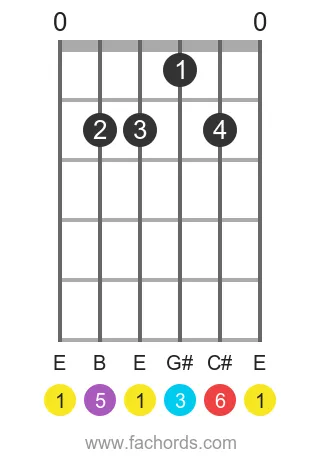
The E 6 chord is constructed from the intervals 1, 3, 5, and 6, which represent the Root, Major Third, Perfect Fifth, and Major Sixth respectively. As a member of the Major Chords family, this rich-sounding chord comprises the notes E, G#, B, and C#. To truly grasp its theoretical structure and practical application, our interactive fretboard tool allows you to visualize these notes across the fretboard and hear its precise playback. Furthermore, you can verify your playing accuracy in real-time with our innovative mic feedback system.
The 6th chord, like the E 6, brings a distinctive vintage or jazz sweetness to your playing, moving beyond the basic major and minor triads. Mastering its unique sound involves understanding how intervals are stacked to create its specific harmonic quality. This concept of interval stacking is crucial for building a solid foundation in music theory, as detailed in our comprehensive guide on Chord Construction. If you're keen to explore this rich harmonic territory further and expand your chord vocabulary, our dedicated lesson on 6th Chords offers deeper insights and various applications.
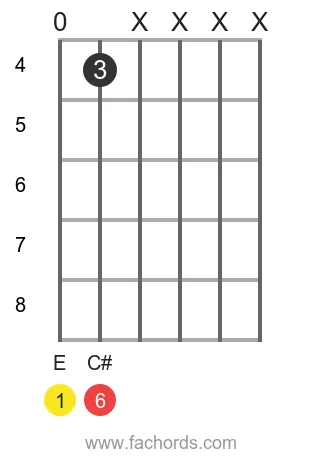
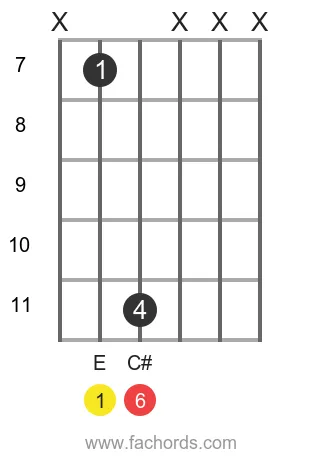
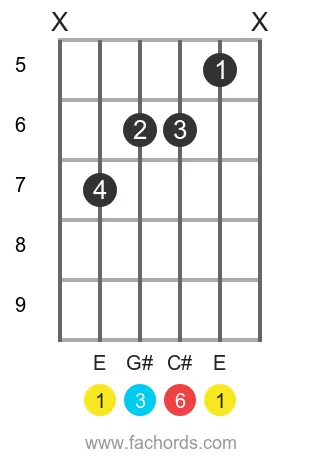
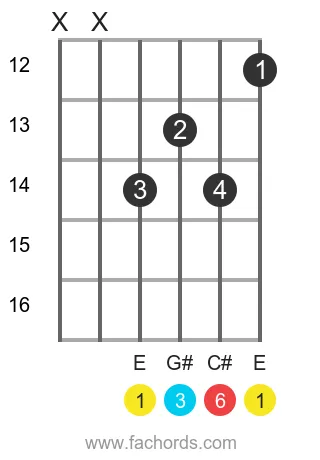
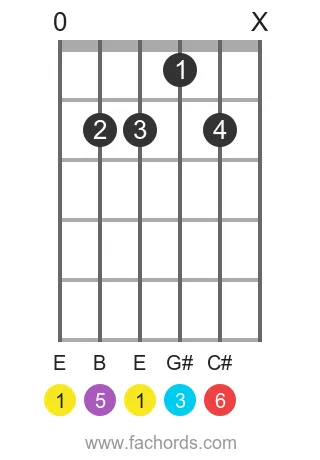
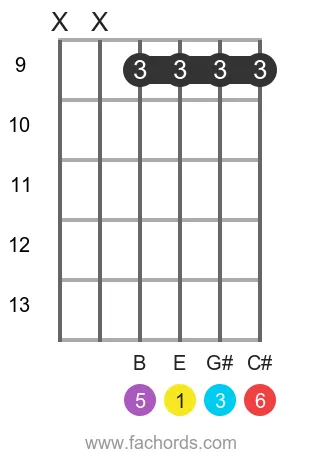
Below, you'll find comprehensive chord diagrams and fretboard patterns, arranged from the simplest to the more challenging, illustrating how the E 6 chord manifests across different fretboard positions and keys. Before diving into memorization, we highly recommend utilizing the interactive tool above to internalize the sound and feel of the chord first. Through disciplined practice, linking theory to your physical playing, you will confidently integrate this and other chords into your songs, enriching your musical expression.
E major 6th guitar chord is also written as E6, Emaj6, EM6 or Eadd6.
Notes in the E 6 chord:
How to create the Major Sixth chord:
E 6 Guitar Chord Diagrams
Position 1
Open
Position 2
Movable
Position 3
Movable
Position 4
Movable
Position 5
Open
Position 6
Open
Position 7
Barre
Movable
Position 8
Barre
Open
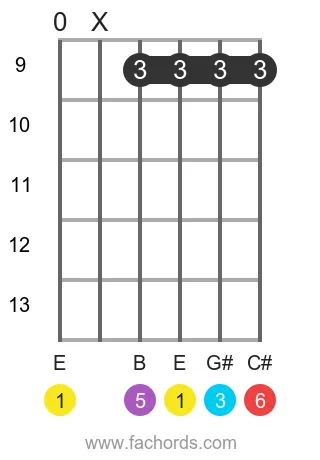
Position 9
Barre
Movable
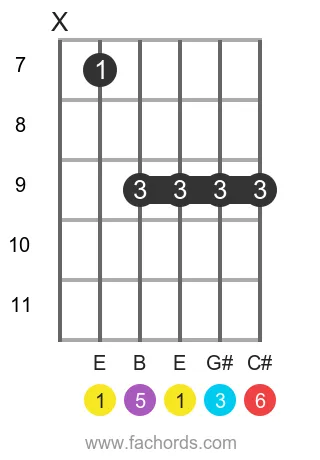
 Find more shapes in our all guitar chords online library. If you
prefer a printable pdf, download
the Free Guitar Chords Chart Pdf
Find more shapes in our all guitar chords online library. If you
prefer a printable pdf, download
the Free Guitar Chords Chart Pdf
You can also use this accessible E6 chord page, with written diagram instructions and screen-reader support for blind users.

Created by
Giancarlo is a musician (teaching guitar since 2000), software engineer, AI consultant and published researcher
FAQ
What makes the E 6 chord different from a standard E major chord?
A standard E major chord consists of the Root (E), Major Third (G#), and Perfect Fifth (B). The E 6 chord adds one more note: the Major Sixth (C#). This additional note gives the E 6 chord its distinct rich and beautiful sound compared to the simpler E major triad.
Why is the E 6 chord considered more advanced for guitarists?
The E 6 chord is more advanced because it includes an additional interval (the Major Sixth) beyond the basic major triad. This means it has four distinct notes, often requiring more complex fingerings on the fretboard than the three-note basic major chords, and understanding its construction involves a slightly deeper grasp of music theory.
What do the intervals 1, 3, 5, and 6 represent in the E 6 chord?
These numbers represent the relationship of each note in the chord to its root note, E. The '1' is the Root (E), '3' is the Major Third (G#), '5' is the Perfect Fifth (B), and '6' is the Major Sixth (C#). Understanding these intervals helps you build the chord theoretically and locate its notes on the fretboard.
How do chord diagrams and fretboard patterns help me learn the E 6 chord effectively?
Chord diagrams and fretboard patterns provide a visual map of where to place your fingers on the guitar. They show you exactly how the notes E, G#, B, and C# are arranged on specific strings and frets to form the E 6 chord, making it easier to visualize the 'tones' and translate theoretical knowledge into practical playing.