Explore D m6/9 Chords on Guitar
Want a structured chord roadmap instead of jumping between pages?
Go to the full guitar chords tutorial.
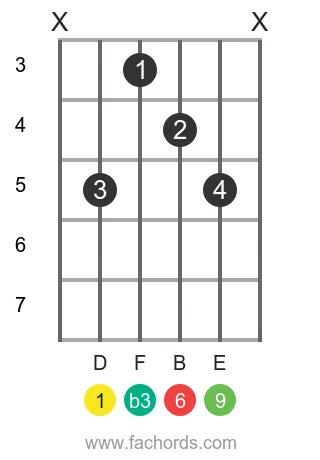
The D m6/9 chord offers a unique blend of sophistication and melancholic warmth, frequently enriching jazz progressions and soulful compositions. This extended minor chord, part of the Minor Chords family, is built from the notes D, F, A, B, and E, corresponding to the intervals Root (1), Minor Third (b3), Perfect Fifth (5), Major Sixth (6), and Major Ninth (9). Use our interactive fretboard to visualize and play the D m6/9, receiving instant, real-time feedback on your accuracy via your microphone. You can also hear the chord clearly played back, and adjust the tempo with our built-in drum machine.
As an extended minor chord, the D m6/9 brings a sophisticated color to your harmony. The added Major Sixth lends a vintage, sometimes melancholic sweetness, while the Major Ninth contributes to the chord's rich, extended harmony, making it a staple in various jazz and contemporary styles. Understanding how these intervals stack up to form complex sonorities is key to mastering such chords; our tutorial on chord construction can provide deeper insights. Explore how ninth chords and sixth chords function individually to appreciate the D m6/9's unique sound. Practicing smooth chord changes with this advanced shape will significantly enhance your playing.
Below, you'll find comprehensive chord diagrams presenting the D m6/9 chord in various voicings, from the most accessible to more advanced fingerings. Beyond just memorizing shapes, delving into the underlying theory will unlock your ability to transpose this chord into any key and apply it creatively in countless songs. Before diving into the theory, we encourage you to spend time interacting with the virtual fretboard above to truly hear and feel this chord's character. Discover its potential and integrate its distinctive sound into your musical vocabulary.
D minor 6/9 guitar chord is also written as Dm6/9, Dm69, Dmin6/9 or D-6/9.
D m6/9 chord Notes:
Chord Formula:
D M6/9 Guitar Chord Diagrams
Position 1
Movable
 Find more shapes in our all guitar chords online library. If you
prefer a printable pdf, download
the Free Guitar Chords Chart Pdf
Find more shapes in our all guitar chords online library. If you
prefer a printable pdf, download
the Free Guitar Chords Chart Pdf
You can also use this accessible Dm6/9 chord page, with written diagram instructions and screen-reader support for blind users.

Created by
Giancarlo is a musician (teaching guitar since 2000), software engineer, AI consultant and published researcher
FAQ
What notes are included in a D m6/9 chord?
A D m6/9 chord is composed of five specific notes: D, F, A, B, and E. These notes combine to create its distinct harmonic quality.
What are the theoretical intervals that define the D m6/9 chord?
The D m6/9 chord is built upon the following intervals relative to its root (D): the Root (1), Minor Third (b3), Perfect Fifth (5), Major Sixth (6), and Major Ninth (9).
What makes the D m6/9 chord sound unique or complex?
The unique sound of the D m6/9 chord comes from the specific combination of its intervals, particularly the Major Sixth and Major Ninth added to a basic minor triad. These extensions add depth and a more sophisticated, often jazzy, flavor compared to simpler chords.
Is the D m6/9 chord appropriate for beginner guitarists?
No, the D m6/9 chord is considered more advanced than beginner chords. It's typically introduced to intermediate players who are ready to expand their chord vocabulary and explore richer harmonies.
In what musical contexts is the D m6/9 chord typically used?
The D m6/9 chord is a staple in many jazz chord progressions. It's often used to add color and complexity, frequently appearing in conjunction with other jazz chord types such as maj7, m7, and 7 chords.
How do the 'm', '6', and '9' in 'D m6/9' relate to its intervals?
The 'm' indicates the presence of a Minor Third (b3) interval, making the chord minor. The '6' signifies the inclusion of a Major Sixth interval, and the '/9' denotes the addition of a Major Ninth interval to the chord's structure.