Master the D#7 Guitar Chord: Interactive Practice & Real-time Feedback
Want a structured chord roadmap instead of jumping between pages?
Go to the full guitar chords tutorial.
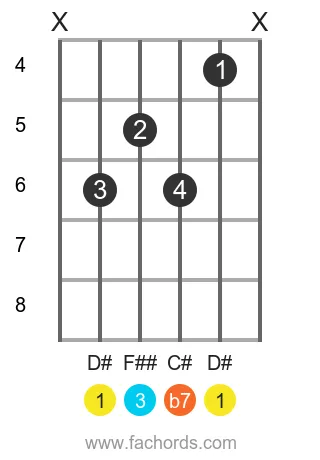
Struggling to nail the D#7 chord? Instantly check your playing accuracy with our interactive fretboard's real-time mic feedback. This essential chord, a member of the vibrant Dominant Chords family, is built from four notes: D#, F##, A#, and C#, which correspond to the intervals Root (1), Major Third (3), Perfect Fifth (5), and Minor Seventh (b7). Beyond validating your finger placement, use the virtual fretboard to visualize every fingering and listen to the chord played as a strum or arpeggio.
Understanding these intervals is crucial for mastering the D#7 chord and other Dominant Chords. The unique tension of a 7th chord, a cornerstone of blues and rock, sets up powerful harmonic resolutions. Deepen your theoretical knowledge with our Chord Construction tutorial to see how chords are built. Since many fingerings for this chord involve barre shapes, our Guitar Bar Chords guide can be an invaluable resource. Also, be sure to practice improving your chord changes for fluid, professional-sounding playing.
Before exploring the detailed chord diagrams further down-ranging from easiest open positions to advanced barre shapes-along with insightful music theory, popular songs featuring the D#7 chord, and its common keys, challenge yourself with the interactive tool above. Set a pace with the BPM/drum tool, strum the chord, and use the mic feedback to truly test your accuracy and embed this chord into your muscle memory. This immediate, hands-on practice is your fastest path to mastery.
D# 7 chord Notes:
Chord formula for the Dominant Seventh chord:
Fingerings for the D#7 guitar chord
Position 1
Movable
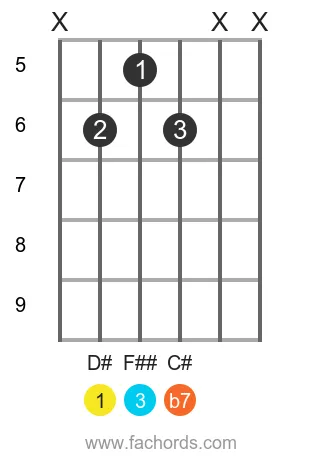
Position 2
Movable
Position 3
Barre
Movable
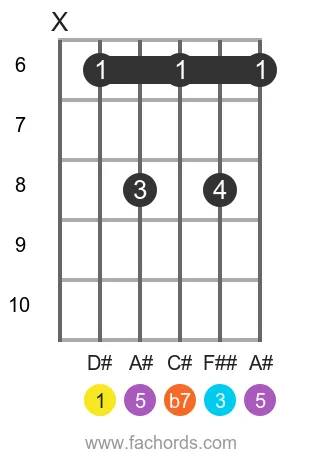
Position 4
Barre
Movable
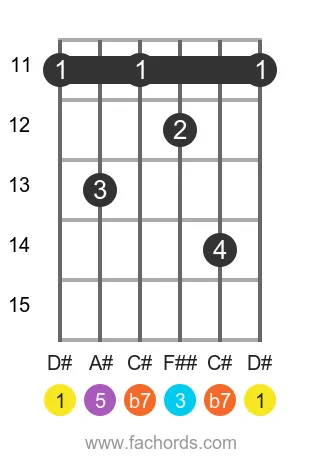
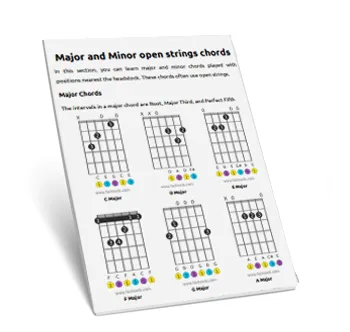
 Find more shapes in our all guitar chords online library. If you
prefer a printable pdf, download
the Free Guitar Chords Chart Pdf
Find more shapes in our all guitar chords online library. If you
prefer a printable pdf, download
the Free Guitar Chords Chart Pdf
You can also use this accessible D#7 chord page, with written diagram instructions and screen-reader support for blind users.

Created by
Giancarlo is a musician (teaching guitar since 2000), software engineer, AI consultant and published researcher
FAQ
What does 'dominant' mean in the context of the D#7 guitar chord?
The D#7 chord is classified as dominant because it contains a Major Third and, crucially, a Minor Seventh (b7) interval. This specific combination of intervals defines its dominant quality, creating a unique sound often used to build tension and lead into other chords in music.
Why is the third note in the D#7 chord called F## instead of G?
The third note is called F## (F double sharp) to maintain correct theoretical spelling within the D# major scale. While F## sounds identical to G on a guitar, naming it F## accurately reflects its function as the Major Third above D# within the chord's defined interval structure (1, 3, 5, b7).
What are the essential intervals that make up the D#7 chord?
The D#7 chord is constructed using four essential intervals relative to its root, D#: the Root (1), a Major Third (3), a Perfect Fifth (5), and a Minor Seventh (b7). These specific intervals work together to create the chord's characteristic dominant sound.
