Master the D#5 Guitar Chord: Interactive Fretboard Practice
Want a structured chord roadmap instead of jumping between pages?
Go to the full guitar chords tutorial.
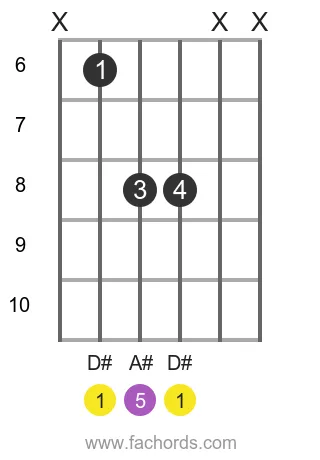
The D#5 chord, a foundational element of the power chords family, drives the sound of rock, punk, and metal with its raw, impactful character. Composed solely of the Root (D#) and the Perfect Fifth (A#), this two-note structure delivers maximum punch. Explore its versatile voicings on our interactive virtual fretboard, experiment with different fingerings, and get instant, precise feedback on your playing through the real-time microphone feature, ensuring every note rings out perfectly. You can also listen to the chord's audio to internalize its sound.
Power chords, like the D#5, are celebrated for their ability to cut through a mix, especially with distortion, forming the backbone of countless iconic guitar riffs. Their simple, yet effective, two-note construction provides a solid rhythmic and harmonic foundation without introducing complex dissonances. Understanding how these chords are built from just two notes is fundamental to mastering them across the fretboard. To delve deeper into their structure and application, explore our dedicated guide to Power Chords, or for a broader understanding of how musical harmony is constructed, consult our comprehensive resource on Chord Construction.
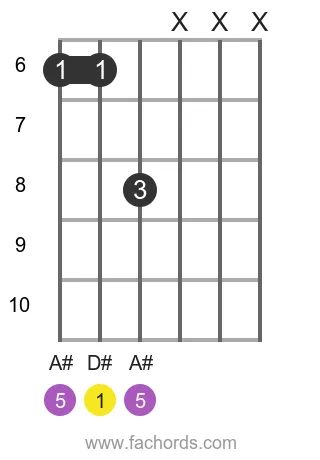
Below, you'll discover a comprehensive collection of D#5 chord diagrams, thoughtfully ranked from the simplest open positions to more advanced movable shapes. We'll also delve into essential music theory surrounding this chord, highlight popular songs where the D#5 is featured prominently, and identify the musical keys in which it most frequently appears. But before you get lost in the diagrams, ignite your practice by fully utilizing the interactive tool above. Set your pace with the integrated drum and BPM tool, then play and listen, trusting the mic feedback to guide your fingers to perfection. Play first, then explore the theory to truly integrate the D#5 into your repertoire!
D# 5 chord Notes:
Tones in the Powerchord chord:
D#5 Guitar Chord Diagrams
Position 1
Movable
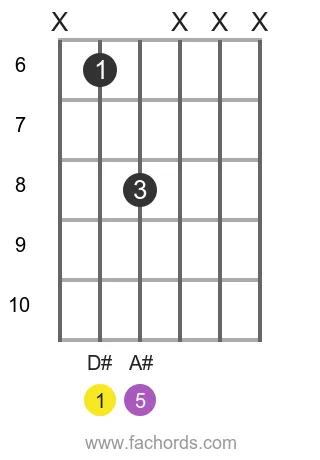
Position 2
Movable
Position 3
Barre
Movable
 Find more shapes in our all guitar chords online library. If you
prefer a printable pdf, download
the Free Guitar Chords Chart Pdf
Find more shapes in our all guitar chords online library. If you
prefer a printable pdf, download
the Free Guitar Chords Chart Pdf
You can also use this accessible D#5 chord page, with written diagram instructions and screen-reader support for blind users.
FAQ
What notes make up the D#5 power chord?
The D#5 power chord is composed of two specific notes: D# and A#. D# is the root of the chord, and A# is the perfect fifth above the root.
What intervals construct the D#5 power chord?
The D#5 power chord is built using the Root (1) and the Perfect Fifth (5) intervals. This simple, two-note intervalic structure is characteristic of all power chords.
Why is it called a 'power chord'?
Power chords, including the D#5, get their name from their strong and robust sound. This 'power' comes from their fundamental composition of just the Root and the Perfect Fifth, which creates a stable and resonant tone, particularly effective with an electric guitar and distortion.
In which music genres is the D#5 power chord commonly used?
The D#5 power chord is a fundamental component of genres such as rock, punk, and heavy music. Its impactful sound makes it a staple in these styles, especially when played on an electric guitar with added distortion.
What is the primary difference in composition between a D#5 power chord and other chord types?
The D#5 power chord is unique in its simple composition, consisting solely of the Root (D#) and the Perfect Fifth (A#). Unlike major or minor chords which include a third interval, power chords deliberately omit the third, giving them a more ambiguous and 'powerful' sound.