Explore Cmaj9: Master Guitar Fretboard Shapes & Sounds
Want a structured chord roadmap instead of jumping between pages?
Go to the full guitar chords tutorial.
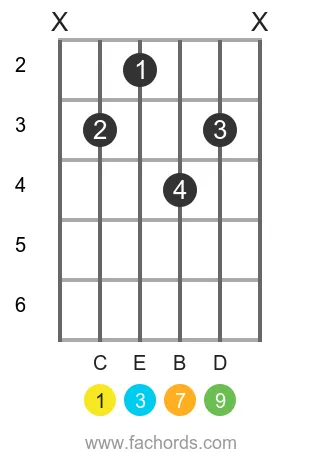
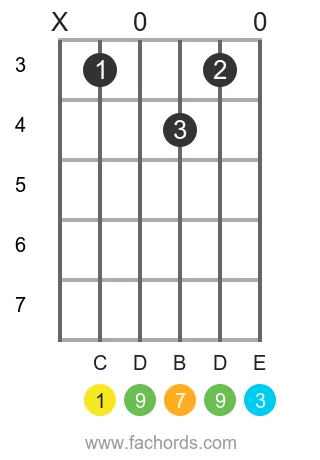
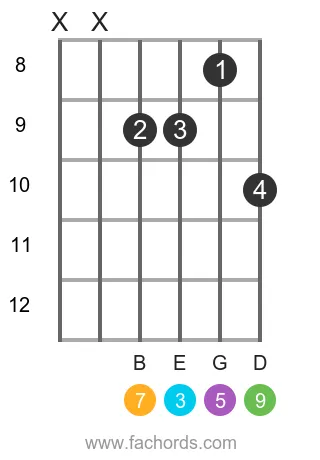
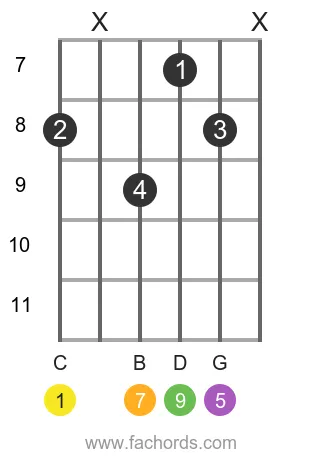
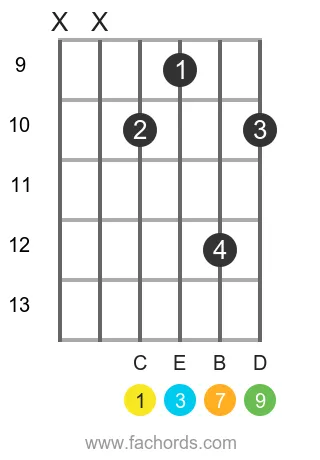
Discover how to visualize and play the Cmaj9 chord by exploring its unique fretboard shapes. Our interactive virtual fretboard tool will guide you through various voicings, emphasizing the spatial layout of notes across the strings. Practice alongside and get instant feedback on your accuracy with our real-time mic input, ensuring every note resonates correctly. The Cmaj9 chord, a rich member of the Major Chords family, is comprised of the notes C, E, G, B, and D, representing the Root, Major Third, Perfect Fifth, Major Seventh, and Major Ninth intervals respectively.
The addition of the Major Ninth (D) to the Cmaj7 chord (C, E, G, B) creates an extended harmony, giving the Cmaj9 its characteristic lush and sophisticated color, often heard in jazz and neo-soul. This layering of intervals is key to understanding how these advanced chords enrich musical compositions. If you're looking to deepen your understanding of such complex structures, our guide on Ninth Chords provides further insights. Building chords by stacking intervals is a fundamental concept, which you can explore further in our Chord Construction tutorial, an essential step before smoothly transitioning between these intricate shapes.
Rather than memorizing static diagrams, start by exploring the visual shapes directly on our interactive fretboard. You'll find various Cmaj9 diagrams, progressing from simpler voicings to more complex arrangements, enabling you to grasp the underlying theory and discover how this chord fits into different musical keys and songs. Utilize the interactive tool to solidify your visual understanding of these shapes before committing them to memory.
C major 9th guitar chord is also written as Cmaj9, CM9, CΔ9 or Cma9.
Notes of the C maj9 chord:
Chord formula for the Major Ninth chord:
C Maj9 Guitar Chord Diagrams
Position 1
Open
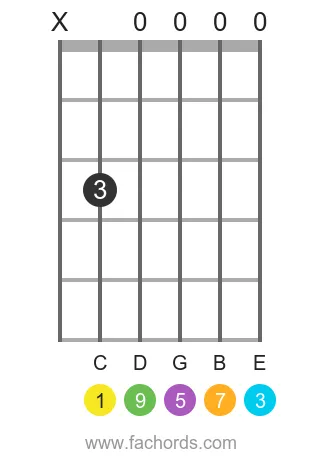
Position 2
Open
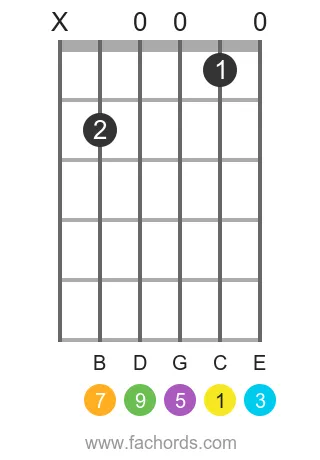
Position 3
Movable
Position 4
Open
Position 5
Movable
Position 6
Movable
Position 7
Movable
Position 8
Open
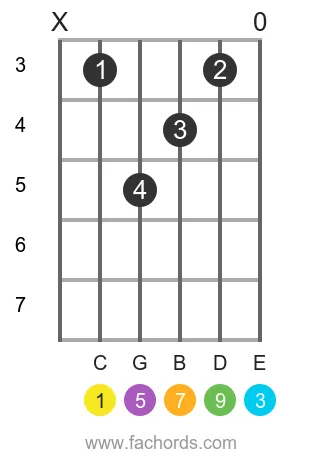
Position 9
Barre
Movable
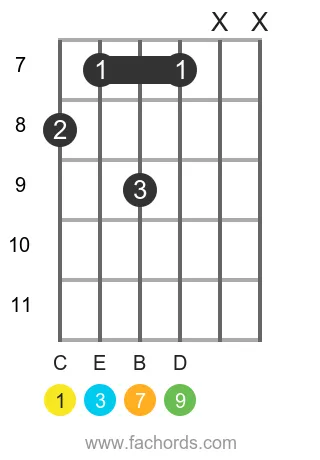
Position 10
Barre
Movable
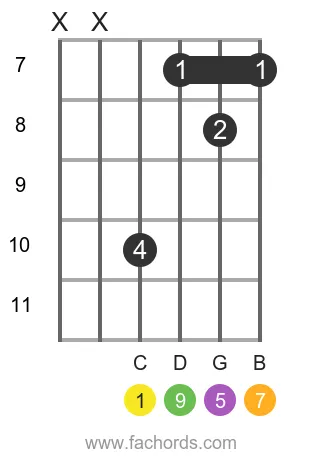
Position 11
Barre
Movable
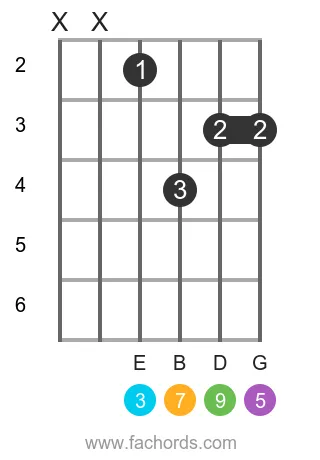
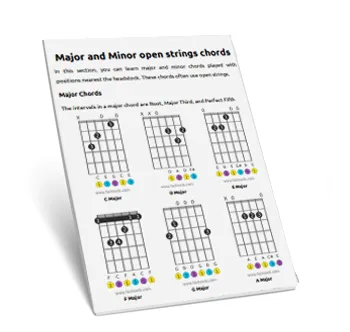
 Find more shapes in our all guitar chords online library. If you
prefer a printable pdf, download
the Free Guitar Chords Chart Pdf
Find more shapes in our all guitar chords online library. If you
prefer a printable pdf, download
the Free Guitar Chords Chart Pdf
You can also use this accessible Cmaj9 chord page, with written diagram instructions and screen-reader support for blind users.

Created by
Giancarlo is a musician (teaching guitar since 2000), software engineer, AI consultant and published researcher
FAQ
What notes are included in a Cmaj9 chord?
The Cmaj9 chord is composed of five distinct notes: C, E, G, B, and D. These notes are derived from the C major scale, with additional extensions.
What intervals make up the Cmaj9 chord?
The Cmaj9 chord is built using specific intervals from its root (C). These intervals are the Root (1), Major Third (3), Perfect Fifth (5), Major Seventh (7), and Major Ninth (9).
How does the Cmaj9 chord differ from a C major chord or Cmaj7 chord?
A basic C major chord contains only the root, major third, and perfect fifth (C-E-G). A Cmaj7 chord adds the major seventh (C-E-G-B). The Cmaj9 chord further extends this by adding the major ninth (D), giving it a richer and more complex sound with all five notes (C-E-G-B-D).
Why is the Cmaj9 chord considered an advanced chord?
The Cmaj9 chord is considered advanced because it includes five notes, making its fingerings on the guitar typically more challenging than basic triads or seventh chords. Its extended intervals (the major seventh and major ninth) also contribute to its sophisticated harmonic quality, often used in jazz and other complex musical styles.
When should I use a Cmaj9 chord in my playing?
You should use a Cmaj9 chord when you want to add a rich, lush, and sophisticated color to your music. It is frequently found in genres like jazz, R&B, funk, and contemporary styles to create an open, full, and dreamy harmonic texture, often for intros, resolutions, or specific melodic voicings.