Explore and Master the C m7 Guitar Chord with Interactive Play
Want a structured chord roadmap instead of jumping between pages?
Download the step-by-step Guitar Chord Ebook
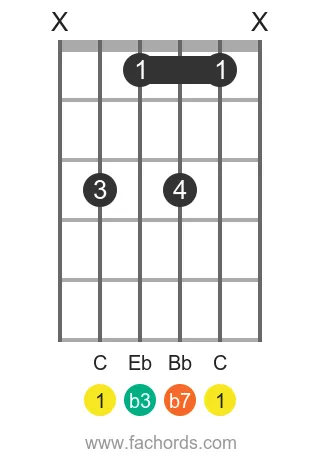
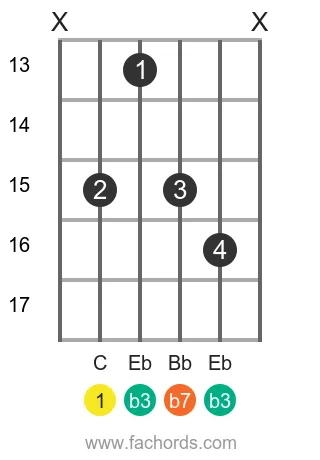
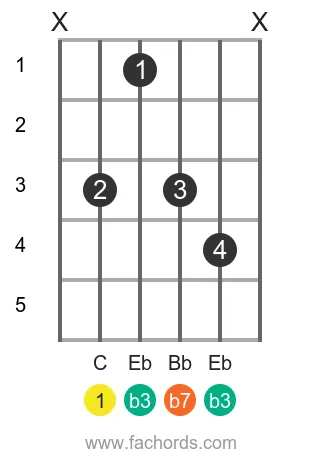
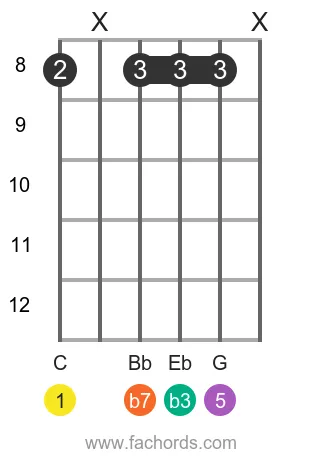
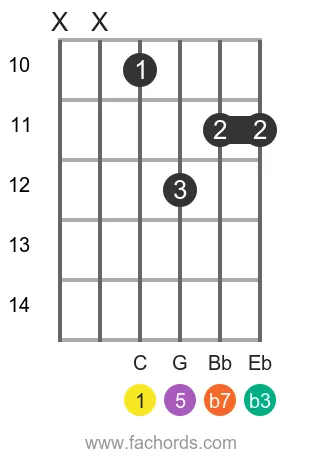
Dive into the rich sound of the C m7 chord, a staple in jazz, funk, and R&B, adding a smooth, melancholic color to your progressions. This versatile minor seventh chord is built from the notes C, Eb, G, and Bb, corresponding to the intervals 1, b3, 5, and b7 (Root, Minor Third, Perfect Fifth, and Minor Seventh). Unlock its full potential using our interactive fretboard, where you can instantly hear chord and arpeggio playback and verify your accuracy with real-time mic feedback, turning practice into an exploration lab.
The minor seventh chord, like the C m7, is fundamental for establishing a groove and exploring modal harmony, particularly in jazz and R&B. Understanding how these chords are built from intervals is crucial for guitar mastery; you can deepen your knowledge with our guide on chord construction. To efficiently navigate different musical keys or genres, consider how the C m7 functions as a ii or vi chord, which you can explore further with our insights on transposing guitar chords. For those looking to streamline their playing, mastering efficient voicings and transitions, including common 'shell' voicings, can be transformative; learn more about learning 3-note 7th chords and improving your chord changes.
Before delving into the detailed diagrams, which progress from easiest to hardest, we encourage you to spend time playing the C m7 chord directly on our interactive fretboard. Experiment with different voicings, understand its theory in various keys, and imagine how it fits into your favorite songs. Play it, feel it, then analyze it-this hands-on approach will accelerate your mastery far beyond static charts.
Notes that compose the C m7 chord:
Formula of the Minor Seventh chord:
Cm7 Guitar Chord Shapes
Position 1
Movable
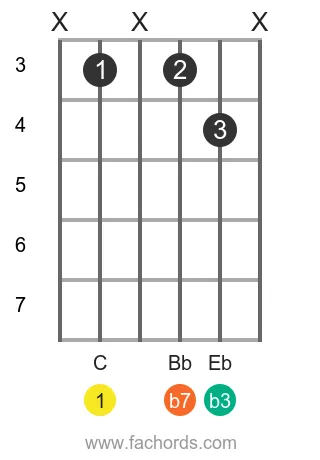
Position 2
Movable
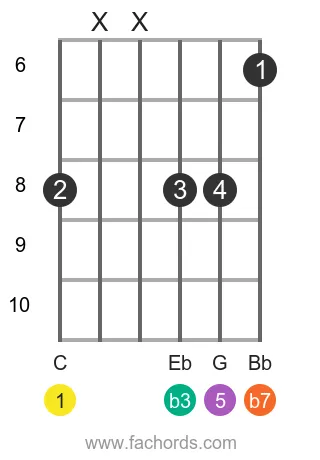
Position 3
Movable
Position 4
Movable
Position 5
Barre
Movable
Position 6
Barre
Movable
Position 7
Barre
Movable
Position 8
Barre
Movable
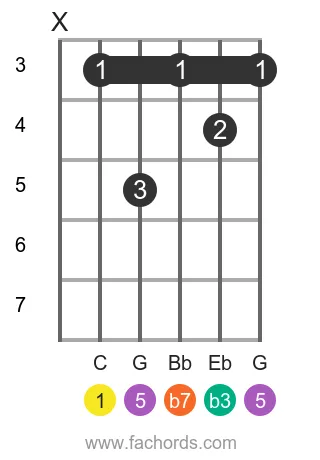
Position 9
Barre
Movable
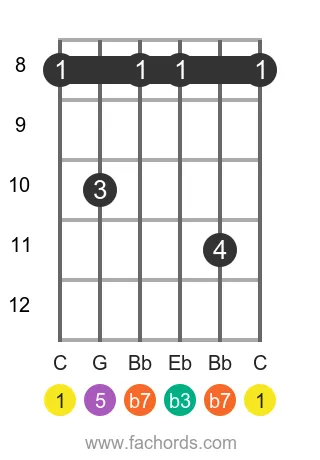
Position 10
Barre
Movable
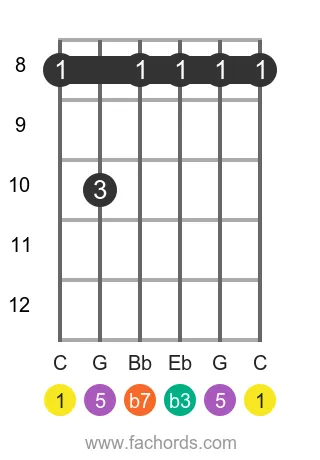
 Find more shapes in our all guitar chords online library. If you
prefer a printable pdf, download
the Free Guitar Chords Chart Pdf
Find more shapes in our all guitar chords online library. If you
prefer a printable pdf, download
the Free Guitar Chords Chart Pdf
You can also use this accessible Cm7 chord page, with written diagram instructions and screen-reader support for blind users.
FAQ
What are the specific notes and intervals that form the C m7 chord?
The C m7 chord is constructed using four specific notes: C, Eb, G, and Bb. In terms of intervals relative to the root note C, these correspond to the Root (1), Minor Third (b3), Perfect Fifth (5), and Minor Seventh (b7), respectively.
Why is this chord called 'C m7' and not just 'C minor'?
The 'm' in C m7 indicates the presence of a minor third (Eb), which is characteristic of minor chords. The '7' signifies the inclusion of a minor seventh (Bb) interval, distinguishing it from a simple C minor triad (which only contains C, Eb, G).
What do the interval numbers (1, b3, 5, b7) represent when building the C m7 chord?
These numbers describe the relationship of each note to the root note (C) within the chord. '1' is the Root (C), 'b3' is the Minor Third (Eb), '5' is the Perfect Fifth (G), and 'b7' is the Minor Seventh (Bb). Understanding these intervals is fundamental to how chords are structured.
In what musical styles is the C m7 chord frequently used?
The C m7 chord is a versatile and common chord used across various musical genres. It is particularly prominent and frequently employed in jazz music, where it forms the basis for many common and advanced chord progressions.