Explore the C7#11 Chord: Play & Understand its Rich Sound
Want a structured chord roadmap instead of jumping between pages?
Go to the full guitar chords tutorial.
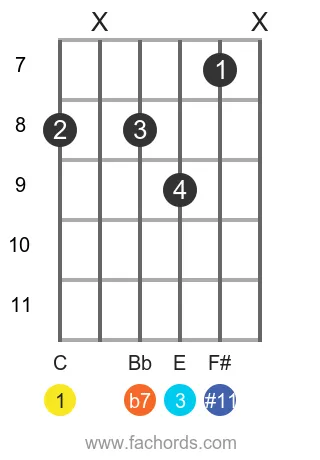
Dive into the vibrant world of jazz and fusion by mastering the complex yet beautiful sound of the C 7(#11) chord. This extended Dominant Chord adds a distinct, shimmering quality, built from the notes C, E, G, Bb, and F#, which represent the 1, 3, 5, b7, and #11 intervals. Our interactive fretboard lets you experiment with this chord and immediately hear its unique voicing through chord or arpeggio playback, while real-time mic feedback confirms your accuracy as you play.
The full interval names for the C 7(#11) are the Root, Major Third, Perfect Fifth, Minor Seventh, and Augmented Fourth. Understanding how these intervals combine is fundamental to mastering any extended harmony. For a deeper dive into how chords are built, explore our guide on Chord Construction. As a member of the Dominant Chord family, the C7#11 carries inherent tension, making it a perfect candidate for resolution in jazz progressions. You can also learn how to apply this chord across different keys by understanding how to Transpose Guitar Chords.
Below, you'll discover a comprehensive selection of C 7(#11) diagrams, presented from the simplest voicings to more complex shapes. While theory is essential, we encourage you to first experiment directly with our virtual fretboard to internalize the sound of this unique chord, applying it to various songs and keys. Begin playing and let your ears guide your learning journey!
Notes of the C 7(#11) chord:
How to create the Dominant Seventh Sharp Eleventh Added chord:
C7(#11) Guitar Chord Voicings
Position 1
Movable
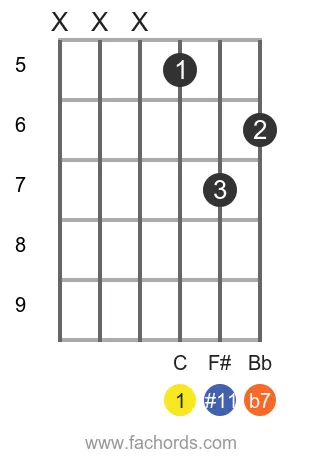
Position 2
Movable
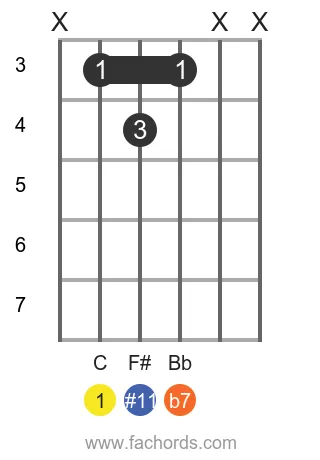
Position 3
Barre
Movable
 Find more shapes in our all guitar chords online library. If you
prefer a printable pdf, download
the Free Guitar Chords Chart Pdf
Find more shapes in our all guitar chords online library. If you
prefer a printable pdf, download
the Free Guitar Chords Chart Pdf
You can also use this accessible C7(#11) chord page, with written diagram instructions and screen-reader support for blind users.

Created by
Giancarlo is a musician (teaching guitar since 2000), software engineer, AI consultant and published researcher
FAQ
What are the specific notes that form a C7#11 chord?
The C7#11 chord is comprised of five distinct notes: C (root), E (major third), G (perfect fifth), Bb (minor seventh), and F# (augmented fourth, which is the #11 interval).
What musical intervals define the C7#11 chord?
This chord is built from the Root (1), Major Third (3), Perfect Fifth (5), Minor Seventh (b7), and an Augmented Fourth (#11). These specific intervals are what create its characteristic rich and complex sound.
Why is the C7#11 classified as a dominant chord?
The C7#11 is part of the dominant chord family because it contains the essential components of a dominant seventh chord: the Root (1), Major Third (3), and Minor Seventh (b7). The #11 is an extension that adds color to this dominant foundation without changing its fundamental dominant function.
What does the '#11' in the C7#11 chord name signify?
The '#11' indicates an augmented eleventh interval from the root. For a C7#11, this means adding an F# note to the chord. This F# is an augmented fourth relative to C, and it's called an #11 because it's typically understood as an upper extension in music theory.
How does a C7#11 chord differ from a regular C7 chord?
A regular C7 chord consists of the root, major third, perfect fifth, and minor seventh (C, E, G, Bb). The C7#11 chord includes all these notes but adds one more: the augmented eleventh (F#). This additional note provides a unique, more complex, and often 'jazzy' flavor.
In what musical contexts is the C7#11 chord typically used?
Due to its rich and complex sound, the C7#11 chord is frequently found in jazz music and other sophisticated genres. It's often employed within dominant chord progressions to add color, tension, and a specific harmonic texture, especially before a resolution.
Why is the C7#11 chord considered advanced and not suitable for beginners?
This chord is not for beginners because it requires a solid foundational understanding of music theory concepts, including intervals, chord construction, and how dominant chords with extensions function. Its unique altered extension makes it more challenging to grasp and apply correctly compared to basic open or barre chords.
