Practice the C5 Guitar Chord with Live Mic Feedback
Want a structured chord roadmap instead of jumping between pages?
Go to the full guitar chords tutorial.
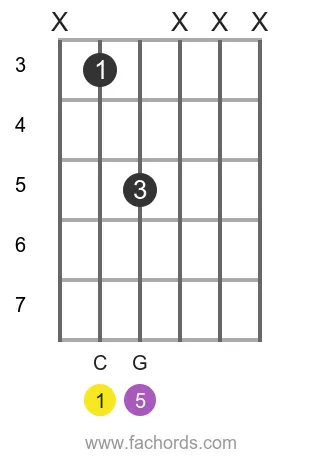
Ready to nail the C5 chord and unleash powerful riffs? Our interactive fretboard is designed to get you there fast, offering real-time mic feedback so you can instantly verify your accuracy as you play. This foundational power chord is composed of just two essential notes: C (the Root) and G (the Perfect Fifth). Built from the 1 and 5 intervals, you can visualize these positions and play along with our integrated chord/arpeggio playback feature.
Power chords like the C5 are the backbone of genres such as rock, punk, and heavy metal, offering a robust sound that truly shines with a bit of distortion on an electric guitar. To dive deeper into the construction of chords and the role of intervals, explore our detailed Chord Construction guide. You can also master the unique applications and techniques for these impactful sounds with our dedicated Power Chords tutorial, perfect for understanding how to create those iconic riffs.
As you scroll down, you'll find comprehensive diagrams showcasing the C5 chord in various positions, from the easiest to the most challenging. Our detailed explanations cover the underlying theory, helping you understand how this chord functions across different keys and how it's applied in countless songs. But before you just memorize, we encourage you to test yourself using the interactive fretboard above. Play the chord, hear it, and verify your finger placement with live feedback to ensure you're building solid muscle memory from the start!
The C power chord is also written as C5, C(no 3rd) or C(omit 3).
Notes of the C 5 chord:
Formula of the Powerchord chord:
C 5 Guitar Chord Diagrams
Position 1
Movable
Position 2
Movable
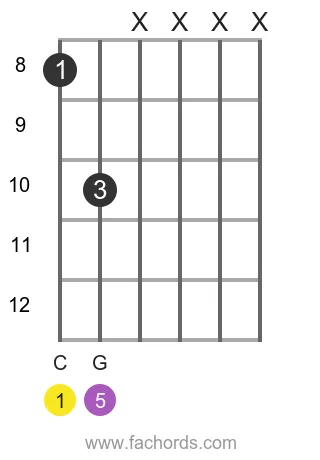
Position 3
Movable
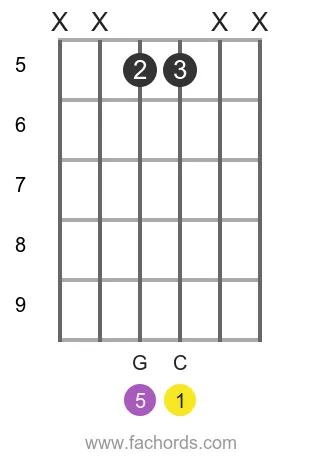
Position 4
Movable
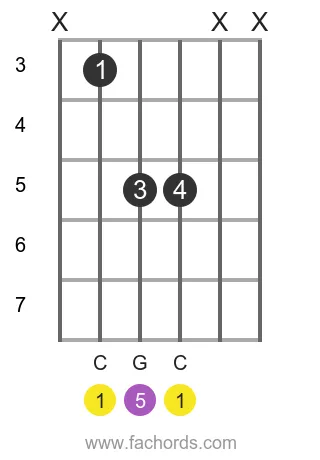
Position 5
Movable
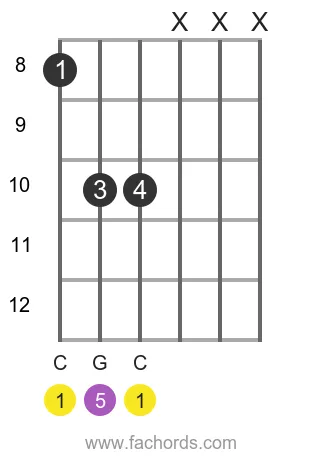
Position 6
Movable
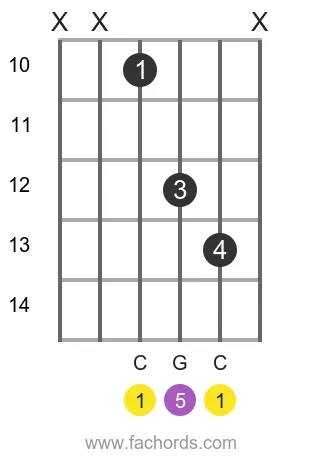
Position 7
Barre
Movable
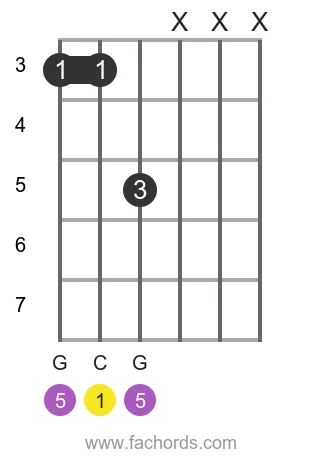
 Find more shapes in our all guitar chords online library. If you
prefer a printable pdf, download
the Free Guitar Chords Chart Pdf
Find more shapes in our all guitar chords online library. If you
prefer a printable pdf, download
the Free Guitar Chords Chart Pdf
You can also use this accessible C5 chord page, with written diagram instructions and screen-reader support for blind users.


Created by
Giancarlo is a musician (teaching guitar since 2000), software engineer, AI consultant and published researcher
FAQ
What notes are necessary to play a C5 power chord?
The C5 power chord is fundamentally composed of only two notes: the root note C, and its perfect fifth, G. This minimal two-note structure is what defines it as a power chord.
Why are chords like C5 referred to as "power chords"?
They are called power chords because they consist solely of the root and the perfect fifth. This simplified interval structure creates a strong, robust, and harmonically stable sound, particularly effective when amplified or distorted, making them a foundational element in genres like rock and heavy music.
What does the number "5" in "C5" mean in guitar chords?
The '5' in C5 specifically indicates that the chord is built using the root note (C) and its perfect fifth (G). It signifies the inclusion of the fifth interval and the deliberate omission of the third, which is present in standard major or minor chords.
Why are C5 power chords often highlighted as sounding great with distortion, especially on electric guitar?
Power chords like C5 are harmonically stable because they lack the major or minor third. The third can create complex overtones that might become muddy or dissonant when heavily distorted. The simple root and fifth structure of a C5 allows it to maintain clarity and power even with high gain, contributing to its iconic rock sound.
How does a C5 power chord differ from a standard C major or C minor chord?
The primary difference lies in the absence of the third interval. A C major chord includes a major third (E), and a C minor chord includes a minor third (Eb). The C5 power chord contains only the root (C) and the perfect fifth (G), making it neither major nor minor, and giving it a more ambiguous, yet powerful and versatile quality.
Can I play the C5 power chord effectively on an acoustic guitar, or is it only for electric?
Yes, you can absolutely play the C5 power chord effectively on an acoustic guitar. While power chords are strongly associated with electric guitars and distortion due to their sonic characteristics, the chord structure itself works perfectly on an acoustic, providing a strong, unambiguous, and foundational sound.
