Master the C#maj9 Guitar Chord with Interactive Practice
Want a structured chord roadmap instead of jumping between pages?
Download the step-by-step Guitar Chord Ebook
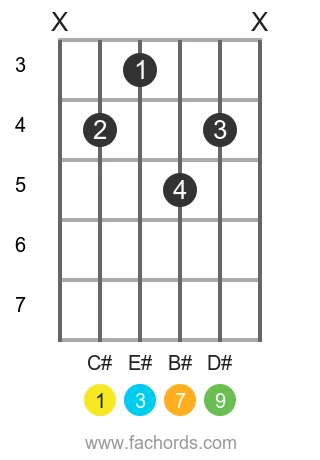
Struggling to perfect your C#maj9 chord? Our interactive fretboard tool is your ultimate practice partner. Immediately get instant, real-time feedback on your playing with our microphone recognition, guiding your finger placement and ensuring accuracy. The C#maj9 chord, a beautiful member of the Major Chords family, is built from the notes C#, E#, G#, B#, and D#. These correspond to the intervals Root (1), Major Third (3), Perfect Fifth (5), Major Seventh (7), and Major Ninth (9). Use the virtual fretboard to visualize every fingering and hear the chord played as a strum or arpeggio.
As a member of the ninth chords family, the C#maj9 chord adds a rich, extended harmony and a sophisticated color tone to your music. Understanding these advanced harmonies will significantly enhance your fretboard knowledge. To dive deeper into its construction and role in music, explore our comprehensive guide on Ninth Chords. Understanding how chords are built from intervals is key, so check out our Chord Construction tutorial. If you find barre shapes challenging, our Guitar Bar Chords resource can help you master them, and for smooth transitions, our Improve Chords Change tips are invaluable.
Below, you'll find a wealth of resources, including chord diagrams ranked from easiest open positions to more complex barre shapes, detailed music theory, popular songs that feature the C#maj9 chord, and the keys where it commonly appears. But before you scroll, put your skills to the test with the interactive tool above. Set a comfortable tempo using the drum and BPM tool, strum the chord, and let the real-time mic feedback verify your finger placement. This hands-on practice loop is the most effective way to internalize new chords and build lasting muscle memory.
Notes of the C# maj9 chord:
Formula of the Major Ninth chord:
C#maj9 Guitar Chord Shapes
Position 1
Movable
Position 2
Barre
Movable
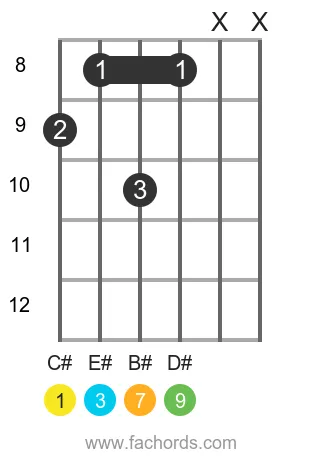
Position 3
Barre
Movable
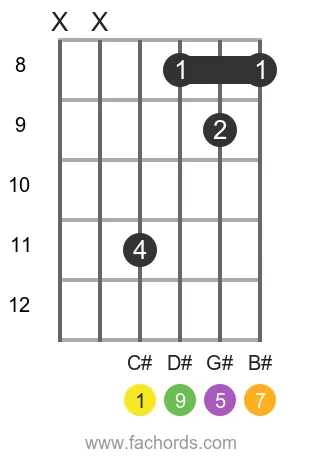
 Find more shapes in our all guitar chords online library. If you
prefer a printable pdf, download
the Free Guitar Chords Chart Pdf
Find more shapes in our all guitar chords online library. If you
prefer a printable pdf, download
the Free Guitar Chords Chart Pdf
You can also use this accessible C#maj9 chord page, with written diagram instructions and screen-reader support for blind users.
FAQ
What are the specific notes that make up a C#maj9 chord?
The C#maj9 chord is comprised of five distinct notes: C# (the root), E# (the major third), G# (the perfect fifth), B# (the major seventh), and D# (the major ninth).
Why are E# and B# used in the C#maj9 chord instead of F and C?
In music theory, notes are named according to their scale degree to maintain consistent interval spelling. For a C# chord, the major third is E# and the major seventh is B#, not their enharmonic equivalents F and C. This ensures each interval has a unique letter name derived from the C# major scale.
What specific intervals are stacked to build the C#maj9 chord?
The C#maj9 chord is constructed by stacking the following intervals from the root C#: the 1 (Root), the 3 (Major Third), the 5 (Perfect Fifth), the 7 (Major Seventh), and the 9 (Major Ninth).
What makes the C#maj9 chord part of the 'Major Chords family' and not another type of ninth chord?
The 'maj' in C#maj9 signifies that it contains a Major Third and, crucially, a Major Seventh interval. These specific intervals define its 'major' quality. Other ninth chords, like a dominant 9th (e.g., C#9), would typically use a minor seventh, creating a different harmonic sound.
Is the C#maj9 chord generally considered difficult for guitarists to play?
Yes, the C#maj9 chord is typically more challenging than basic chords. It requires precise finger placement to articulate all five notes and often involves stretching or specific fretboard voicings. Consistent practice is key to mastering it.
When would a guitarist typically use a C#maj9 chord in musical contexts?
The C#maj9 chord offers a rich, complex sound that is especially prevalent in jazz music and jazz chord progressions. Its sophisticated harmony is often used to add color and depth, making it suitable for genres requiring a lush or expansive harmonic texture.
