C#6 Guitar Chord: Understand and Play with Interactive Feedback
Want a structured chord roadmap instead of jumping between pages?
Go to the full guitar chords tutorial.
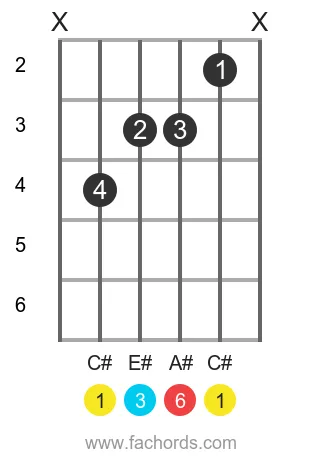
The C# 6 chord is constructed from the intervals 1, 3, 5, and 6, corresponding to the Root, Major Third, Perfect Fifth, and Major Sixth. This chord is a member of the Major Chords family, featuring the notes C#, E#, G#, and A#. To fully grasp its sound and feel, utilize our interactive fretboard tool above, where you can explore every fingering, listen to the chord as a strum or arpeggio, and receive instant verification of your playing accuracy via the real-time microphone feature.
The C# 6 chord provides a distinct vintage and jazz-like sweetness, extending beyond a simple major triad by adding the sixth to create a rich, sophisticated harmonic texture. Recognizing its unique sound is key to incorporating it effectively into your progressions. For a deeper understanding of these unique chords, explore our comprehensive guide on 6th Chords, or delve into the fundamental principles of Chord Construction to better understand how notes combine to form harmonies. Mastering its shapes and smoothly transitioning between them can significantly enhance your playing, and our tips for Improve Chords Change can help you achieve this fluidity.
Further down this page, you'll find detailed chord diagrams, organized from the simplest open positions to more advanced barre shapes. We also delve into the underlying music theory, showcase songs that beautifully feature the C# 6 chord, and identify the common keys where it appears. Before diving into these resources, commit to disciplined practice by engaging with the interactive tool above. Listening, playing along, and utilizing the mic feedback is crucial for internalizing the chord's sound and developing muscle memory on the fretboard.
C# 6 chord Notes:
Chord structure of the Major Sixth chord:
C#6 Guitar Chord Fingers Positions
Position 1
Movable
Position 2
Barre
Movable
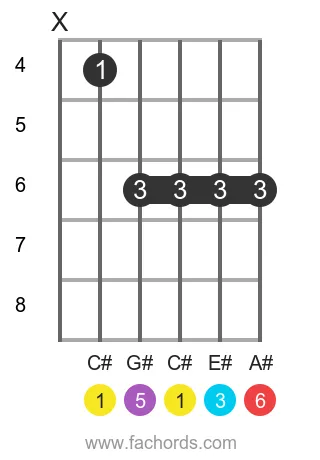
Position 3
Barre
Movable
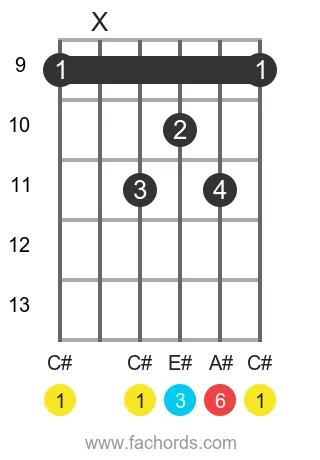
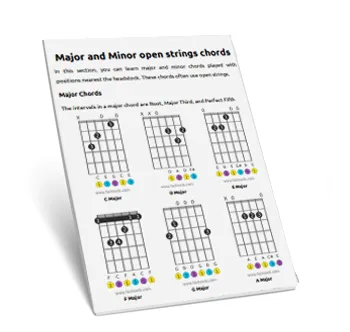
 Find more shapes in our all guitar chords online library. If you
prefer a printable pdf, download
the Free Guitar Chords Chart Pdf
Find more shapes in our all guitar chords online library. If you
prefer a printable pdf, download
the Free Guitar Chords Chart Pdf
You can also use this accessible C#6 chord page, with written diagram instructions and screen-reader support for blind users.
FAQ
What notes and intervals make up a C# 6 chord?
The C# 6 chord is built from the notes C#, E#, G#, and A#. These correspond to the intervals of Root (C#), Major Third (E#), Perfect Fifth (G#), and Major Sixth (A#).
Why is the C# 6 chord considered a 'Major Chord' when it has a '6' in its name?
The 'major' classification comes from the presence of the Major Third (E#) above the root (C#). The '6' simply indicates that a Major Sixth (A#) has been added to the foundational C# Major triad (C#, E#, G#), giving it a unique color rather than changing its fundamental major quality.
What is the key difference between a C# Major chord and a C# 6 chord?
A standard C# Major chord is a triad consisting of the Root (C#), Major Third (E#), and Perfect Fifth (G#). The C# 6 chord expands on this by adding one more note: the Major Sixth (A#). This added interval gives the C# 6 chord a distinct, often more sophisticated or 'jazzy' sound.
Why are the notes E# and A# used in the C# 6 chord instead of F and Bb?
In music theory, specific letter names are used to correctly identify intervals within a key or chord structure. For a C# chord, the major third is E# (not F) and the major sixth is A# (not Bb). While F and E# (or Bb and A#) are enharmonically equivalent (sound the same), using E# and A# correctly reflects their intervallic function relative to C# within the major scale system.
When might I use a C# 6 chord in a song or musical composition?
C# 6 chords can add a distinctive flavor to your music. They are often used to provide a slightly more complex or 'vintage' sound than a basic major chord. You might use them as a substitute for a simple major chord to add color, or within chord progressions, particularly in styles like jazz, R&B, or certain pop genres, to create a specific harmonic texture.
Why is the C# 6 chord described as more 'advanced' for beginner guitarists?
The C# 6 chord is considered more advanced because it typically involves less common fretboard shapes and requires a foundational understanding of intervals beyond basic major and minor triads. Beginners usually focus on mastering fundamental open and barre chords before moving on to extended chords like the 6th, which require a deeper grasp of music theory and fretboard knowledge.