B m7b5 Guitar Chord
Chord Diagrams, Interactive Fretboard and Chord Theory
B minor 7th with flat 5th guitar chord is also written as Bm7b5, Bm7(b5), Bø7 or Bmin7b5. It is also known as the B half-diminished chord.
Position 1
Movable
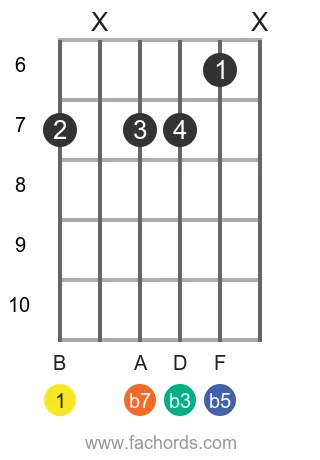
Position 2
Movable
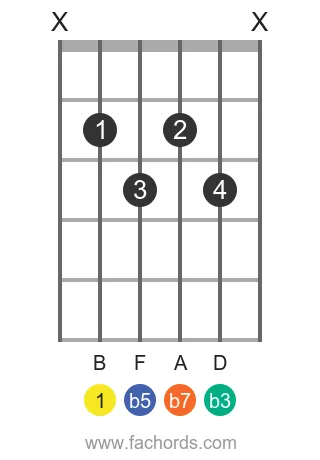
Position 3
Open
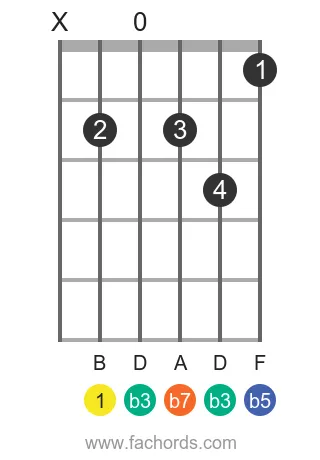
Position 4
Barre
Movable
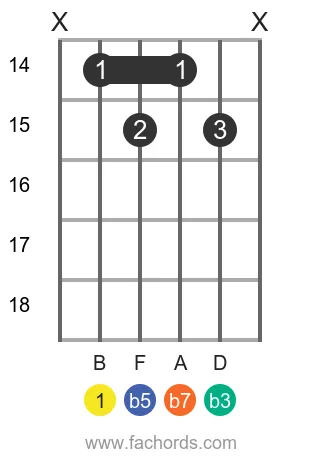
 Find more shapes in our all guitar chords online library. If you
prefer a printable pdf, download
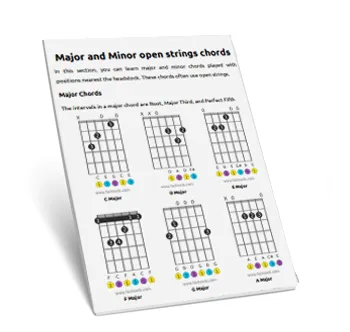
the Free Guitar Chords Chart Pdf
Find more shapes in our all guitar chords online library. If you
prefer a printable pdf, download
the Free Guitar Chords Chart Pdf
You can also use this accessible Bm7b5 chord page, with written diagram instructions and screen-reader support for blind users.
Explore B m7b5 Guitar Chord Shapes on the Fretboard
Want a structured chord roadmap instead of jumping between pages?
Go to the full guitar chords tutorial.
Unlock the visual landscape of the B m7b5 chord across your guitar fretboard. Our interactive virtual fretboard lets you immediately see the unique spatial arrangement of its notes: B, D, F, and A, laying out the 1, b3, b5, and b7 intervals (Root, Minor Third, Diminished Fifth, Minor Seventh). Play along and receive instant, precise mic feedback to confirm your finger placement and ensure every note rings true for this essential member of the Diminished Chords family.
As a core member of the Diminished Chords family, the B m7b5 chord, also known as a half-diminished seventh, carries a distinct tension often utilized to build harmonic interest, especially functioning as the iiø chord in a minor key progression. Its unique sound stems from the specific intervals – Root, Minor Third, Diminished Fifth, and Minor Seventh – which you can delve into further with our guide on Chord Construction. Exploring these types of chords can truly broaden your musical palette, particularly when understanding how they relate to the broader category of Diminished Guitar Chords. This chord structure is a fundamental building block for advanced harmony.
Before moving on to the detailed diagrams and theory presented below – arranged from easiest to hardest to learn – spend some time exploring this B m7b5 chord on the virtual fretboard. Experiment with different positions and fretboard patterns to truly internalize its shape across various keys. This hands-on approach, combined with studying its theory and practical application in songs, will accelerate your mastery. Explore these shapes and listen to their sound before committing them to memory.
Notes that compose the B m7b5 chord:
Chord structure of the Minor Seventh Flat five chord:
Play This Chord With Other Roots
C m7b5 | D m7b5 | E m7b5 | F m7b5 | G m7b5 | A m7b5 | B m7b5 | C#m7b5 | D#m7b5 | F#m7b5 | G#m7b5 | A#m7b5 | Abm7b5 | Bbm7b5 | Dbm7b5 | Ebm7b5 | Gbm7b5

Created by
Giancarlo is a musician (teaching guitar since 2000), software engineer, AI consultant and published researcher
FAQ
What do the 'm7b5' symbols mean in the Bm7b5 chord name?
The symbols indicate the specific intervals used to build the chord from its root note. 'm' refers to a Minor Third, '7' signifies a Minor Seventh, and 'b5' means a Diminished Fifth. Together, these define the unique structure of the Bm7b5 chord.
What notes are essential for playing a Bm7b5 chord on the guitar?
To form a Bm7b5 chord, you need to play the notes B, D, F, and A. These notes correspond to the 1 (Root), b3 (Minor Third), b5 (Diminished Fifth), and b7 (Minor Seventh) intervals, respectively.
How do the specific intervals (1, b3, b5, b7) define the Bm7b5 chord's structure?
The intervals are the building blocks: '1' is the Root (B), 'b3' is the Minor Third (D), 'b5' is the Diminished Fifth (F), and 'b7' is the Minor Seventh (A). These four specific intervals create the unique sound and identity of the Bm7b5 chord.
What is the characteristic sound of the Bm7b5 chord, and how is it typically used in music?
The Bm7b5 chord has a rich, complex, and distinctive sound, often described as dissonant and tense. It is frequently used in music to create tension that typically needs to be resolved into a more stable chord, adding drama and movement to a piece.
Why is the Bm7b5 chord categorized under the 'Diminished Chords' family?
The Bm7b5 chord is part of the Diminished Chords family because of its inherent dissonant and tense quality, largely due to its Diminished Fifth interval (b5). Chords in this family are known for creating musical tension that demands resolution.
