Understand and Play the B7(#11) Chord for Guitar
Want a structured chord roadmap instead of jumping between pages?
Go to the full guitar chords tutorial.
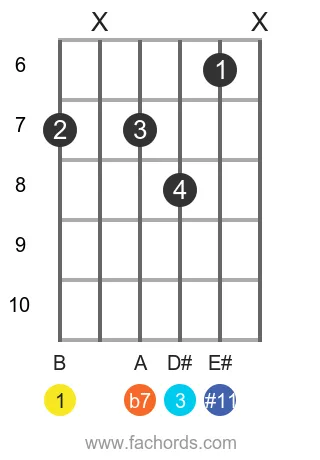
The B7(#11) chord is constructed from a precise set of intervals: 1 (Root), 3 (Major Third), 5 (Perfect Fifth), b7 (Minor Seventh), and #11 (Augmented Fourth). This sophisticated dominant chord family member comprises the notes B, D#, F#, A, and E#. To truly internalize these theoretical building blocks, utilize our interactive virtual fretboard. It allows you to visualize each note and interval, offering chord and arpeggio playback, and critically, provides real-time mic feedback to instantly verify your playing accuracy as you practice.
Grasping the precise interval structure is fundamental for truly mastering complex voicings like the B7(#11). This deep understanding of how chords are built by stacking intervals is a cornerstone of guitar theory, which you can explore further in our dedicated Chord Construction tutorial. As a member of the extended dominant chord family, the B7(#11) offers rich harmonic possibilities. Delve deeper into the characteristics and applications of this entire category with our comprehensive Dominant Chord guide.
This page provides various B7(#11) chord diagrams, ranked from easiest to most challenging, along with theoretical explanations and insights into its usage in different keys and songs. Before attempting these shapes, leverage the interactive tool above to experiment with the notes and hear the sound. Cultivate disciplined practice by first understanding the underlying theory, then applying it to the fretboard with consistent feedback.
Notes in the B 7(#11) chord:
Chord Structure:
B Dominant Seventh Sharp Eleventh Added Guitar Chord Shapes
Position 1
Movable
 Find more shapes in our all guitar chords online library. If you
prefer a printable pdf, download
the Free Guitar Chords Chart Pdf
Find more shapes in our all guitar chords online library. If you
prefer a printable pdf, download
the Free Guitar Chords Chart Pdf
You can also use this accessible B7(#11) chord page, with written diagram instructions and screen-reader support for blind users.

Created by
Giancarlo is a musician (teaching guitar since 2000), software engineer, AI consultant and published researcher
FAQ
What notes make up the B7(#11) chord?
The B7(#11) chord is composed of five distinct notes: B, D#, F#, A, and E#. These notes are determined by its specific interval structure from the root.
What are the specific intervals that form a B7(#11) chord?
The B7(#11) chord is built using the following intervals from its root (B): the Root (1), Major Third (3), Perfect Fifth (5), Minor Seventh (b7), and Augmented Fourth (#11).
Why is the #11 interval in the B7(#11) chord also called an Augmented Fourth?
The #11 interval is referred to as an Augmented Fourth because it represents a perfect fourth interval that has been raised by a semitone. This specific naming clarifies its exact position and quality within the chord structure.
In which musical styles is the B7(#11) chord typically used?
The B7(#11) chord is considered a more advanced chord and is frequently utilized in genres such as jazz. Its unique sound adds harmonic color and tension, making it suitable for sophisticated musical contexts.
Why is the B7(#11) chord categorized as a dominant chord?
The B7(#11) chord belongs to the dominant chord family because it contains the characteristic combination of a root, major third, perfect fifth, and crucially, a minor seventh (b7) interval. The #11 is an additional extension to this dominant structure.
What makes the B7(#11) a more advanced chord for guitarists to learn?
The B7(#11) is considered an advanced chord due to its complex five-note composition and the inclusion of the extended, augmented #11 interval. Understanding its theoretical structure and accurately forming it on the fretboard requires a solid grasp of music theory and finger technique beyond basic chords.