B 5 Guitar Chord
Chord Diagrams, Interactive Fretboard and Chord Theory
The B power chord is also written as B5, B(no 3rd) or B(omit 3).
Position 1
Movable
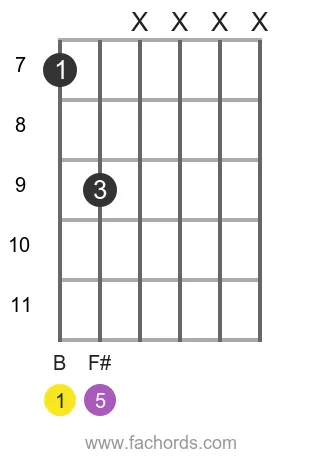
Position 2
Movable
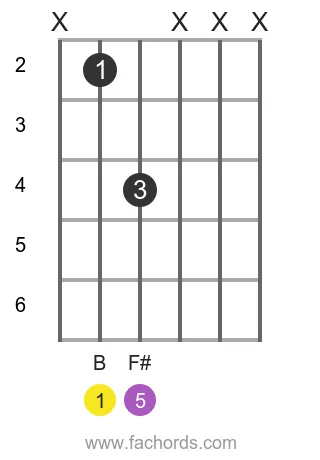
Position 3
Movable
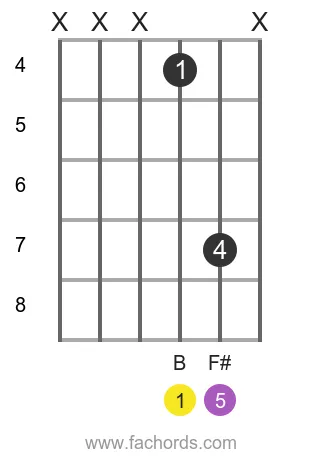
Position 4
Movable
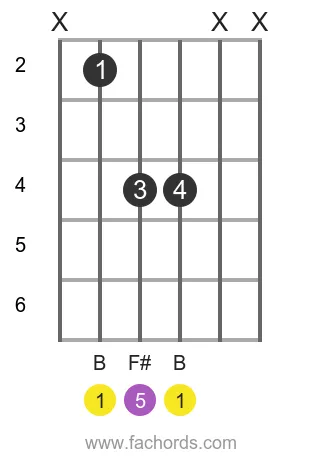
Position 5
Movable
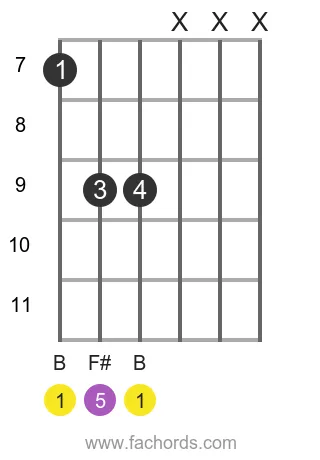
Position 6
Movable
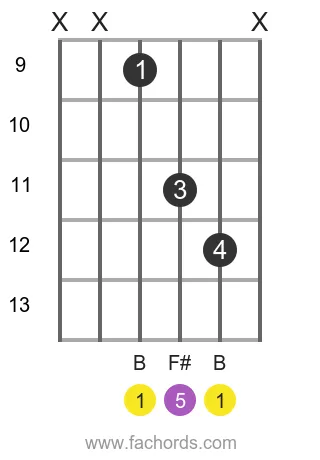
Position 7
Open
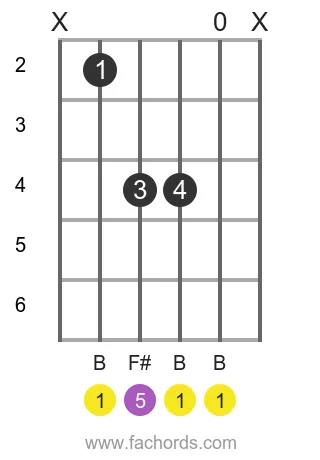
Position 8
Barre
Movable
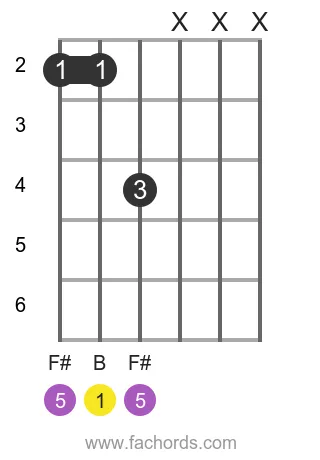
 Find more shapes in our all guitar chords online library. If you
prefer a printable pdf, download
the Free Guitar Chords Chart Pdf
Find more shapes in our all guitar chords online library. If you
prefer a printable pdf, download
the Free Guitar Chords Chart Pdf
You can also use this accessible B5 chord page, with written diagram instructions and screen-reader support for blind users.
Practice the B 5 Chord on Guitar: Get Live Feedback
Want a structured chord roadmap instead of jumping between pages?
Go to the full guitar chords tutorial.
Ready to conquer the B 5 chord on your guitar? Instead of just reading, put your skills to the test right now! Our interactive virtual fretboard provides instant mic feedback, verifying your accuracy as you play. This powerful member of the power chords family is built from just two notes: B and F#, corresponding to the 1 (Root) and 5 (Perfect Fifth) intervals. Challenge yourself to nail these fundamental notes with precision using our tool's real-time analysis.
As a quintessential member of the power chords family, the B 5 chord thrives in the context of driving riffs and distorted tones, making it indispensable for rock, punk, and metal. Understanding how these chords are constructed from intervals, like the 1 and 5, is key to truly mastering them across the fretboard. For a deeper dive into how musical theory underpins chord creation, explore our comprehensive guide on chord construction.
As you scroll down, you'll discover our clearly presented chord diagrams, arranged from the easiest to the most challenging, along with the underlying theory. But before you dive into static images, we encourage you to first experiment with the interactive fretboard above. Use it to understand how the B 5 chord's notes fit into different keys, and apply it to various songs. Play it yourself, and let the tool confirm your progress.
Notes in the B 5 chord:
Chord structure of the Powerchord chord:
Play This Chord With Other Roots
C 5 | D 5 | E 5 | F 5 | G 5 | A 5 | B 5 | C#5 | D#5 | F#5 | G#5 | A#5 | Ab5 | Bb5 | Db5 | Eb5 | Gb5


Created by
Giancarlo is a musician (teaching guitar since 2000), software engineer, AI consultant and published researcher
FAQ
What is a B5 chord and what makes it a 'power chord'?
A B5 chord is a two-note chord, known as a dyad, composed of the notes B and F#. It is considered a 'power chord' because it consists only of the root and a perfect fifth, intentionally omitting the third interval. This structure creates a strong, robust sound, making it a backbone in genres like rock, punk, and heavy music, especially when played with distortion.
What specific notes and intervals are found in a B5 chord?
The B5 chord is built from two specific notes: B and F#. In terms of musical intervals, B is the 1 (Root) and F# is the 5 (Perfect Fifth). These two intervals form the core structure of the chord.
The tutorial refers to the B5 chord as a 'suspended chord.' What does this mean for power chords?
When the B5 chord is referred to as a 'suspended chord' in this context, it highlights the absence of a major or minor third. Unlike traditional suspended chords (sus2, sus4) which replace the third with another interval, a power chord simply omits it. This lack of a defining major or minor third leaves the chord's quality ambiguous or 'suspended' from a specific tonality, contributing to its strong, open, and versatile sound.
Why are power chords like the B5 so popular in genres like rock and heavy music?
Power chords are favored in rock, punk, and heavy music because their simple structure (root and perfect fifth) produces a very powerful and unambiguous sound. This clarity is particularly effective when played with high gain and distortion, as the absence of a third interval helps to avoid muddy or dissonant overtones that can arise with fuller chords under heavy amplification.
How do the Root (1) and Perfect Fifth (5) intervals define the B5 chord's sound?
The Root (1), which is B in the B5 chord, establishes the fundamental pitch and gives the chord its name. The Perfect Fifth (5), F#, provides a highly stable and consonant harmonic foundation. Together, these two intervals create a solid, open, and powerful sound that lacks the specific emotional quality (major or minor) typically provided by a third, making the chord impactful and adaptable across various musical situations.
