Bb6#11 Guitar Chord | Play, Hear and Practice Interactively
Want a structured chord roadmap instead of jumping between pages?
Go to the full guitar chords tutorial.
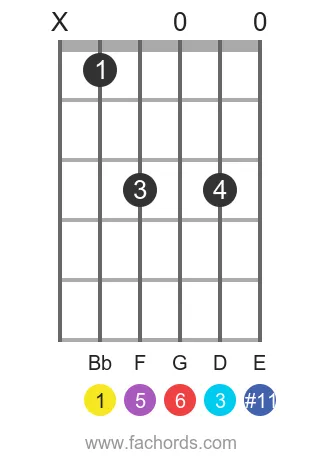
The Bb6#11 chord, a distinctive member of the Major Chords family, is built from the notes Bb, D, F, G, and E. These correspond to the intervals 1 (Root), 3 (Major Third), 5 (Perfect Fifth), 6 (Major Sixth), and #11 (Augmented Fourth), giving it a rich, complex sound. Use the interactive fretboard tool at the top of this page to visualize fingerings, listen to the chord as a strum or arpeggio, and instantly check your playing accuracy with the real-time microphone feedback.
Known for its sophisticated sound, the Bb6#11 is a favorite in genres like jazz, adding unique harmonic color to progressions. To better understand how sixth chords function and sound, explore our dedicated guide to 6th Chords. For a deeper dive into how such complex chords are constructed from intervals, our Chord Construction tutorial provides essential insights. Mastering this chord’s positioning on the fretboard will also benefit from understanding Understanding Chord Inversions, as different voicings are crucial for its application.
As you scroll down, you'll find numerous chord diagrams ranging from simple shapes to more advanced positions, along with music theory explanations, songs featuring the Bb6#11, and keys where it commonly appears. Before you explore the diagrams, spend some time with the interactive tool above. Set a comfortable tempo using the drum and BPM tool, play the chord, and let the mic feedback guide your finger placement. This hands-on approach is the most effective way to integrate new chords into your playing.
Bb 6th with sharp 11th guitar chord is also written as Bb6(#11), Bb6#11, Bbmaj6(#11) or Bb6(+11).
Bb 6(#11) chord Notes:
Chord structure of the Major Sixth Sharp Eleventh Added chord:
Bb 6(#11) Guitar Chord Diagrams
Position 1
Open
 Find more shapes in our all guitar chords online library. If you
prefer a printable pdf, download
the Free Guitar Chords Chart Pdf
Find more shapes in our all guitar chords online library. If you
prefer a printable pdf, download
the Free Guitar Chords Chart Pdf
You can also use this accessible Bb6(#11) chord page, with written diagram instructions and screen-reader support for blind users.


Created by
Giancarlo is a musician (teaching guitar since 2000), software engineer, AI consultant and published researcher
FAQ
What notes make up the Bb6#11 chord?
The Bb6#11 chord is constructed from five specific notes: Bb, D, F, G, and E. These notes are derived from its root (Bb), Major Third, Perfect Fifth, Major Sixth, and Augmented Fourth intervals, respectively.
What are the intervals that define the Bb6#11 chord?
The Bb6#11 chord is built from the following intervals relative to its root: 1 (Root), 3 (Major Third), 5 (Perfect Fifth), 6 (Major Sixth), and #11 (Augmented Fourth). These specific intervals are what give the chord its unique and distinctive sound.
Why is the Bb6#11 chord considered an advanced chord?
The Bb6#11 chord is considered advanced because it includes extended intervals like the Major Sixth and, more notably, the Augmented Eleventh. This complexity makes it richer and more intricate than basic major or minor chords, requiring a deeper understanding of music theory and fretboard knowledge.
How does the '#11' interval contribute to the sound of the Bb6#11 chord?
The '#11' (Augmented Fourth) interval is a key component that gives the Bb6#11 chord its characteristic sophisticated and somewhat 'open' or 'bright' quality. This interval adds a unique harmonic tension and color, distinguishing it from simpler 6th chords and contributing to its appeal in modern music.
Is the Bb6#11 chord part of the major or minor chord family?
The Bb6#11 chord is a member of the Major Chords family. This classification is determined by the presence of a Major Third (D) above the root (Bb), which establishes its fundamental major quality, even with the added extensions.
In what musical genres is the Bb6#11 chord commonly used?
Due to its rich and complex sound, the Bb6#11 chord is frequently found in genres like jazz. Its distinctive harmonic qualities make it ideal for adding color, sophistication, and a modern feel to compositions in these styles.
