Amaj9 Guitar Chord | Play, Hear and Practice Interactively
Want a structured chord roadmap instead of jumping between pages?
Go to the full guitar chords tutorial.
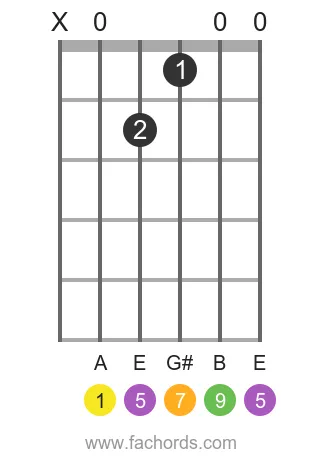
The Amaj9 chord belongs to the Major Chords family and is built from the notes A, C#, E, G#, and B, corresponding to the intervals Root (1), Major Third (3), Perfect Fifth (5), Major Seventh (7), and Major Ninth (9). Use the interactive fretboard tool at the top of this page to visualize every fingering, listen to the chord played as a strum or arpeggio, and check your own playing with the real-time microphone feedback - the tool will instantly show you if you're hitting all the notes correctly.
The Amaj9 extends beyond the octave, adding a rich, sophisticated sound to your playing. If you're new to these more complex voicings, our guide to Ninth Chords provides a solid foundation. Understanding how chords like the Amaj9 are constructed by stacking intervals is key to mastering them – explore this concept in our Chord Construction tutorial. Once you can fret the Amaj9 cleanly, focus on smooth transitions; our tips for Improve Chords Change will help you incorporate it into your playing fluidly.
Scrolling down, you'll find comprehensive chord diagrams ranked from easiest open positions to full barre shapes, alongside deeper music theory, common songs that feature the Amaj9, and the keys where it shines. Before you dive into the diagrams, spend a few moments with the interactive tool above. Set a comfortable tempo with the drum and BPM tool, strum the Amaj9, and let the mic feedback guide your hand. This hands-on, immediate practice loop is the fastest way to truly integrate this beautiful chord into your muscle memory.
A major 9th guitar chord is also written as Amaj9, AM9, AΔ9 or Ama9.
Notes of the A maj9 chord:
How to create the Major Ninth chord:
A Maj9 Guitar Chord Diagrams
Position 1
Open
Position 2
Open
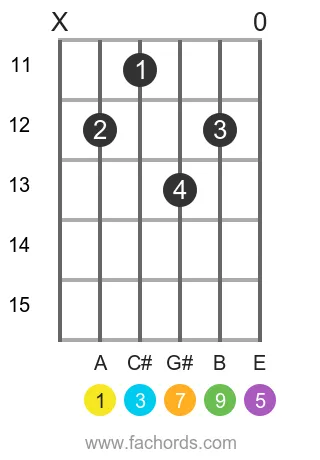
Position 3
Barre
Open
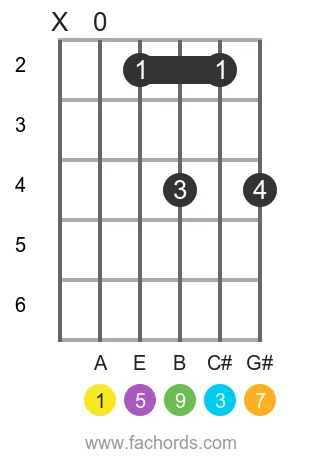
Position 4
Barre
Movable
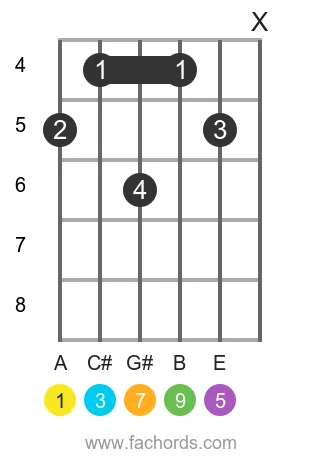
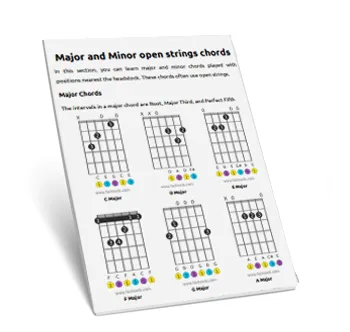
 Find more shapes in our all guitar chords online library. If you
prefer a printable pdf, download
the Free Guitar Chords Chart Pdf
Find more shapes in our all guitar chords online library. If you
prefer a printable pdf, download
the Free Guitar Chords Chart Pdf
You can also use this accessible Amaj9 chord page, with written diagram instructions and screen-reader support for blind users.

Created by
Giancarlo is a musician (teaching guitar since 2000), software engineer, AI consultant and published researcher
FAQ
What specific notes are included in an A maj9 chord?
The A maj9 chord is composed of the notes A, C#, E, G#, and B. These are derived directly from the root, major third, perfect fifth, major seventh, and major ninth intervals.
What do the interval numbers 1, 3, 5, 7, and 9 represent in the A maj9 chord?
For the A maj9 chord, these numbers represent its core intervals: 1 is the Root (A), 3 is the Major Third (C#), 5 is the Perfect Fifth (E), 7 is the Major Seventh (G#), and 9 is the Major Ninth (B). Each interval adds a specific harmonic color to the chord.
Why is the A maj9 chord described as 'extending beyond the octave'?
The A maj9 chord extends beyond the octave because it includes a Major Ninth interval (B relative to A). This ninth is essentially the second note of the scale played an octave higher than the root, which means the chord uses notes spanning more than a single eight-note range.
How does the A maj9 chord acquire its 'major' quality and its 'rich' sound?
The 'major' quality of the A maj9 chord comes from its Major Third (C#) and Major Seventh (G#) intervals. Its 'rich' and 'beautiful' sound is attributed to the combination of these major qualities with the added complexity and harmonic color provided by the Major Ninth (B) interval, making it a five-note chord that extends harmonically.
What is the primary difference between an A major triad, an A maj7 chord, and an A maj9 chord?
An A major triad contains the Root (A), Major Third (C#), and Perfect Fifth (E). An A maj7 chord builds on this by adding the Major Seventh (G#). The A maj9 chord further expands upon the A maj7 by adding the Major Ninth (B), making it a more complex chord with five distinct notes.
