Amaj7 Guitar Chord | Play, Hear and Practice Interactively
Want a structured chord roadmap instead of jumping between pages?
Go to the full guitar chords tutorial.
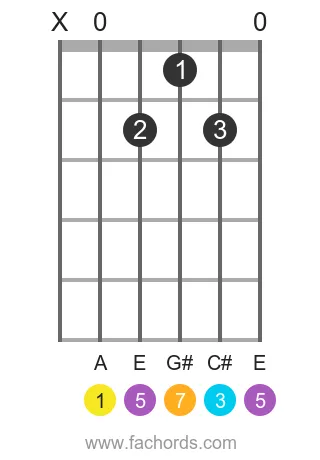
An Amaj7 chord, also called A major seventh, is made of A, C#, E and G#. The seventh, G#, lies eleven semitones above the root.
Six voicings are mapped out here, three of them with open strings and two using a barre. Dropping the fifth still leaves a recognisable major seventh sound, because the third and the seventh define the chord's quality. The A Lydian scale contains all four chord tones and has a raised fourth. Short on fingers? Try three-note seventh chords first.
Set a tempo in the chord player above, start the drums and play Amaj7 along with the loop.
A major 7th guitar chord is also written as Amaj7, AM7, AΔ7 or Ama7.
Notes of the A maj7 chord:
Chord structure of the Major Seventh chord:
Formula: 1 3 5 7
A Maj7 Guitar Chord Diagrams
Position 1 Open
Finger Positions
- Mute the low E string
- Let the A string play without pressing any fret
- Let the high E string play without pressing any fret
- Place your index finger (1) on the fret 1 of the G string
- Place your middle finger (2) on the fret 2 of the D string
- Place your ring finger (3) on the fret 2 of the B string
Position 2 Open
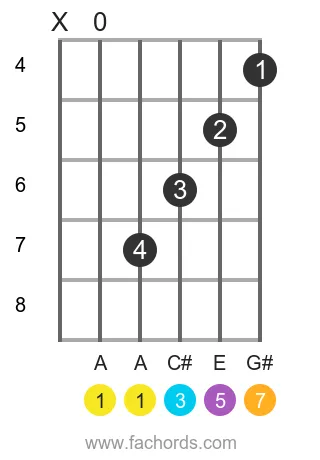
Finger Positions
- Mute the low E string
- Let the A string play without pressing any fret
- Place your index finger (1) on the fret 4 of the high E string
- Place your middle finger (2) on the fret 5 of the B string
- Place your ring finger (3) on the fret 6 of the G string
- Place your pinky finger (4) on the fret 7 of the D string
Position 3 Barre Movable
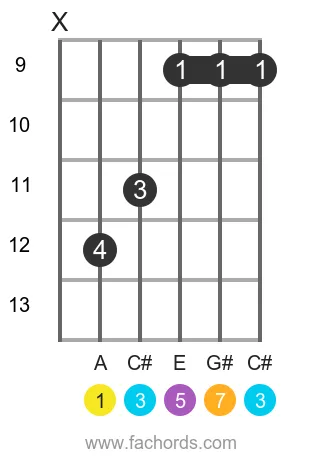
Finger Positions
- Mute the low E string
- Place your index finger (1) on the fret 9 of the G, B and high E strings at the same time
- Place your ring finger (3) on the fret 11 of the D string
- Place your pinky finger (4) on the fret 12 of the A string
Position 4 Movable
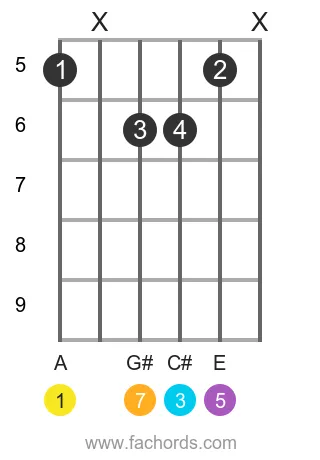
Finger Positions
- Mute the A string
- Mute the high E string
- Place your index finger (1) on the fret 5 of the low E string
- Place your middle finger (2) on the fret 5 of the B string
- Place your ring finger (3) on the fret 6 of the D string
- Place your pinky finger (4) on the fret 6 of the G string
Position 5 Open
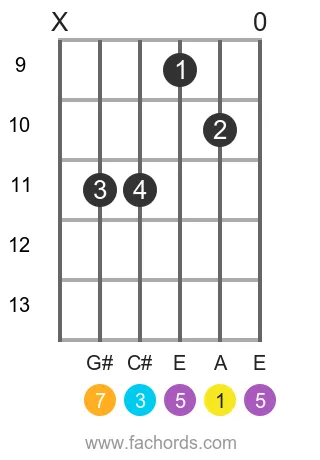
Finger Positions
- Mute the low E string
- Let the high E string play without pressing any fret
- Place your index finger (1) on the fret 9 of the G string
- Place your middle finger (2) on the fret 10 of the B string
- Place your ring finger (3) on the fret 11 of the A string
- Place your pinky finger (4) on the fret 11 of the D string
Position 6 Barre Movable
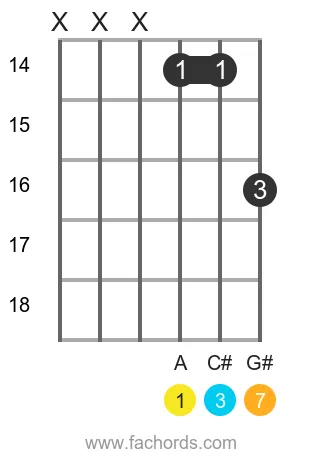
Finger Positions
- Mute the low E string
- Mute the A string
- Mute the D string
- Place your index finger (1) on the fret 14 of the G and B strings at the same time
- Place your ring finger (3) on the fret 16 of the high E string
 Find more shapes in our all guitar chords online library. If you
prefer a printable pdf, download
the Free Guitar Chords Chart Pdf
Find more shapes in our all guitar chords online library. If you
prefer a printable pdf, download
the Free Guitar Chords Chart Pdf

Created by
Giancarlo is a musician (teaching guitar since 2000), software engineer, AI consultant and published researcher
FAQ
What notes are in A major seventh?
A major seventh contains A, C#, E and G#. G# is the major seventh, one semitone short of the octave of A.
How many voicings does Amaj7 have?
Amaj7 has 6 voicings, 3 with open strings and 2 with a barre. The highest one reaches the 16th fret.
Where does Amaj7 appear in a key?
Amaj7 is the I chord of A major and the IV chord of E major. Both scales contain A, C#, E and G#.
How is Amaj7 different from an A major triad?
The A major triad is A, C#, E. Amaj7 adds G#, a major seventh, which gives a colour often heard in jazz.
