A m7b5 Guitar Chord | Play, Hear and Practice Interactively
Want a structured chord roadmap instead of jumping between pages?
Go to the full guitar chords tutorial.
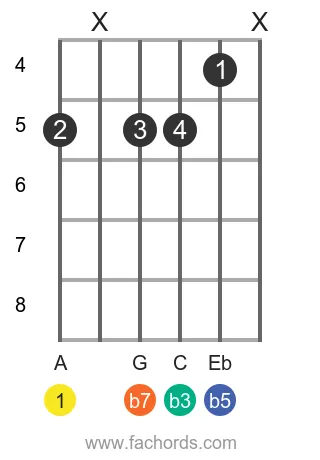
The A m7b5 chord is a unique member of the Diminished Chords family, also known as a half-diminished chord. It is composed of the notes A, C, Eb, and G, corresponding to the intervals Root (1), Minor Third (b3), Diminished Fifth (b5), and Minor Seventh (b7). Explore this distinctive sound using the interactive fretboard tool at the top of the page: visualize fingerings on the virtual fretboard, hear it played as a strum or arpeggio, and get instant feedback on your accuracy with real-time microphone feedback as you play along.
The diminished fifth (b5) gives the A m7b5 its distinctive, often dissonant, sound, making it a crucial chord in jazz and other genres for adding tension and color. Understanding how this chord is built by stacking intervals is key to mastering it; dive deeper into how music works with our Chord Construction tutorial. Since this is a 7th chord, you might also find our guide on Learn 3-Note 7th Chords helpful for understanding its core structure. For more on its unique sonic quality, explore our comprehensive guide on Diminished Guitar Chords.
Below, you'll discover comprehensive resources for the A m7b5 chord, including detailed chord diagrams (ranked from easiest open positions to more complex voicings), essential music theory insights, popular songs that feature this chord, and a breakdown of the keys where it commonly appears. Before you explore the diagrams, take a moment to engage with the interactive tool above. Set a comfortable tempo with the built-in drum & BPM tool, strum the chord, and use the mic feedback to refine your finger placement and ensure every note rings clear. This immediate, hands-on practice loop is the fastest way to solidify your understanding and performance of the A m7b5.
Notes in the A m7b5 chord:
How the Minor Seventh Flat five chord is built:
How To Play The A Minor Seventh Flat five chord on guitar
Position 1
Movable
 Find more shapes in our all guitar chords online library. If you
prefer a printable pdf, download
the Free Guitar Chords Chart Pdf
Find more shapes in our all guitar chords online library. If you
prefer a printable pdf, download
the Free Guitar Chords Chart Pdf
You can also use this accessible Am7b5 chord page, with written diagram instructions and screen-reader support for blind users.
FAQ
What do the 'm7b5' elements mean in the A m7b5 guitar chord name?
The 'm7b5' in the A m7b5 chord name specifies its unique construction based on intervals. 'm' indicates a minor third interval, '7' refers to a minor seventh, and 'b5' denotes a diminished fifth. These intervals from the root A are precisely 1 (Root), b3 (Minor Third), b5 (Diminished Fifth), and b7 (Minor Seventh).
Why is the A m7b5 chord part of the 'Diminished Chords family' if it includes a minor seventh?
The A m7b5 chord is categorized within the 'Diminished Chords family' primarily because of its diminished fifth interval (b5). This diminished fifth creates a characteristic tension and sound. While it contains a minor seventh (b7) rather than a diminished seventh, its specific interval structure (1, b3, b5, b7) places it in this family.
What are the specific notes I need to play to form an A m7b5 chord?
To play the A m7b5 chord, you will use four specific notes: A, C, Eb, and G. These notes correspond to the root, minor third, diminished fifth, and minor seventh intervals, respectively, when built from the root note A.
How does the diminished fifth (b5) interval contribute to the A m7b5 chord's distinctive sound?
The diminished fifth (b5) interval is crucial to the A m7b5 chord's distinctive sound. This interval creates a unique harmonic tension and a slightly melancholic or unresolved quality compared to standard minor or dominant chords. It's the key element that gives the chord its characteristic color and sets it apart.
How do the intervals 1, b3, b5, and b7 define the A m7b5 chord?
The intervals 1, b3, b5, and b7 precisely define the A m7b5 chord's structure from the root note A: 1 is the Root (A), b3 is the Minor Third (C), b5 is the Diminished Fifth (Eb), and b7 is the Minor Seventh (G). Understanding these specific intervals is crucial for building and recognizing the chord.