A13(#11) Guitar Chord | Play, Hear and Practice Interactively
Want a structured chord roadmap instead of jumping between pages?
Go to the full guitar chords tutorial.
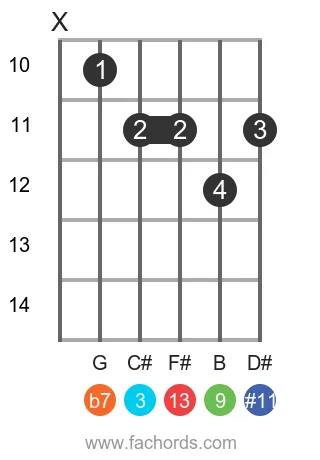
The A13(#11) chord is a rich and complex member of the Dominant Chords family, composed of the notes A, C#, E, G, B, D#, and F#. These notes correspond to the intervals 1, 3, 5, b7, 9, #11, and 13, giving it a sophisticated sound. Our interactive fretboard tool provides a dynamic way to explore this chord, allowing you to visualize every fingering, hear the chord played as a strum or arpeggio, and get instant feedback on your accuracy with real-time microphone input.
Understanding how the A13(#11) is constructed, particularly its extended intervals, unlocks its full potential on the fretboard. This chord, with its distinctive sharp eleventh, adds sophisticated harmonic color, often found in jazz and fusion. If you're looking to master these rich sounds, exploring our Dominant Chord guide can provide a solid foundation. You might also find our Ninth Chords tutorial helpful for understanding these extended voicings. To fully grasp how these intervals combine, dive into our Chord Construction lesson. Many shapes for this chord will involve barre techniques, so our Guitar Bar Chords guide can help you navigate those fingerings.
As you scroll down, you'll discover a comprehensive collection of A13(#11) chord diagrams, ranked from the easiest open positions to more challenging barre shapes. We also provide deeper music theory insights, popular songs that feature this chord, and the various keys where it shines. Before you dive into the diagrams, take a moment to use the interactive tool above. Set your preferred tempo with the drum tool, experiment with different voicings, and let the mic feedback guide you to perfect your finger placement. This hands-on approach will accelerate your learning and help you truly internalize the sound and feel of the A13(#11) chord.
Notes of the A 13(#11) chord:
Chord Formula:
A13(#11) Guitar Chord Diagrams
Position 1
Barre
Movable
 Find more shapes in our all guitar chords online library. If you
prefer a printable pdf, download
the Free Guitar Chords Chart Pdf
Find more shapes in our all guitar chords online library. If you
prefer a printable pdf, download
the Free Guitar Chords Chart Pdf
You can also use this accessible A13(#11) chord page, with written diagram instructions and screen-reader support for blind users.
FAQ
What does the '13' and '#11' signify in the A13(#11) chord name?
The numbers '13' and '#11' refer to specific extended intervals beyond the basic seventh chord. The '13' indicates the presence of the 13th interval, and the '#11' signifies that the 11th interval is raised a half step (sharped), adding a distinct color to the chord.
How many notes are typically found in an A13(#11) chord?
The A13(#11) chord is a complex chord composed of seven distinct notes. These notes are A, C#, E, G, B, D#, and F#, corresponding to the root, 3rd, 5th, flat 7th, 9th, sharp 11th, and 13th intervals, respectively.
Why is the A13(#11) chord considered a 'Dominant Chord'?
The A13(#11) is categorized as a Dominant Chord because it contains the characteristic flat 7th interval (G in the key of A) along with its root (A) and major 3rd (C#). This combination gives it qualities common to the dominant chord family, even with its added extensions.
What kind of sound does the A13(#11) chord produce?
The A13(#11) chord is known for its complex, rich, and sophisticated sound. Its extended intervals, particularly the sharp 11th, contribute to a unique harmonic color that can add depth to your guitar playing.
What are the specific intervals that build the A13(#11) chord?
The A13(#11) chord is constructed from a specific set of intervals: the 1st (root), 3rd, 5th, flat 7th, 9th, sharp 11th, and 13th. These intervals are stacked to create its full harmonic structure.
When should I use an A13(#11) chord in my playing?
The A13(#11) chord is particularly useful for adding a sophisticated touch to your guitar playing, especially in genres like jazz. Its complex sound can open up new harmonic possibilities and enrich your chord vocabulary in advanced contexts.
