Seventh 7th Chords On Guitar
The Most Important Seventh Chords (With Chord Chart)
 In this tutorial we'll learn
how to play 7th guitar chords on
the guitar
.
In this tutorial we'll learn
how to play 7th guitar chords on
the guitar
.
When learning guitar, it's common to start playing some basic major and minor chords , that is composed of three tones.
The real fun begins when we add another tone and give birth to new sounds (our new chords ebook will give you a huge number of options).
We can encounter Seventh Chords everywhere: Jazz , Blues , Country , even Pop music use often 7th chords.
In this post, we're going to start from triads , which are the foundation of chord construction , then well, see how to combine them with the different types of seventh intervals to create new chord kinds.
Then we'll see how to play seventh chords in the context of a chord progression.
Let's see how to construct 7th chords and where they are used.
It all starts with triads
The most basic chord kind is the triad . We can have 4 different kinds of triad:
- Major triad (e.g. C major )
- Minor triad (e.g. C minor )
- Diminished Triad (e.g. C dim )
- Augmented Triad (e.g. C aug )
The following tables help you understand better the interval structure of each type of triad:
Major Triad
A Major Triad is composed of the Root (R), the Major Third (3) and the Perfect Fifth (5)
Minor Triad
A Minor Triad is composed of the Root (R), the Minor Third (b3) and the Perfect Fifth (5)
Diminished Triad
A Diminished Triad is composed of the Root (R), the Minor Third (b3) and the Diminished Fifth (b5)
Augmented Triad
An Augmented Triad is composed of the Root (R), the Major Third (3) and the Augmented Fifth (#5)
Seventh Intervals
So far we've seen the basic intervals that are the building blocks of triads: major and Minor Thirds, and Diminished, Perfect and augmented Fifths.
Now we introduce a new kind of interval: the Seventh.
Seventh intervals exist in three different kinds:
- Major Seventh (11 half-steps)
- Minor Seventh (10 half-steps)
- Diminished Seventh (9 half-steps)
Here are some examples with note names:
- the Major Seventh of C is B
- the Minor Seventh of C is Bb
- the Diminished Seventh of C is Bbb
Some of you probably have noticed that if we count 9 half-steps from C, we land on the note A, not Bbb.
This is an enharmonic : two notes with the same pitches but different names , depending on the context in which they are used.
We said Bbb instead of A because we made the process of "diminish" the note B (Major Seventh) to Bbb (Diminished Seventh, which consists of a Major Seventh lowered by two half-steps)
The table below shows you visually the three kinds of Seventh Interval
Stacking Seventh Intervals on the Top of Triads
Now that we know the basic triad types and the Seventh intervals, we can stack them together to obtain different combinations:
There exist other possible combinations but are rarely used and will not be covered in this tutorial.
In the following, you'll find the most common guitar chord diagrams for 7th chords.
All the diagrams are with the root of C, but the shapes are movable .
That means that you can shift the shape up and down the neck to play chords of the same quality but with a different root.
This is made possible by the fact that movable shapes don't use any open string.
For each chord, we show possible fingerings with root on the 6th, 5th and 4th strings.
If you need help in reading these diagrams, check the how to read chord tables tutorial.
 Download the free
Guitar Chords Chart
in pdf format.
Download the free
Guitar Chords Chart
in pdf format.
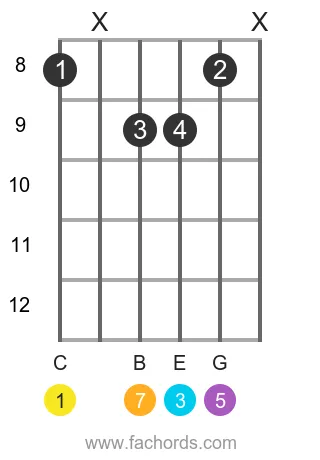
Major Seventh Chord Chart (maj7)
The Major Seventh chord is composed of the Root, Major Third, Perfect Fifth and Major Seventh
Root on the 6th string
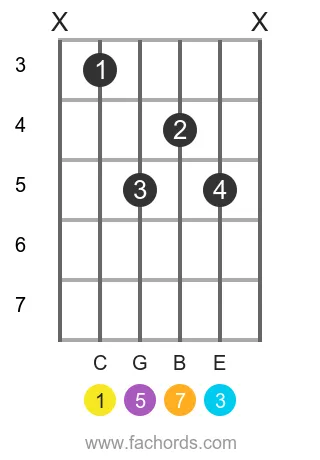
Root on the 5th string
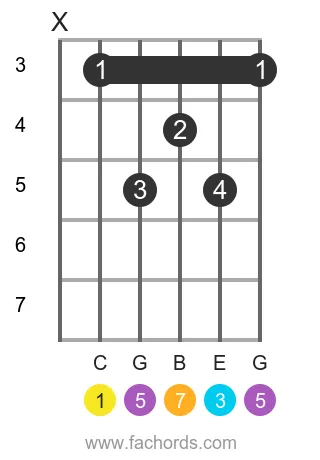
Root on the 5th string (alternative)
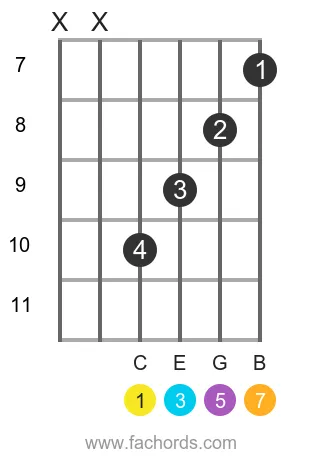
Root on the 4th string
Dominant Seventh Chord Guitar Shapes (7)
The Dominant Seventh chord is composed of the Root, Major Third, Perfect Fifth and Minor Seventh
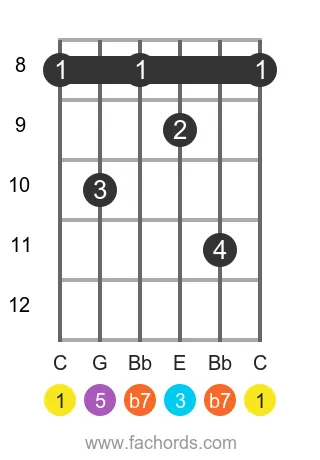
Root on the 6th string
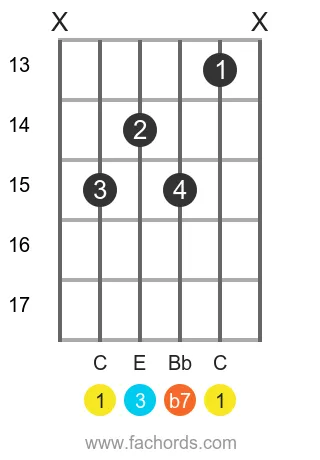
Root on the 5th string
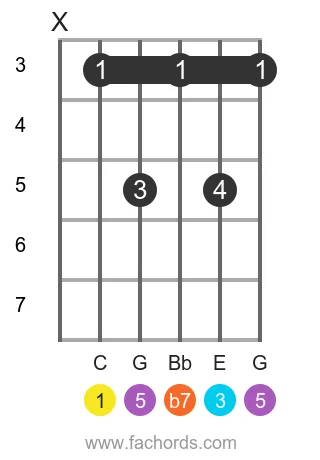
Root on the 5th string (alternative)
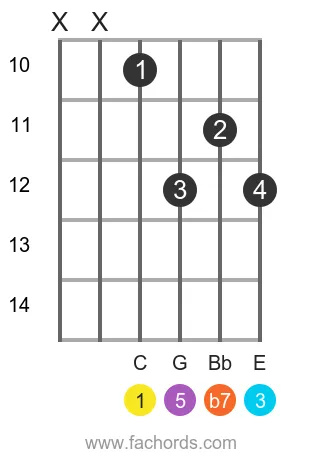
Root on the 4th string
Minor Seventh Guitar Chord Charts (m7)
The Minor Seventh chord is composed of the Root, Minor Third, Perfect Fifth and Minor Seventh
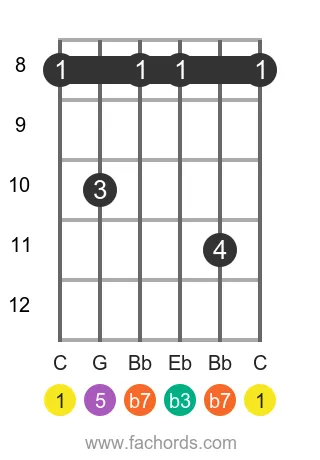
Root on the 6th string
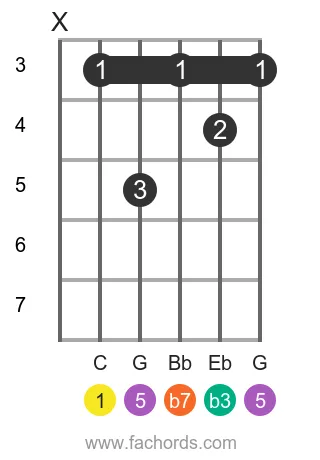
Root on the 5th string
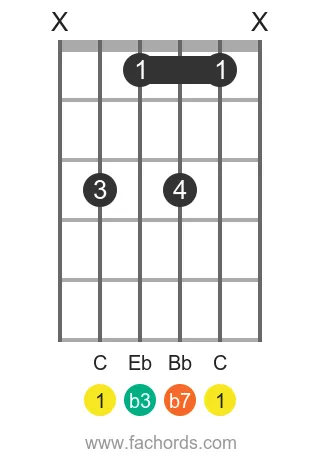
Root on the 5th string (alternative)
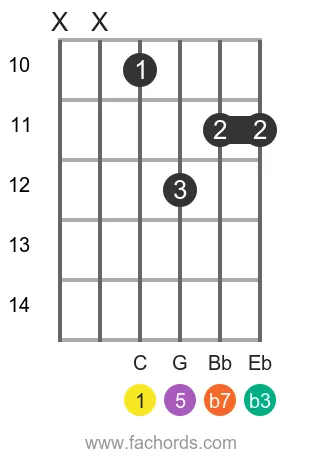
Root on the 4th string
Minor Seventh Flat Five Chord Guitar Shapes (m7b5)
The Minor Seventh Flat Five (m7b5) chord is composed of the Root, Minor Third, Diminished Fifth and Minor Seventh
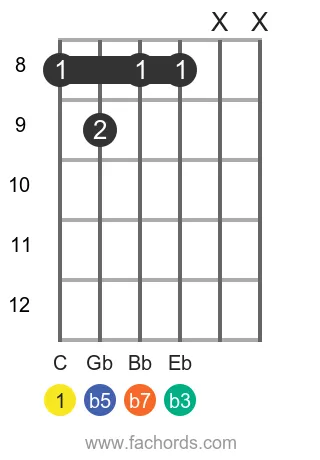
Root on the 6th string
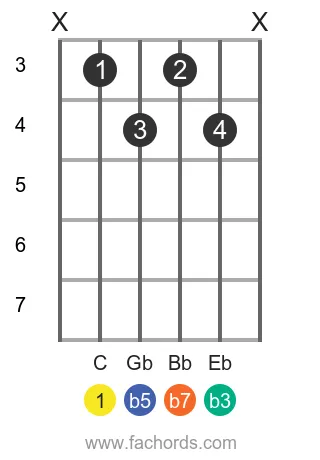
Root on the 5th string
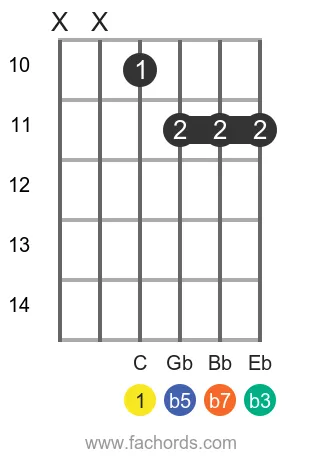
Root on the 4th string
Diminished Seventh Guitar Chord Diagrams (Dim7)
The Diminished Seventh chord is composed of the Root, Minor Third, Diminished Fifth and Diminished Seventh.
This chord is symmetric, each tone in the chord is three half-steps from the other, as you can see in the table below. You can learn more in the diminished chords tutorial .
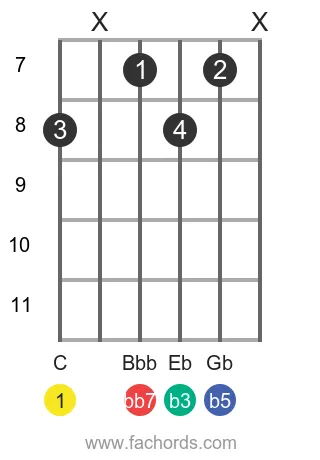
Root on the 6th string
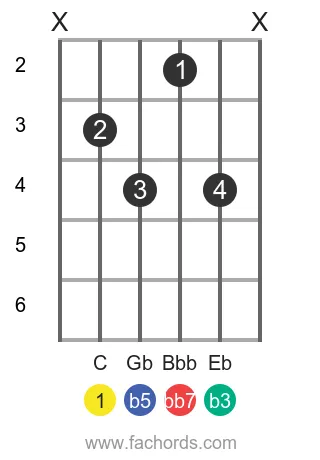
Root on the 5th string
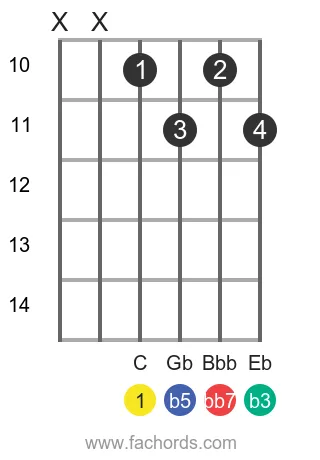
Root on the 4th string
Minor Major Seventh Chord (m maj7)
The Minor Major Seventh chord is composed of the Root, Minor Third, Perfect Fifth and Major Seventh.
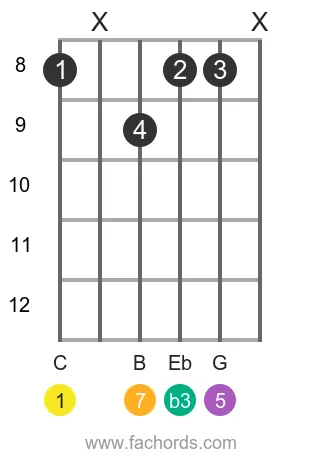
Root on the 6th string
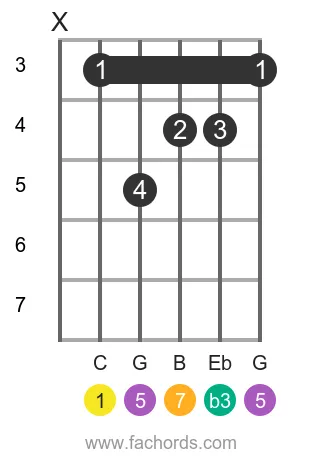
Root on the 5th string
How To Use 7th Guitar Chords
Now that we know how to play 7th chords, let's see how to include them in any chord progression.
Depending on the scale on which the chord progression is created , we can encounter different situations.
In a Major Scale, we have a Major Seventh Chord on the 1st and 4th degree, a Minor Seventh Chord on the 2nd, 3rd and 6th degree, a Dominant 7 Chord on the 5th degree , and a Minor 7b5 Chord on the 7th degree.
C Major Scale
For example, if we play the classic chord progression I-V-vi-IV in the key of C, we would have:
A Natural Minor Scale
Switching to minor keys, here below you find the Seventh Chords generated from the Natural Minor Scale:
Playing the same progression i-v-VI-iv in the A minor key, we would obtain:
A Harmonic Minor Scale
If you want to build chord progressions on the Harmonic Minor scale, things become more interesting, because, due to the particular nature of the harmonic minor scale, new chord qualities appear, but we're going to learn more about this topic in the next tutorial.
Try to experiment by applying different chord progressions of these scales and pay attention to the sound that 7th chords create.
Seventh Chords - Conclusions
To learn more about the relation between chords and scales, visit the chords in keys tutorial and grab our Chords Domination ebook.
If you already have requested your access to the free download area, you can download a helpful pdf with all the chords in keys for each root (you've got the link in your welcome email, otherwise request your access here )
This ends our tutorial on 7th chords for guitar. Practice them by paying attention to how the seventh tone adds a new feeling and different colors to the sound of basic chords .
Download the free
Guitar Chords Chart
in pdf format.
FAQ
What is the main difference between a basic guitar chord and a seventh chord?
Basic major and minor chords, also known as triads, are composed of three notes: a root, a third, and a perfect fifth. A seventh chord adds a fourth note, which is a seventh interval above the root, introducing a new harmonic 'color' and complexity to the sound.
How do the different types of seventh intervals affect a chord's character?
The type of seventh interval (Major, Minor, or Diminished) added to a triad significantly alters the chord's emotional and harmonic quality. For instance, a Major Seventh often adds a bright, sophisticated, or open sound, while a Minor Seventh can contribute a bluesy, mellow, or tense (dominant) feel. Each specific seventh interval provides a unique 'color' to the chord.
What does it mean for a seventh chord shape to be 'movable' on the guitar?
A 'movable shape' for a seventh chord is a fingering that does not utilize any open strings. This design allows guitarists to shift the entire chord shape up or down the fretboard to play the same type of chord (e.g., a Major Seventh chord) with different root notes (e.g., Cmaj7, Dmaj7, Fmaj7) without changing the fingering pattern.
When should I typically use a Dominant Seventh (V7) chord in a chord progression?
In a major scale, the Dominant Seventh (V7) chord naturally occurs on the fifth degree. It is often used to create a strong sense of tension and a powerful pull towards the tonic (I) chord, leading to a satisfying resolution within a chord progression. This tension-release function makes it a cornerstone of functional harmony.
What is the theoretical reason for naming a diminished seventh interval from C as Bbb instead of A?
The name Bbb, rather than A, is used to correctly represent the theoretical construction of a diminished seventh interval. A diminished seventh is derived by taking a Major Seventh (like the interval from C to B) and lowering it by *two* half-steps. Therefore, B becomes Bbb. While A and Bbb are enharmonically equivalent (they sound the same), Bbb accurately reflects its specific interval relationship and theoretical origin.
What is the key difference between a Minor Seventh (m7) and a Minor Major Seventh (m-maj7) chord?
Both the Minor Seventh and Minor Major Seventh chords are built upon a minor triad (Root, Minor Third, Perfect Fifth). The crucial distinction lies in the seventh interval added: a Minor Seventh chord uses a Minor Seventh (b7), giving it a more common, often bluesy or jazzy feel. In contrast, a Minor Major Seventh chord uses a Major Seventh (7), resulting in a more complex, often darker or melancholic sound.
