The Best Way To Practice Guitar Scale
Context Is More Important Than Speed
When it comes to learning guitar scales, many guitar players are obsessed with speed and technique.
So a common approach is to run patterns up and down the fretboard, until the fingers develop a certain level of agility and dexterity.
Of course, mechanics is important: you need to right technique so you can express yourself on the instruments without limits (here are some picking scales and guitar scales exercises).
But there's a more important aspect often neglected: the ear! Practicing scales (as well as any other thing on guitar) should always involve aural training.
For example, are you able to perceive the the subtle difference between a major scale and a Mixolydian scale?
That b7 degree dramatically changes the feeling of the scale.
And what's the best way to exercise the ear while practicing scale?
Introducing a musical context!
Putting Your Ear At Work: Use Context
To train your ear while playing scales, you should always have a reference point somewhere: it could be a backing track or a bass player, but the important thing is that each note of your scales will be played against a root note.
Only in this way you can really listen to intervals and internalize the unique nuance of a scale.
For example, the common way in which modes are explained is faulty; usually they say: take the C major scale, play D to D to have a Dorian scale, E to E for Phrygian, F to F for Lydian, and so forth.
Actually, without a musical context, you are simply playing the major scale starting from different notes.
A Simple Way To Practice Scales In Context
We can exploit the genius layout of the guitar fretboard to introduce a musical context in our practice: we'll play the E low string as a root note while playing one-octave scales with the same root (E) on the G string.
Let's have a look at the tabs below:
E Guitar Scales
E Major Scale
Let's begin with the E major scale:
E, F♯, G♯, A, B, C♯, D♯
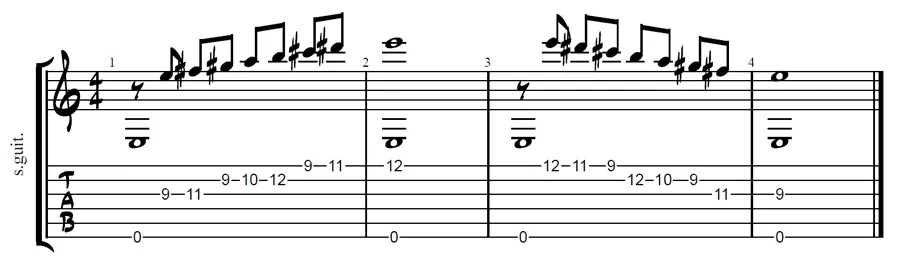
E Lydian Scale
E F# G# A# B C# D#
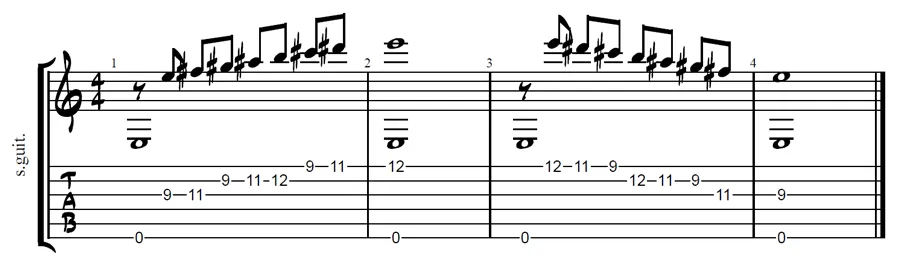
E Mixolydian Scale
E F# G# A B C# D
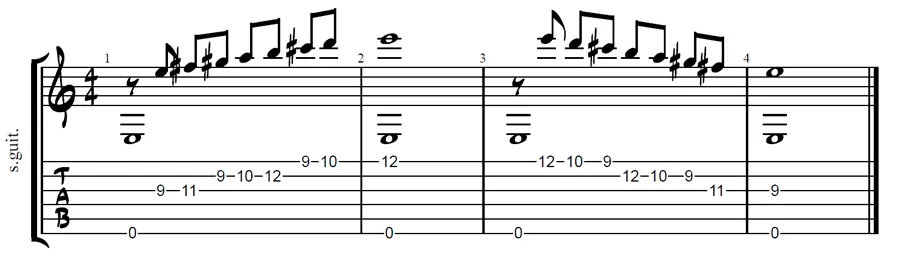
E Minor Scale
E, F♯, G, A, B, C, D
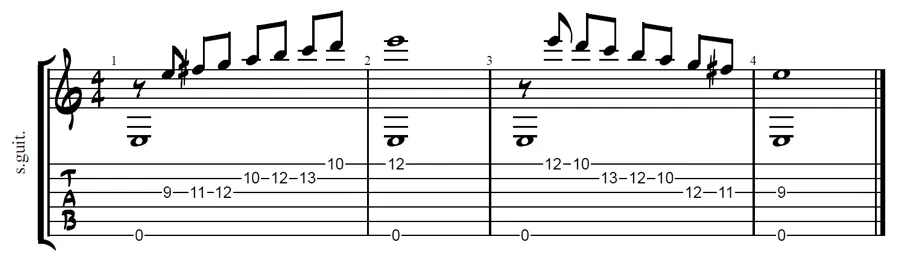
E Dorian Scale
E F# G A B C# D
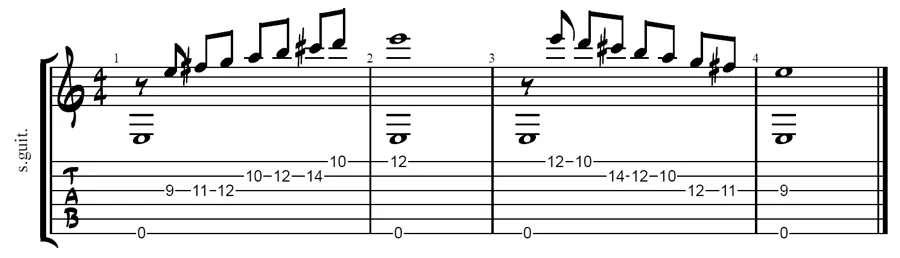
E Phrygian Scale
E F G A B C D
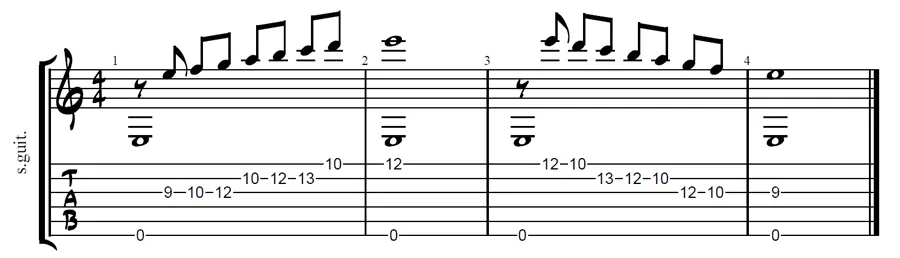
E Locrian Scale
E F G A Bb C D
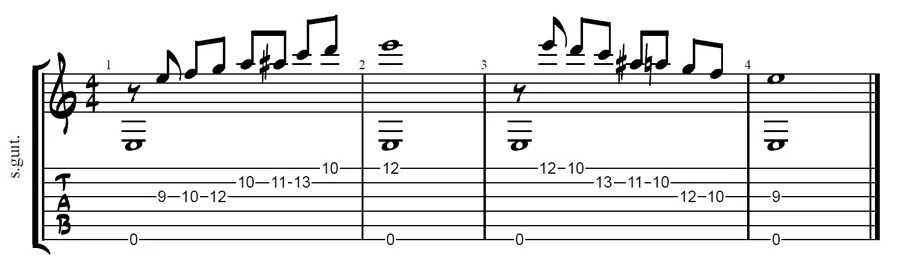
Practicing Guitar Scales In Context: Conclusions
I hope that now you are convinced of the importance of using scales in a musical context.
Of course, you can elaborate on the concepts exposed in this article and use backing tracks or a chord progression generator, even if the most fun and rewarding thing will be joining a band!
For a complete ebook on guitar scales and which scales play over a chord, check my Scales Over Chords | Learn How To Play The Right Scales Over Any Chord.
To stay updated on new tutorials (and get free access to the download area) subscribe here.
FAQ
Why is practicing guitar scales 'in context' considered more effective than just focusing on speed and technique?
While speed and technique are important for physical agility on the instrument, practicing scales in context prioritizes aural training. It helps you develop your ear to understand the unique sound and emotional quality of each note within a scale when played against a consistent reference point, which is crucial for true musical expression, rather than just finger dexterity.
How does having a constant 'root note' or 'backing track' help with ear training when practicing scales?
When you play the notes of a scale against a sustained root note or within a musical context like a backing track, you learn to perceive the specific sound and tension/resolution qualities of each interval. This process helps you internalize the unique nuance and 'flavor' of different scales and modes, making their characteristic sounds identifiable to your ear.
Can you describe the practical method suggested for practicing scales in context using the low E string?
This method involves continuously sounding the low E string (either open or fretted at E) as a constant drone or root reference. While this E note rings, you then play one-octave scales that also have E as their root (such as E Major, E Mixolydian, E Dorian, etc.) on a higher string, like the G string. This allows your ear to clearly distinguish the subtle intervallic differences of each scale against the common E root.
What specific differences should I listen for when comparing scales like E Major and E Mixolydian using the low E string method?
When comparing E Major (E F# G# A B C# D#) and E Mixolydian (E F# G# A B C# D) with a sustained E root, pay close attention to the seventh degree. E Major has a major seventh (D#), which creates a strong sense of leading to the root. E Mixolydian has a flattened seventh (D natural), which gives it a dominant, slightly bluesy, or more resolved sound. This single note difference dramatically alters the overall feeling of the scale.