Open Major Guitar Scales
Exercises To Master Major Scales in Open Position
The major scale is the most important type of scale; from it, we can derive other forms such as pentatonic and modal scales. In this tutorial, we're going to learn major scales in open positions.
Playing scales in open positions is quite easy, as these fingerings do not require big stretches; this is possible because they use open strings, on which you don't have to press any fret.
Unlike other scale forms such as 4-frets-boxes or 3-notes-strings, open scales are not movable, you can't shift them up or down the neck to play in another key (you can do this only by using a capo).
For this reason, in this post, we'll learn 7 different open major scales for the keys of C, D, E, F, G, A and B, introducing sharps and flats as required by the key.
Open scales have a richer and bigger sound, and they are used a lot in rock and country.
So let's get started
Open Major Scales on Guitar
The following fingerings use the major scale formula, W-W-H-W-W-W-H (whole step, whole step, half step, whole step, whole step, half step) starting from each root:
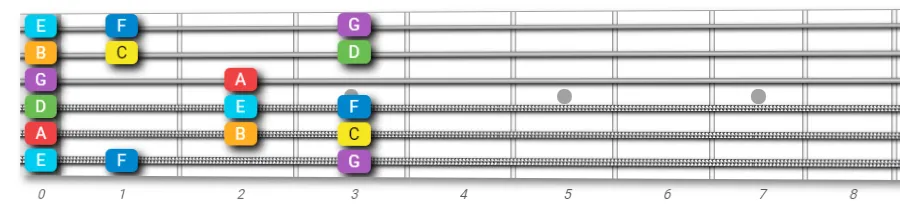
Open C Major Scale
The C Major scale does not have any sharp or flat.
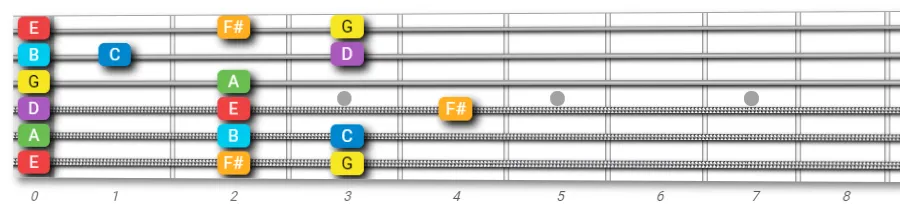
Open G Major Scale
In the G major scale we have an F#.
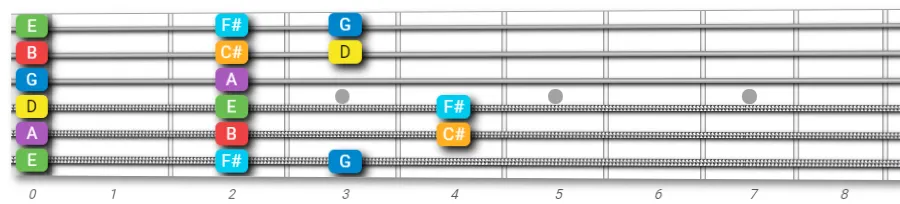
Open D Major Scale
F# and C# are needed to build the D major scale.
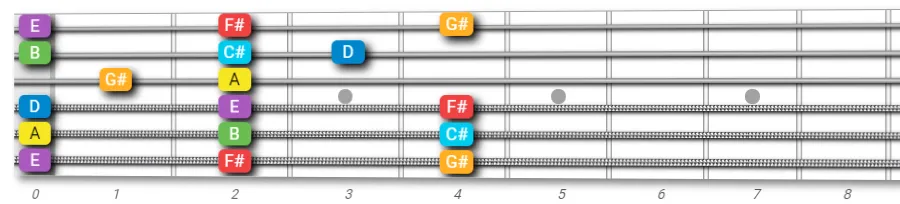
Open A Major Scale
The A major scale has C#, F# and G#.
Open E Major Scale
In the E major scale we find F#, G#, C# and D#.
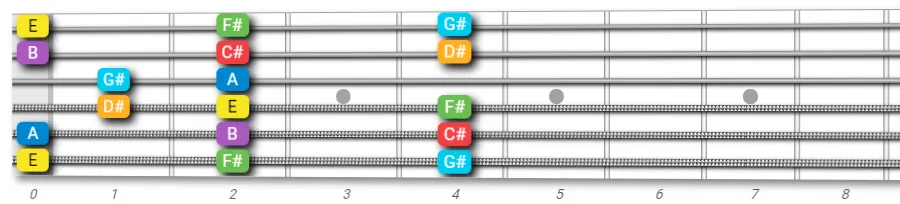
Open B Major Scale
The B major scale has sharps on C#, D#, F#, G# and A#
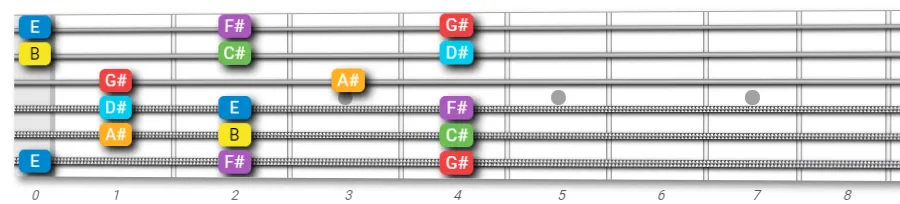
Open F Major Scale
To build a F major scale, we need a flat on B, so here we have a Bb.
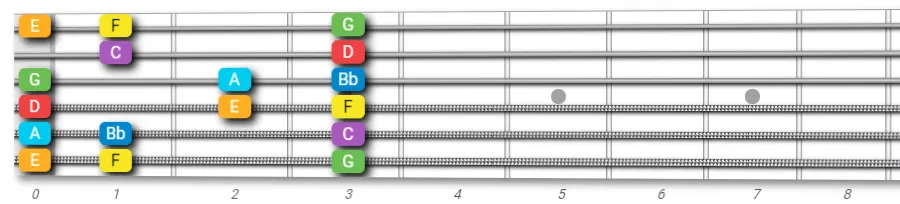
Maybe you are wondering why these major scales are listed in this particular order (C, G, D, A, E, B, F). This sorting is derived from the Circle of Fifths, in which keys are shown by adding one sharp or flat at a time (C has no flats/sharps, G has 1 sharps, D has 2 sharps, A 3 sharps and so on).
Tips On How To Practice These Scales
Ok, now that we know the fingerings for open major scales, here are some tips to practice them in the most effective way:
- Always begin the scale from the tonic (1), go up to the higher E string, and then go down to the lower E string.
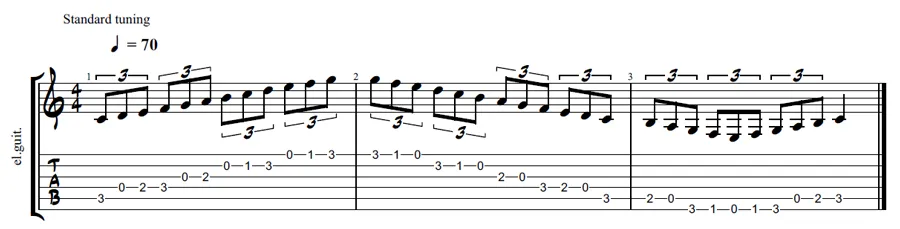
- Set the metronome to 70 bpm and play the scale in octave (1/8) and triplets
- All these fingerings should be memorized as second nature.
- Once you have the fingerings under your belt, you could also apply more complex exercises.
C Open Major Guitar Scale Tab
Here below you find the guitar tab for playing these open major scale patterns (the examples are based on the key of C):
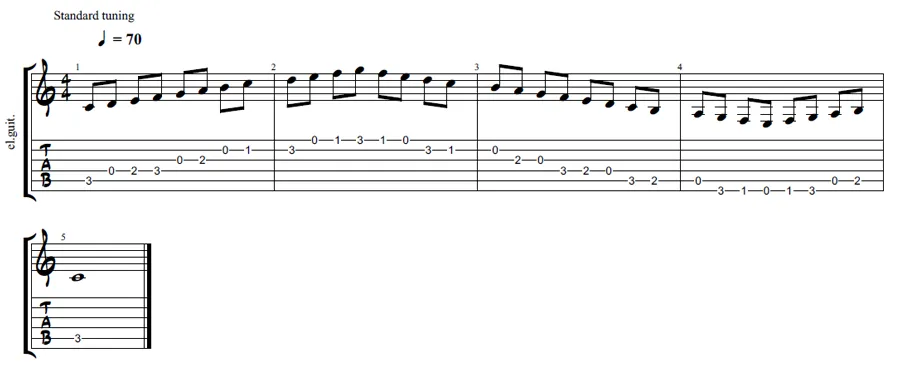
C Open Major Guitar Scale in Triplets Tab
Open Major Scales - Conclusions
Ok, now you have something to work on. Be sure to internalize all these fingerings, they will come in handy in a variety of situations.
The major scale is the foundation of music theory, from it you can derive basically any other theory concept.
Want to build chords? Start with the major scale and pick notes in thirds. Want to play arpeggios? Same as above, but play one note at a time.
Want to play a mixolydian scale? All you have to do is to start from your major scale, and lower the 7th degree by one flat (in the key of C, B will become Bb).
Those are more advanced concepts that we will tackle in future lessons, for this tutorial be sure to memorize all these open major scale fingerings.
To stay updated and access the free downloads, subscribe here.
FAQ
What is the primary difference between open major scales and other guitar scale forms?
Open major scales distinguish themselves by utilizing open strings, which means they generally do not require large finger stretches, making them easier to play. However, unlike other scale forms like 4-fret-boxes, open scales are not movable up or down the neck to change keys without the use of a capo.
Can I shift an open major scale pattern to play in a different key?
No, open major scales are not movable in the same way other scale fingerings are. Each open scale pattern is specific to its key (e.g., open C major scale). To play an open scale pattern in a different key, you would typically need to use a capo to shift the entire pattern up or down the neck.
Why are the open major scales in this tutorial presented in the order of C, G, D, A, E, B, F?
This specific order is based on the Circle of Fifths. It's a pedagogical approach that introduces keys by progressively adding one sharp or flat at a time, making it a systematic way to learn and understand key signatures (C has no sharps/flats, G has one sharp, D has two sharps, and so on).
How should I practice these open major scales effectively?
To practice effectively, always begin the scale from its root note (tonic), ascend to the highest string, and then descend back to the lowest string. Set a metronome to about 70 bpm and practice playing the scale in octaves (eighth notes) and triplets to develop rhythm and fluency. The goal is to memorize the fingerings so they become second nature.
How does the W-W-H-W-W-W-H formula apply to these open major scales?
The W-W-H-W-W-W-H formula represents the pattern of whole (W) and half (H) steps that defines any major scale. Each open major scale fingering presented in this tutorial adheres to this specific interval pattern, ensuring that you are playing a true major scale starting from its root note on the guitar.
What are the broader applications of mastering the major scale beyond just playing its notes?
Mastering the major scale provides a strong foundation for understanding many music theory concepts. You can use it to build chords by selecting notes in thirds, create arpeggios by playing chord notes individually, and derive other modal scales (such as the Mixolydian scale by lowering the 7th degree).
