Modal Interchanges Made Easy
Learn How To Transform Your Guitar Chord Progressions
In this article, we're going to learn a songwriting technique that will add new nuances to your chord progressions.
Apparently, modal interchanges seem a complicated beast, but once you master their logic, your creativity will be incredibly enhanced.
So let's begin!
Chord Progressions Basics
We already talked about chord progressions extensively in past tutorials; here's a quick recap that uses the key of C as an example.
The Nashville numbers for the key of C are the following:
| Key | 1 | 2 | 3 | 4 | 5 | 6 | 7 |
|---|---|---|---|---|---|---|---|
| C | Dm | Em | F | G | Am | Bdim |
So we have 3 major chords (C, F and G), 3 minor chords (Em, Dm and Am) and an diminished chord (Bdim), like in any major key.
There are some chord sequences that sound pleasing and familiar, like:
- 1 4 5 (C F G) - Rock Progression
- 1 5 6 4 (C G Am F) - Four Chord Progression
- 2 5 1 (Dm G C) - Jazz Progression
- 1 3 4 5 (C Em F G) - Rock Ballad Progression
- ... and many others common chord progressions
So we have 7 chords to combine to build something interesting.
What if we want to be more creative, and introduce further variations?
Of course, we could modulate to another key, for example from C to G, to introduce new chords in our palette. The Circle of Fifths can help us find neighbor keys. In this case, G will become the new tonal center.
We could also apply modal interchanges, and stay in the same key and the same tonal center, but with new chords!
Modal Interchanges Explained
Before dealing with modal interchanges and borrowed chords, we need to draw attention to the concepts of relative and parallel keys.
Relative keys are created starting from each degree of a scale, while parallel keys share the same root. Here's an example:
C Major Relative Keys
If we build a scale starting from each note of the C major scale, using only the notes in the C major scale, we get the following relative scales (their names depend on the specific tones and half-tones structure)
- C Major (Ionian) - C D E F G A B C
- D Dorian - D E F G A B C D
- E Phrygian - E F G A B C D E
- F Lydian - F G A B C D E F
- G Mixolydian - G A B C D E F G
- A Minor (Aeolian) - A B C D E F G A
- B Locrian - B C D E F G A B C
C Major Parallel Key
Parallel keys share the same root, while the distances between the notes depend on the mode structure. The generated scales will be:
- C Major (Ionian) - C D E F G A B C
- C Dorian - C D Eb F G A Bb C
- C Phrygian - C Db Eb F G Ab Bb C
- C Lydian - C D E F# G A B C
- C Mixolydian - C D E F G A Bb C
- C Minor(Aeolian) - C D Eb F G Ab Bb C
- C Locrian - C Db Eb F Gb Ab Bb C
As we already know, to build chords from a scale, we stack the notes in that scale in third intervals, skipping every alternate note: 1,3,5, then 2,4,6, then 3,5,7, and so forth.
The most common scale is the major scale, but we can build chords from any type of scale.
Here below we find a table with the respective chords generated from all the parallel keys, in Roman Numbers Notation:
| Mode | 1 | 2 | 3 | 4 | 5 | 6 | 7 |
|---|---|---|---|---|---|---|---|
| Major | I | ii | iii | IV | V | vi | vii dim |
| Dorian | i | ii | bIII | IV | v | vi dim | bVII |
| Phrygian | i | bII | bIII | iv | v dim | bVI | bvii |
| Lydian | I | II | iii | #iv dim | V | vi | vii |
| Mixolydian | I | ii | iii dim | IV | v | vi | bVII |
| Minor | i | ii dim | bIII | iv | v | bVI | bVII |
| Locrian | i dim | bII | biii | iv | bV | bVI | bvii |
Which, in the key of C, correspond to the following chords:
| Mode | 1 | 2 | 3 | 4 | 5 | 6 | 7 |
|---|---|---|---|---|---|---|---|
| C Major | C | Dm | Em | F | G | Am | Bdim |
| C Dorian | Cm | Dm | Eb | F | Gm | Adim | Bb |
| C Phrygian | Cm | Db | Eb | Fm | Gdim | Ab | Bbm |
| C Lydian | C | D | Em | F#dim | G | Am | Bm |
| C Mixolydian | C | Dm | Edim | F | Gm | Am | Bb |
| C Minor | Cm | Ddim | Eb | Fm | Gm | Ab | Bb |
| C Locrian | Cdim | Db | Ebm | Fm | Gb | Ab | Bbm |
With Modal Interchanges, we can borrow a chord from any parallel key, and use it in a chord progression, without changing tonal center of the tune. Let's see some examples:
Modal Interchanges Examples
We're going to show you some simple modal interchanges that mix chords from C major and minor keys. Notice how the tonal center still remains the same even if we introduce new colours.
| Key | 1 | 2 | 3 | 4 | 5 | 6 | 7 |
|---|---|---|---|---|---|---|---|
| Major | C | Dm | Em | F | G | Am | Bdim |
| Minor | Cm | Ddim | Eb | Fm | Gm | Ab | Bb |
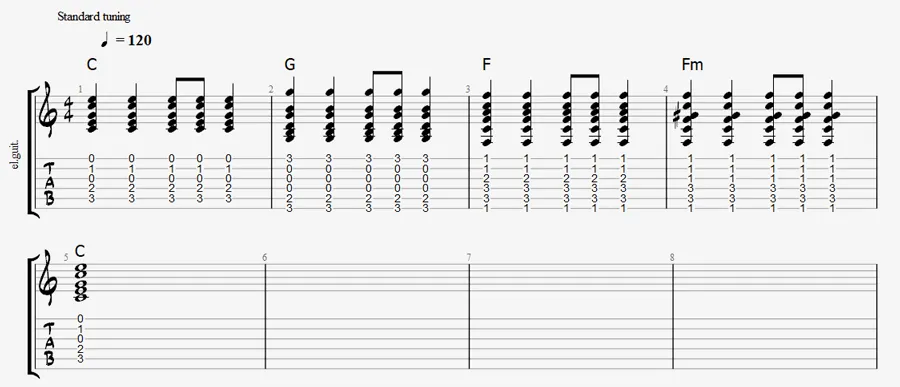
iv borrowed from the parallel minor key
In this example, we borrow the iv chord (F minor) from the parallel minor key.
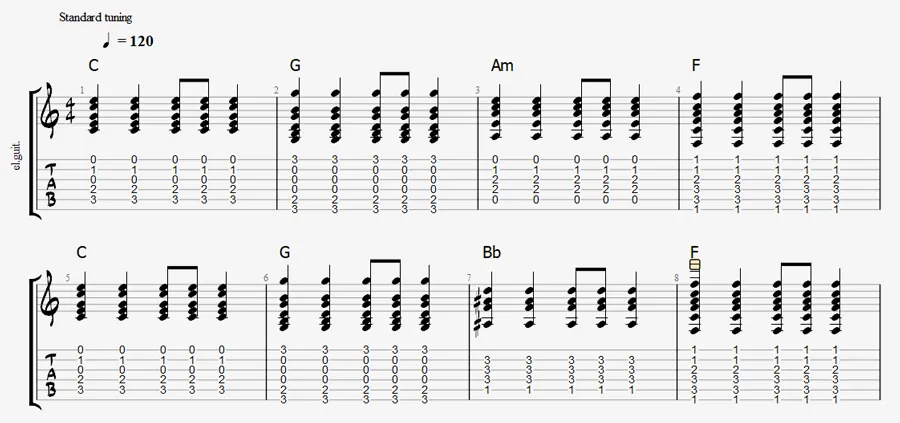
bVII borrowed from the parallel minor key
Bb is the bVII of the relative minor key; this is a common chord substitution often used in rock.
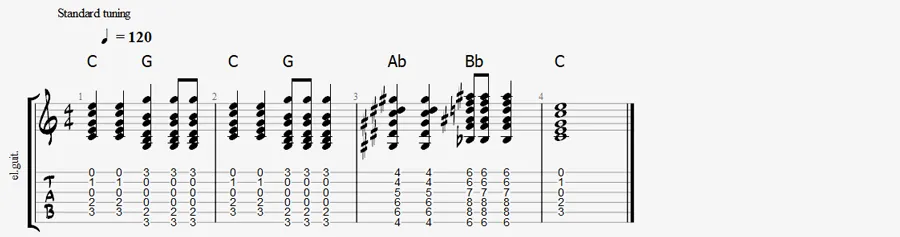
bVI and bVII borrowed from the parallel minor key
In this example, we borrow the bVI (Ab) and bVII (Bb), to create an escaping effect at the end of the progression.
Many famous songs use borrowed chords to create a unique listening experience.
Some Guidelines For Using Modal Interchanges In Your Songs
Modal interchanges are a tool nice to know, but beware, not every borrowed chord will work well. There are some guidelines to keep in mind when dealing with this stuff:
- To be sure that the tonal center is preserved, modal interchanges should be used only between diatonic chords.
- Pay attention to any clashes between the melody of the songs and the backing chords.
- Use modal interchanges as an ingredient to spice up things: don't overuse them.
- The Locrian mode is an unstable mode and rarely you'll borrow chords from it.
Modal Interchanges - Further Resources and Conclusions
In this post, we've covered the basics of modal interchanges, mixing chords of major and minor keys; now you can start experiment borrowing chords from the other modes, and using also seventh chords. I'm sure you'll be busy for quite some time.
In my complete ebook, 52 Chord Progressions | Learn How To Connect Chords and Create Great Songs, you'll find many progressions that use techniques like modal interchanges, modulation and chord substitution.
To stay updated on new resources, please subscribe here.
FAQ
What is a modal interchange and how does it differ from modulating to a new key?
A modal interchange is a songwriting technique where you borrow a chord from a parallel mode (a mode with the same root note but a different scale structure) into your current chord progression. The key difference from modulation is that with modal interchanges, you intentionally keep the original tonal center of your song, merely adding new harmonic 'colors' from a related mode rather than fully changing to a new key.
How do I identify which chords can be 'borrowed' for modal interchanges in my guitar progressions?
To identify borrowable chords, you look at the chords that naturally occur within the various parallel modes of your chosen key. For example, if you're in C Major, you can look at the chords built from C Dorian, C Phrygian, C Minor (Aeolian), etc. The article provides tables showing the Roman numeral and specific chord quality for each degree in different parallel modes, which serve as your palette for borrowing.
Are there certain modes or chord types that are more commonly borrowed from in modal interchanges?
Yes, it's very common to borrow chords from the parallel minor key (Aeolian mode) into a major key progression. Examples include the iv (minor four), bVI (flat six major), and bVII (flat seven major) chords. While theoretically you can borrow from any parallel mode, modes like Locrian are considered unstable, and chords from them are rarely borrowed in practice to maintain a stable sound.
What practical benefits do modal interchanges offer for guitar players in their songwriting?
Modal interchanges allow guitar players to 'spice up' their chord progressions by introducing fresh, unexpected harmonic nuances and emotional colors. This technique enables you to create more sophisticated and unique progressions, adding depth and interest to your songs without the complexity of a full key modulation. It expands your harmonic vocabulary significantly.