Jazz Chord Progression Workout
Practice The ii-V-I Chord Sequence Effectively
The ii V I chord progression is the foundation of Jazz and is an essential concept to practice if you want to enter in the Jazz realm.
In this lesson, I'm going to propose you a full workout that will help you play instinctively this important Jazz progression, and, at the same time, internalize a number of important chord shapes.
The final target of this practice is to see the ii-V-I progression as a whole chunk, instead of thinking about single chords.
What is the ii-V-I chord progression

The ii-V-I chord progression is a harmonic sequence commonly used in jazz and other genres of music.
It is built on the tonic (I), supertonic (ii) and dominant (V) chords of a major scale.
In the key of C major, for example, the progression would be Dm7-G7-Cmaj7.
The ii-V-I chord progression is used in various genres of music, including jazz, blues, rock, folk, and pop.
It is also used in many popular songs, such as "Autumn Leaves" by Nat King Cole, "All the things you are" by Oscar Hammerstein II, and "In a Mellow Tone" by Milt Gabler.
Benefits Of Learning a Progression as A Whole Chunk
Learning a chord progression as a whole chunk helps you to better understand how different chords fit together in a musical context.
This understanding is essential for being able to create effective musical phrases and transitions.
It also makes it easier to remember a particular chord progression, as you can recall the whole progression rather than individual chords.
This is useful for improvising or writing music, as you can quickly remember and play a certain progression.
Learning chord progressions as a whole chunk also helps to develop your ear and aural skills.
By playing and listening to a chord progression, you can become familiar with how it sounds and how each chord fits within the progression.
This helps you to better understand the harmonic language of music and how to use it effectively.
Chords Shapes For the ii-V-I Progression Workout
We want to practice the progression in all the keys, so we're going to use movable chords (without open strings) with root on the 6th, 5th and 4th strings.
This will help immensely expand your chord vocabulary.
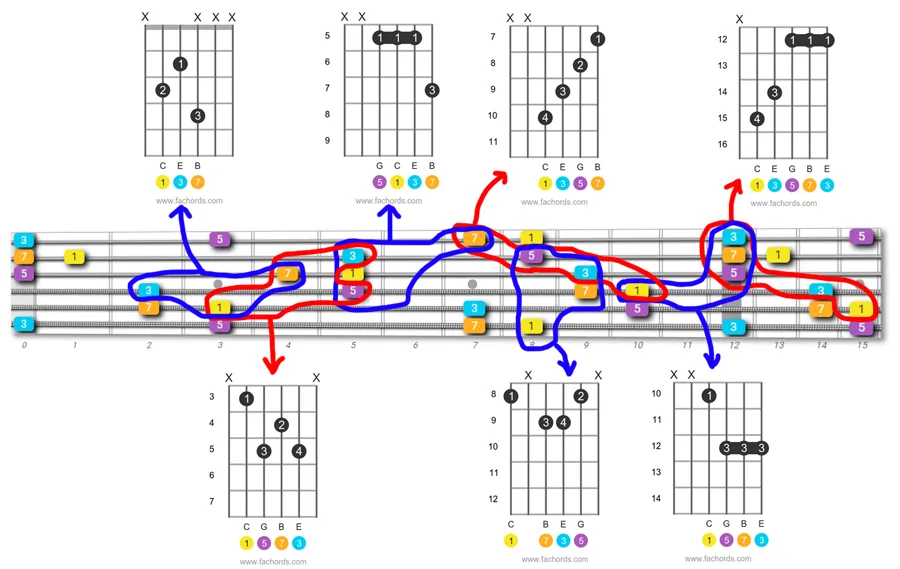
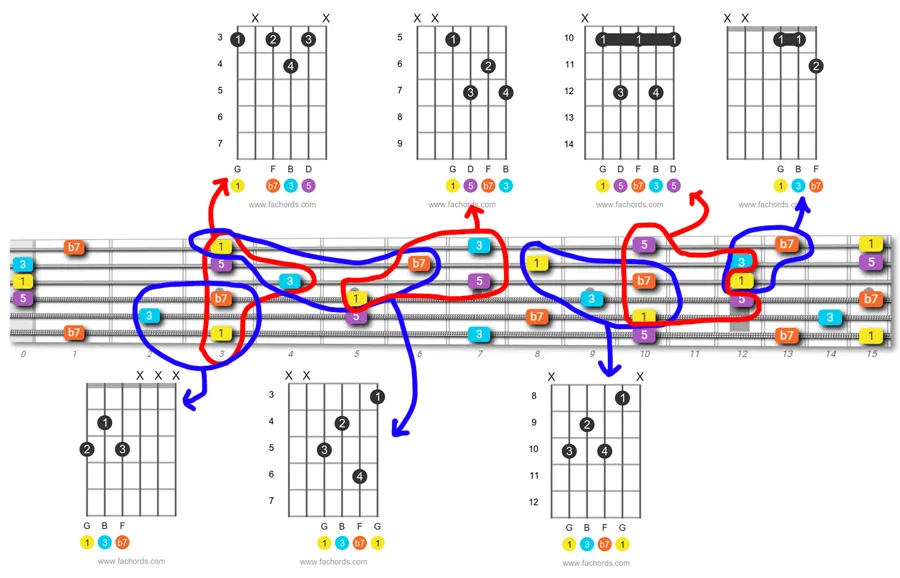
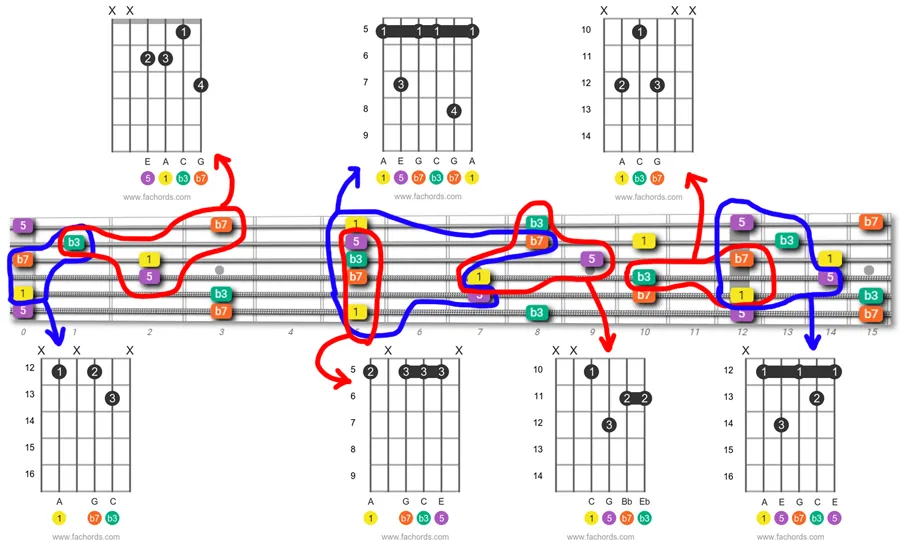
Below you find some fretboard maps with the chord tones and the corresponding chord shapes.
Please note that these fingerings are only a subset of the endless options you have, try to stick with them.
If you want to experiment your own shapes, be sure to include at least the root, the third and the seventh (you might want to have a look at my shell chords tutorial to learn more about this aspect).
Now we're going to take a look at the chord qualities we're dealing with.
Major Seventh Chord
A major seventh chord is a chord composed of four notes: the root note, the major third, the perfect fifth, and the major seventh.
It is often thought of as an extended version of a major triad, as it adds an extra note to the basic three-note structure.
The major seventh chord has a bright, uplifting sound and often creates a feeling of anticipation and resolution due to its dissonant nature.
Dominant Chord
A dominant chord is composed of a root, major third, perfect fifth, and minor seventh.
This type of chord is commonly used to create a sense of tension and instability, which can lead to a feeling of movement and resolution.
Minor Seventh Chord
A minor seventh chord is a musical chord consisting of a root note, a minor third, a fifth, and a minor seventh.
Jazz Chord Progression Workout
The workout is organized in the following way:

- We choose a fretboard area 5 frets wide. For example, from fret 5th to fret 9th (as the image above shows)
- We play the ii-V-I progression choosing chord shapes that allow us to remain in the selected area.
- We repeat the process following all the keys we encounter in the Circle of Fifths.
The constraint of staying between the selected frets forces us to use a different set of chord voicings for each key, helping us tremendously internalize chord shapes.
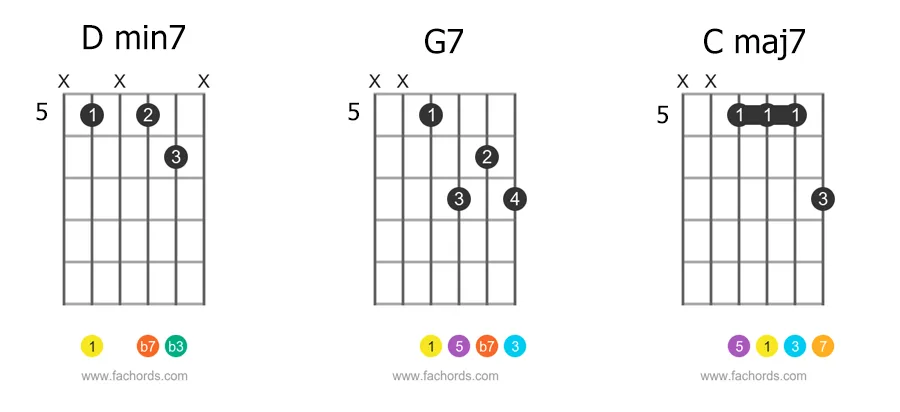
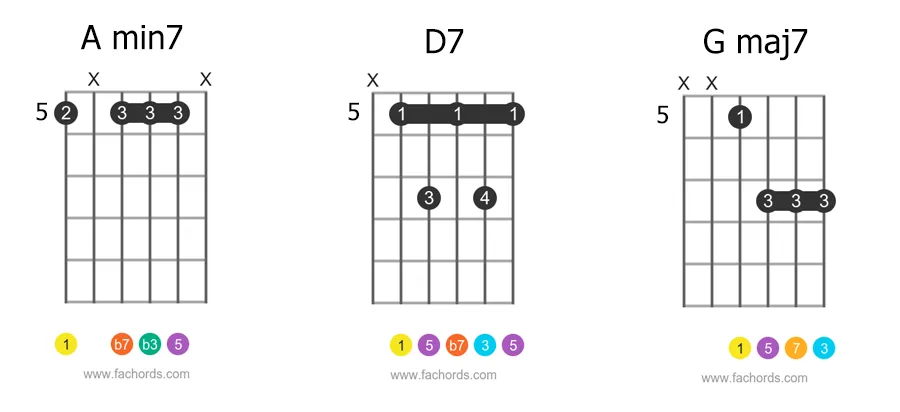
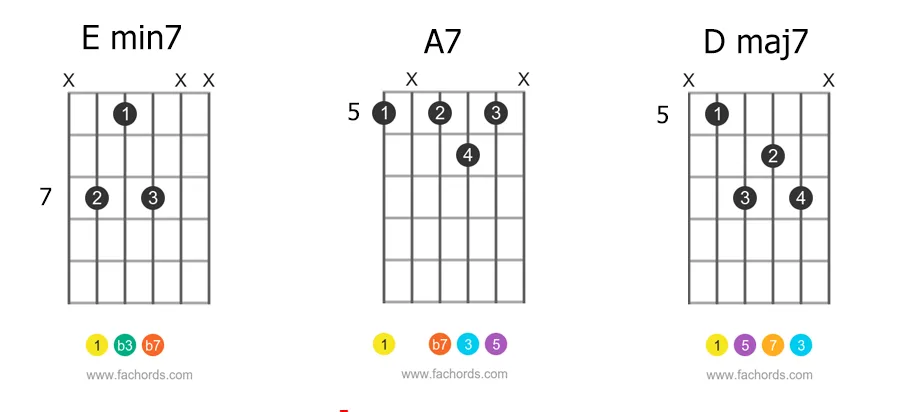
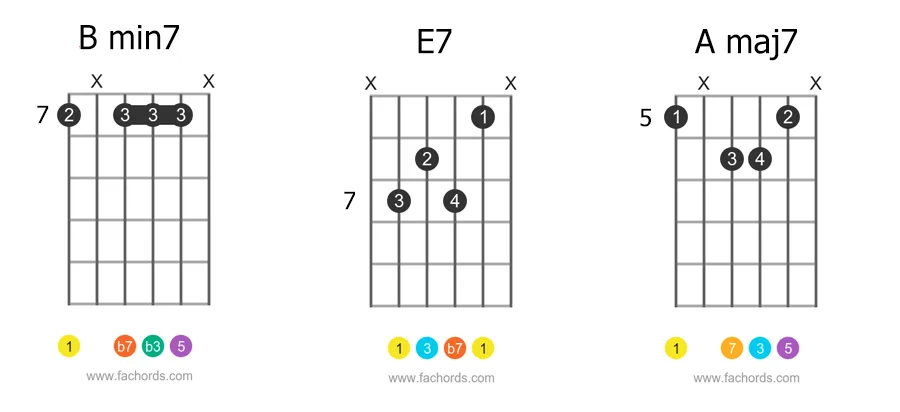
Here below you find all the chords for the ii V I progression in all the keys:
ii-V-I in the key of C
| Key | Bar 1 | Bar 2 | Bar 3 | Bar 4 |
|---|---|---|---|---|
| C | Dm7 | G7 | Cmaj7 | Cmaj7 |
ii-V-I in the key of G
| Key | Bar 1 | Bar 2 | Bar 3 | Bar 4 |
|---|---|---|---|---|
| G | Am7 | D7 | Gmaj7 | Gmaj7 |
ii-V-I in the key of D
| Key | Bar 1 | Bar 2 | Bar 3 | Bar 4 |
|---|---|---|---|---|
| D | Em7 | A7 | Dmaj7 | Dmaj7 |
ii-V-I in the key of A
| Key | Bar 1 | Bar 2 | Bar 3 | Bar 4 |
|---|---|---|---|---|
| A | Bm7 | E7 | Amaj7 | Amaj7 |
ii-V-I in the key of E
| Key | Bar 1 | Bar 2 | Bar 3 | Bar 4 |
|---|---|---|---|---|
| E | F#m7 | B7 | Emaj7 | Emaj7 |
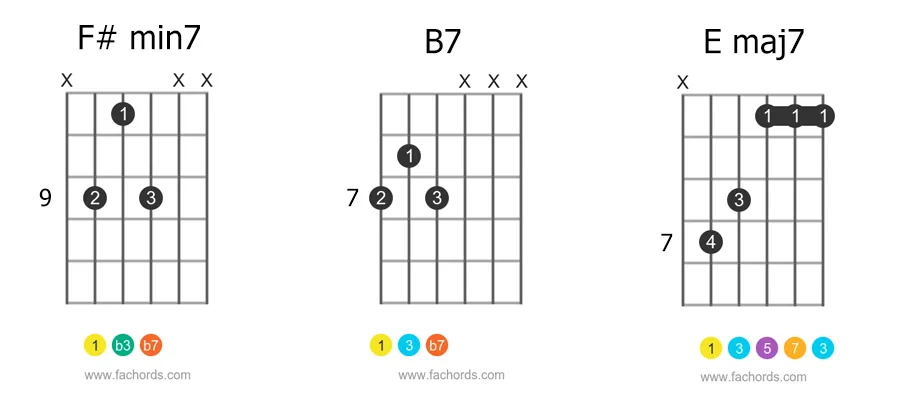
ii-V-I in the key of B
| Key | Bar 1 | Bar 2 | Bar 3 | Bar 4 |
|---|---|---|---|---|
| B | C#m7 | F#7 | Bmaj7 | Bmaj7 |
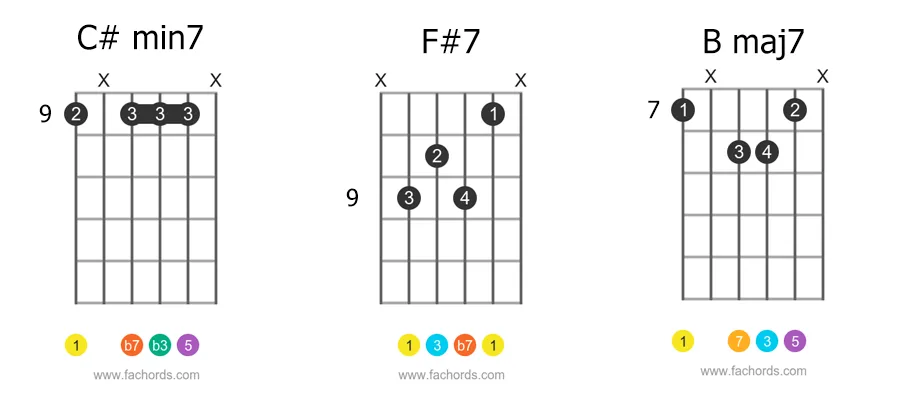
ii-V-I in the key of F#
| Key | Bar 1 | Bar 2 | Bar 3 | Bar 4 |
|---|---|---|---|---|
| F# | G#m7 | C#7 | F#maj7 | F#maj7 |
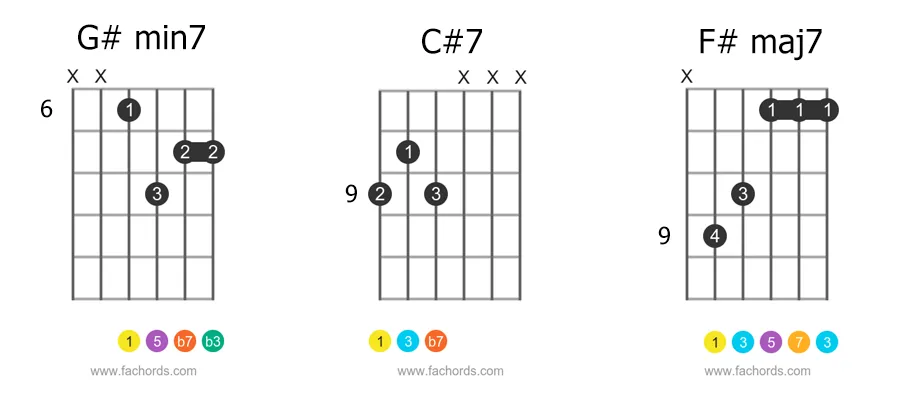
ii-V-I in the key of C#
| Key | Bar 1 | Bar 2 | Bar 3 | Bar 4 |
|---|---|---|---|---|
| C# | D#m7 | G#7 | C#maj7 | C#maj7 |
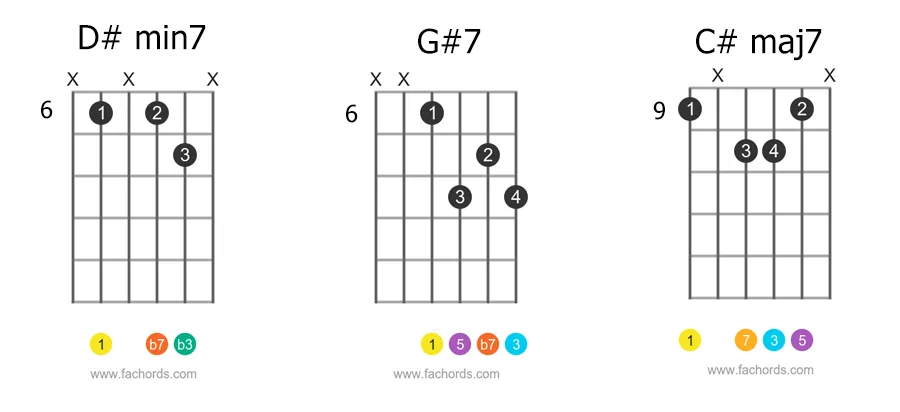
ii-V-I in the key of G#
| Key | Bar 1 | Bar 2 | Bar 3 | Bar 4 |
|---|---|---|---|---|
| G# | A#m7 | D#7 | G#maj7 | G#maj7 |
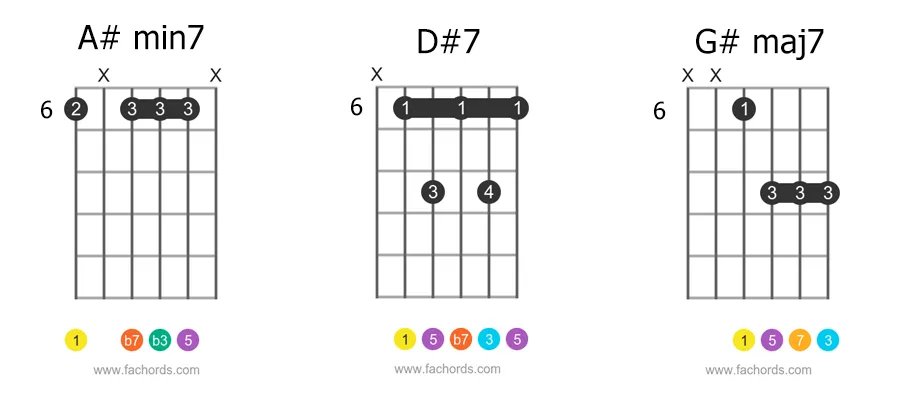
ii-V-I in the key of D#
| Key | Bar 1 | Bar 2 | Bar 3 | Bar 4 |
|---|---|---|---|---|
| D# | E#m7 | A#7 | D#maj7 | D#maj7 |
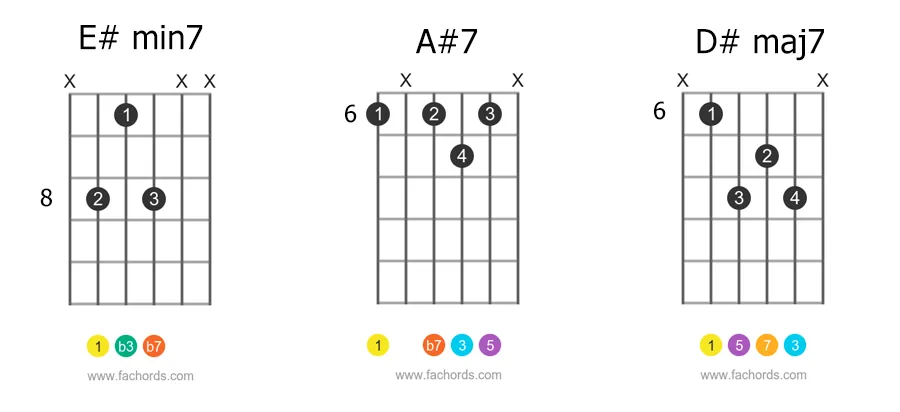
ii-V-I in the key of A#
| Key | Bar 1 | Bar 2 | Bar 3 | Bar 4 |
|---|---|---|---|---|
| A# | B#m7 | E#7 | A#maj7 | A#maj7 |
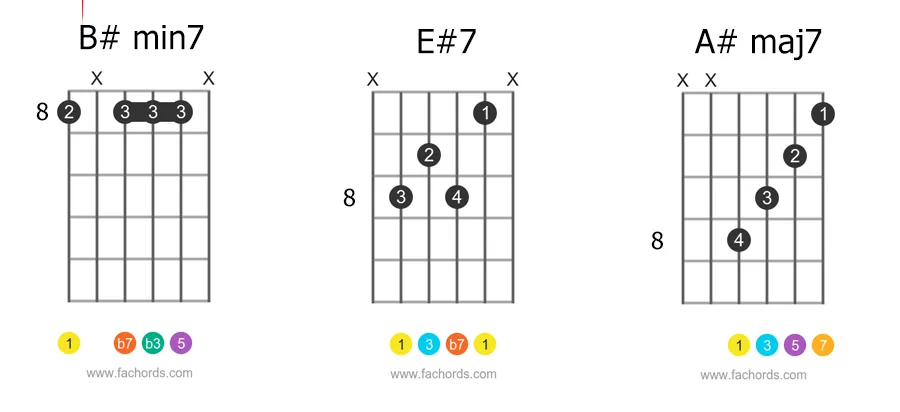
ii-V-I in the key of F
| Key | Bar 1 | Bar 2 | Bar 3 | Bar 4 |
|---|---|---|---|---|
| F | Gm7 | C7 | Fmaj7 | Fmaj7 |
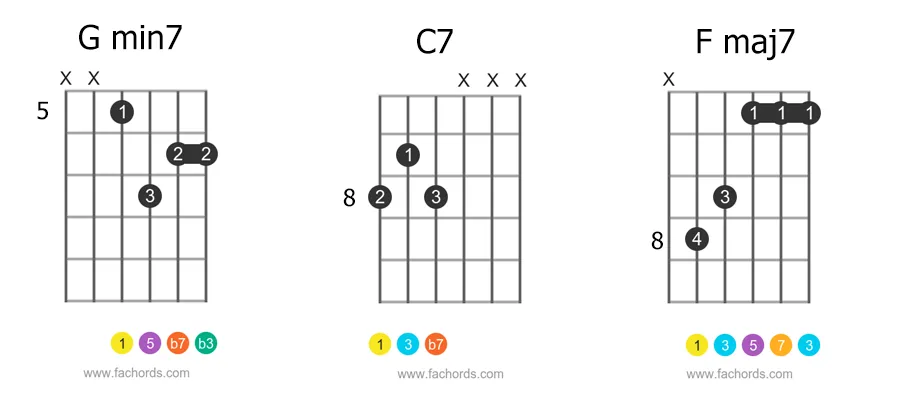
Jazz Progression Workout - Conclusion
Ok, now you have some material to work on.
It's important that you follow all the keys, even the strangest (wonder how an E# can exist? Check the enharmonics tutorial).
Once you have this stuff under your belt, we will proceed to the minor version of this progression, and learn how to solo over those chords.
But for now, be sure to practice these progressions and other jazz progression types. To stay updated, subscribe here, thanks!
FAQ
What is the 'ii-V-I' chord progression and why is it considered fundamental in jazz?
The ii-V-I (pronounced 'two-five-one') is a harmonic sequence built on the second (supertonic), fifth (dominant), and first (tonic) chords of a major scale. For instance, in C major, it's Dm7 (ii)-G7 (V)-Cmaj7 (I). It's fundamental in jazz because it creates a strong sense of tension and resolution, forming the backbone for countless jazz standards and improvisational approaches.
How does learning the ii-V-I as a 'whole chunk' rather than individual chords improve my guitar playing?
Learning the ii-V-I as a whole chunk means you perceive and play it as a single musical idea, not three separate chords. This approach helps you better understand how chords flow together harmonically, makes the progression easier to remember for improvisation or composition, and significantly develops your ear by familiarizing you with its distinct sound and function within a musical context.
Why does the workout emphasize using movable chord shapes with roots on the 6th, 5th, and 4th strings?
Using movable chord shapes (those without open strings) allows you to transpose the ii-V-I progression to any key across the fretboard easily. Focusing on roots on the 6th, 5th, and 4th strings provides a systematic way to learn multiple voicings for each chord type, greatly expanding your chord vocabulary and comprehensive fretboard knowledge.
What is the primary musical function and sound characteristic of each chord type in a major ii-V-I progression?
The minor seventh (ii-7) chord initiates the progression, often creating a mild tension or sense of beginning. The dominant seventh (V7) chord is the main source of tension; its inherent dissonance creates a strong pull towards resolution. The major seventh (Imaj7) chord provides the final resolution, offering a bright, uplifting, and stable sound that signifies arrival at the tonal center.
What is the benefit of restricting the chord shapes to a 5-fret wide area during the workout?
This restriction is a powerful pedagogical tool. It forces you to discover and utilize different chord voicings for each key that fit within that specific fretboard 'neighborhood.' This process deepens your understanding of how various chord shapes can be constructed and connected across the guitar neck, rather than relying on a single, familiar shape for each chord.
Why does the workout include so many different keys, even less common ones, and how should I approach them?
The workout includes all keys, organized by the Circle of Fifths, to ensure comprehensive fretboard mastery and full internalization of the ii-V-I progression. Practicing in every key, regardless of its perceived commonality or sharp/flat spelling, builds complete fluency, strengthens your ability to transpose, and prepares you for any musical situation you might encounter on the guitar. Approach them systematically, key by key, focusing on maintaining the 5-fret area constraint for each.