All About Hybrid Scales
Mixing Scales For New Colours
If your melodies or guitar soloing are getting a little repetitive you can always try some new hybrid scales.
The good news is that composite or hybrid music scales are just mixtures of other scales we have dealt with in the past, usually tied together because of the same root.
Here are some of the more popular hybrid scales and ways in which you can use them.
While you may not know much about hybrid scales, you are familiar with them as a lot of jazz and rock songs have them.
That is one reason it is difficult to analyze modern pop through the lens of older music theory, as they often do not follow the predictable patterns.
In many cases the major and minor scales are mixed over a variety of chord progressions.
This is why it is common to see arguments over what modes or scales are in many popular jazz or rock tunes!
Another fundamental aspect of rock, jazz, and all related genres are that blue notes and chromatic movement are essential.
The vibe the movement gives the listener comes from how we flatten certain notes in a scale.
Major Scale: 1 2 3 4 5 6 7
Minor Scale: 1 2 b3 4 5 b6 b7
In a normal major scale the notes to flatten are the b3, b5, and b7, these are the blue notes, and one of the most common blues scales uses all three.
Blues Scale: 1 b3 3 4 b5 5 b7
As we can see this scale drops the b6 from the minor scale and has a b5.
Our goal with hybrid scales is to mix these blue notes in but it must be at the right time. When playing a regular scale it is usually safe to play most of the notes in it within your song or solo.
However once we add hybrid notes we have to start being a little pickier where we place them.
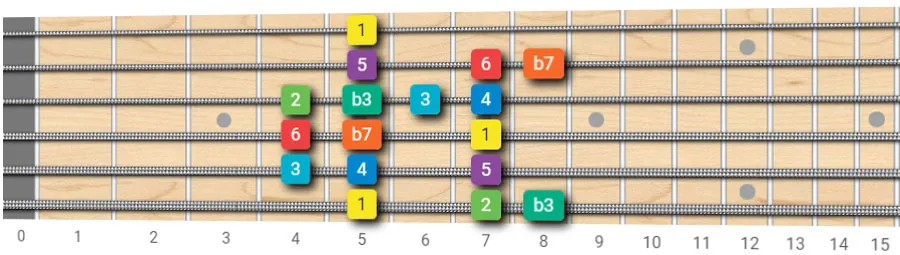
Major/Minor Pentatonic Hybrid Scale
The Major Pentatonic: 1 2 3 5 6
The Minor Pentatonic: 1 b3 4 5 b7
Major/Minor Pentatonic Hybrid Scale: 1 2 b3 3 4 5 6 b7
This scale usually works over major key and common chord progressions like the I-IV-V or variations of I-V-vi-IV.
This will be the usual hybrid scale to come across. Once we take those chord progressions and start adding in b3 and b7 it starts to sound more bluesy, jazzy, and rocking.
Play the progression of C-Am-F-G plain and then start adding a b3 (Eb) and b7 (Bb) note changes in and it will give the chord progression a much livelier feel.
Thousands of rock songs use this hybrid scale, most often you see it as an added V7 chord.
Mixolydian Blues Scale
Mixolydian Scale: 1 2 3 4 5 6 b7
Blues Scale: 1 b3 3 4 b5 5 b7
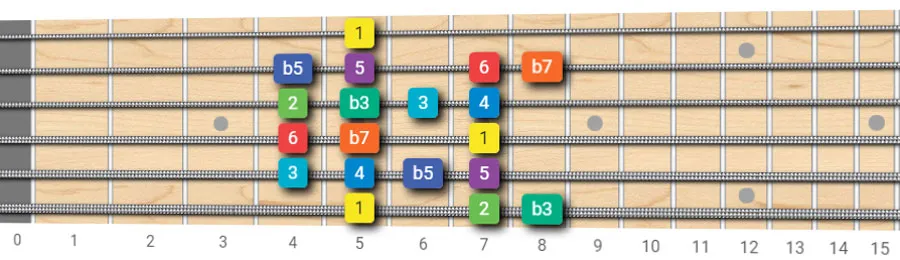
Mixolydian Blues Hybrid Scale: 1 2 b3 3 4 b5 5 6 b7
The Mixolydian is one of the most common scales or modes used in rock and pop, as it mostly provides a major uplifting vibe, but with the flattened 7th.
It will use the same chord progressions above but also with minor substitutions like the v for V.
When we add the blues scale note b5 in, it allows us to have progressions like I-v.
The b5 will give it more chromaticism, so more feeling and movement than the previous hybrid scales.
These are common in rock songs that use the I-b7-IV or other variations, sometimes they just use the simple I-IV and include b7 and b3’s notes over it.
That’s one way rock keeps such a repetitive song going without it feeling that way, with the added tension of the new blue notes it seems like more is happening.
These Mixolydian and blues mixtures are regular in funk hits and those with a minor feel.
These could even be used to make a jazzy ii-V-I seem more bluesy.
Hybrid Scales: Conclusions
If you notice when you make a hybrid blues scale out of the Dorian (which is 1 2 b3 4 5 6 b7) and Mixolydian modes you will end up with the same overall notes.
That is why there is often so much overlap and argument over the modes of certain rock songs.
In most cases these songs were written by artists unfamiliar with music theory so they were just going with what sounded good!
Even though these are all similar scales it is important to listen to the times that they do and do not work.
If your song has an overall major feeling then the simple pentatonic and blues will mix fine, but if you are playing in a minor key some of those pentatonic notes may sound harsh over certain chords.
The best way to practice is to simply pick a key and common progression and just add in b3, b5, b7 notes in places where they sound good.
Of course you can mix other note sequences together to make your own hybrid scales for guitar.
Just remember to keep a similar root and that it will take a little more practice to see which notes work over the right chords.
Hybrid scales bring more variety into the music, so that usually means a little bit of complication.
Just remember when playing or soloing over chords to use the right composite notes with it, and that it will take trial and error and practice.
To stay updated, subscribe here.

Created by
Giancarlo is a musician (teaching guitar since 2000), software engineer, AI consultant and published researcher
FAQ
What is the main purpose of using hybrid scales in guitar playing?
Hybrid scales are primarily used to add new melodic and harmonic 'colors' to your guitar solos and melodies, helping to prevent repetition. By mixing elements from familiar scales, they introduce a fresh, often bluesy, jazzy, or rocking feel to your music.
How do 'blue notes' specifically contribute to creating hybrid scales?
Blue notes, specifically the b3, b5, and b7, are essential for hybrid scales because they introduce crucial chromatic movement and a distinctive 'vibe.' Strategically incorporating these flattened notes into major or minor scale frameworks is how you create the unique bluesy, jazzy, or rock characteristics of hybrid scales.
When is the Major/Minor Pentatonic Hybrid Scale most effective for guitarists to use?
This hybrid scale is highly effective when playing over major key chord progressions, such as I-IV-V or I-V-vi-IV. By adding the b3 and b7 notes, it instantly imparts a bluesy, jazzy, or rocking feel, commonly found in thousands of rock songs, especially over V7 chords.
What musical effect does the b5 (flat five) typically add when used in a Mixolydian Blues Hybrid Scale?
Adding the b5 note to the Mixolydian scale to form a Mixolydian Blues Hybrid primarily increases chromaticism in your playing. This added chromatic movement creates more tension, feeling, and overall melodic interest, often facilitating progressions like I-v and contributing to a 'funk' or 'minor feel' sound.
Can I create my own hybrid scales by combining different notes and scales?
Yes, you are encouraged to experiment and create your own hybrid scales by mixing different note sequences. The key is to maintain a consistent root note across the scales you combine. Be aware that this process requires trial and error and significant practice to discover which specific notes sound good and work effectively over various chord progressions.
