Guitar Strings Explained
The complete guide for acoustic and electric guitar strings
When it comes to stringed instruments students aren't often taught just how important the strings are . In some cases good strings can make a cheaper instrument sound better, that is how great of an effect they can have.
In this article we will go over some of the basics on strings for acoustic and electric guitars.
Which material is good for guitar strings?
Depending on the material, strings will have a specific effect on the sound. However just like the wood used there are always multiple factors involved in the final sound we get from our guitar.
Difference between acoustic and electric guitar strings
Before we mention specific materials stop and think about the difference between an acoustic and electric guitar.
The acoustic is light hollow wood that relies on a large string to be plucked so the sound can carry. While the electric wood is solid and needs to pick up a magnetic signal from vibrating strings so that it can amplify the sound.
These major differences make for very different strings.
Classical and Acoustic Guitar Strings
Original guitars used guts , literally animal intestines . You can still buy gut if you want, but it is expensive and honestly modern tech sounds better! These days they have nylons and other fluorocarbon plastics to take the place of gut.
Classical guitars cannot handle much tension so you must use nylon strings .
That's why classical is a great beginner guitar because it is easier on the fingers!
Acoustic guitars can handle more tension because they have more bracing. It is common for them to have steel strings ; however the steel is wrapped in brass or bronze (referred to as phosphor bronze). Brass is usually brighter in sound.
Electric Guitar Strings
Electric guitar strings are mostly made of steel and/or nickel , often the core being steel, and the thicker strings being wrapped in nickel.
The steel makes for a bright sound while the nickel enhances the lower tones.
Roundwound vs Flatwound
Other important terms to know are roundwound vs flatwound , which are named based on how the strings are formed.
- A roundwound string is made by wrapping a wire around a metal core, to get the right thickness.
- A flatwound string has the winding around the core flat.
Most strings are roundwound but many jazz players prefer flatwound , for the warmer tone. However, flatwound strings are more difficult to bend because they have less grip.
The construction difference can be seen here:
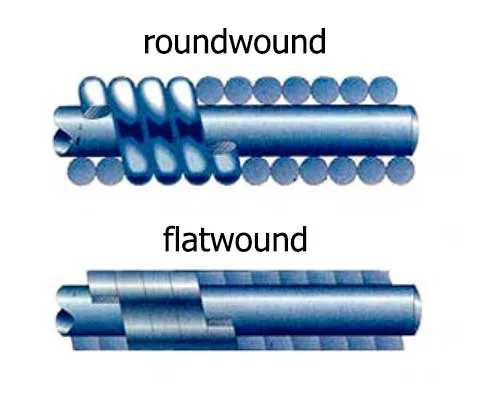
Image courtesy of Fender
Sometimes you will also see strings with or without coating. Which means the metal is coated in some modern space age polymer. Coated strings are a matter of personal preference that you have to play and hear to know if you will like them.
Guitar string gauge sizes (*)
It's important to know that acoustic guitar string gauges are not the same as for electric guitars. A light gauges on acoustic is 12s , while on electric is 10s , have a look at the tables below:
* Guitar string gauge (or diameter) is denoted in thousandths of an inch. ( 0.001 inches = 0.0254 mm ) For example, a 13s gauge string is 0.013 inches or 0.3302 mm.
Electric Guitar Strings Gauges
| Gauge | E high | B | G | D | A | E low |
|---|---|---|---|---|---|---|
| Super Extra Light | 8 | 10 | 15 | 21 | 30 | 38 |
| Super Light | 9 | 11 | 16 | 24 | 32 | 42 |
| Light | 10 | 13 | 17 | 26 | 36 | 46 |
| Medium | 11 | 15 | 18 | 26 | 36 | 50 |
| Heavy | 12 | 16 | 20 | 32 | 42 | 56 |
Acoustic Guitar Strings Gauges
| Gauge | E high | B | G | D | A | E low |
|---|---|---|---|---|---|---|
| Super Extra Light | 10 | 14 | 23 | 30 | 39 | 47 |
| Super Light | 11 | 15 | 23 | 32 | 42 | 52 |
| Light | 12 | 16 | 25 | 32 | 42 | 54 |
| Medium | 13 | 17 | 26 | 35 | 45 | 56 |
| Heavy | 14 | 18 | 27 | 39 | 49 | 59 |
The gauge is simply the thickness of the string and of course the thicker the string the harder it is to play ! Acoustic guitars have thicker gauges for a fuller sound and are harder to press down. An electric has smaller gauges for light as a feather touch and fast playing. It is actually good hand strength practice to play acoustic if your main guitar is electric. When you start playing that electric again it feels like nothing!
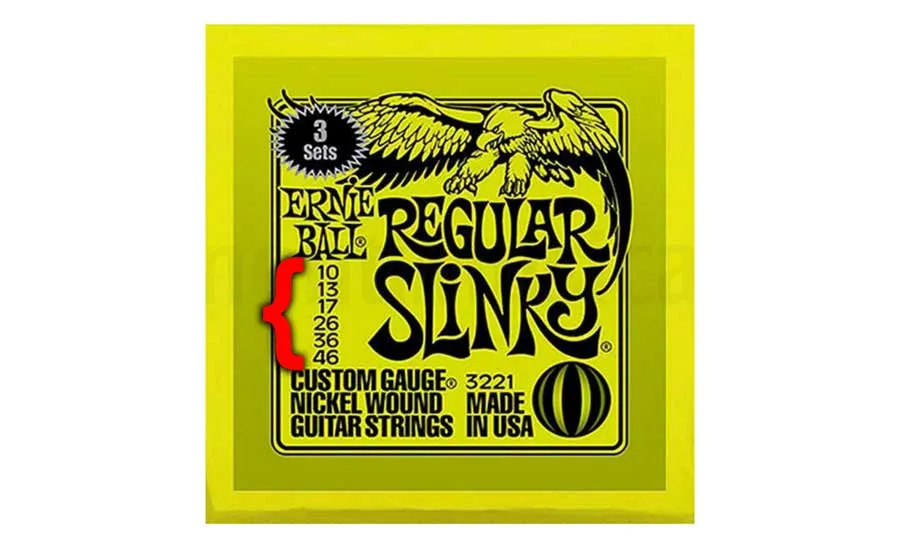
Guitar string packs are identified by the thinnest string (E high string), for example "A 10s guitar strings pack":
 >
>
What is the thickest and thinnest guitar string gauge available?
The thinnest gauge is .008 inches (8s on electric guitar) and the thickest is .059 inches (56s on acoustic guitar)... Wow! it is wise to stay away from both extremes. (Of course the genre of music you like will be a factor in the thickness too).
How often should you change guitar strings
When to change your strings will be up to you, but every six months to a year is generally fine. If you like to experiment with new sounds, try new brands as often as you like. If you buy a guitar and it doesn't come set up with nice strings it is advised to put a new and better set on. Don't be cheap with strings , they will make a huge difference in your sound.
Here you find an easy tutorial on how to change strings.
Is there anything to revitalize guitar strings?
While there are a number of urban legends on revitalizing strings the reality is you have to keep them clean from day one . If you come across an old instrument don't even attempt to keep the strings, instead replace it with something similar and new. Depending on the string material you will always want to keep it wiped down with the appropriate cleaner. You should already be wiping your fretboard down often , so the strings should be cleaned too.
If you absolutely have no choice but to use old strings, well sometimes it happens. But in general don't attempt to reuse old strings. If you really want to recycle and reuse your old metal guitar strings you can always do something creative like guitar string jewelry !
The biggest limitation on changing strings is usually instrument build and string gauges. Of course you now know if you put steel strings on a classical that it will break it ! But there is more to it than material. If you try to put a string gauge in the nut that doesn't fit you will change the guitar intonation.
What type of guitar string should beginners use?
On an electric guitar, the best strings for beginners are nickel wound and with gauge 10-36 (light gauge).
With acoustic guitars, bronze strings are good for novices, with a size of 12-46 (light gauge)
Using a light gauge helps beginners because less strength is required to press frets, especially with bar chords .
Guitar Strings Used by Famous Players
Even though you now have the basics of guitar strings down, it still can be a little confusing so look to your heroes for help . Just like using a similar guitar model of the greats you can also use the same strings. In many cases well-known guitar players have their own line of strings . And even though they aren't all the best quality at least it gives you a starting point.
Stevie Ray Vaughan strings gauge: 13s!
 Stevie Ray Vaughan was known for using real thick gauges. Many electric guitar players used to use a 10s, or 11s for the high E, Stevie used 13s! Yikes, that's a big string gauge.
Other
famous guitarists that used heavy gauges are
Joe Bonamassa
,
James Hetfield
,
Dick Dale
, and
Jeff Beck
.
Stevie Ray Vaughan was known for using real thick gauges. Many electric guitar players used to use a 10s, or 11s for the high E, Stevie used 13s! Yikes, that's a big string gauge.
Other
famous guitarists that used heavy gauges are
Joe Bonamassa
,
James Hetfield
,
Dick Dale
, and
Jeff Beck
.
Joe Satriani, Steve Vai, Yngwie Malmsteen: lighter strings
 And some artists that preferred light gauge strings are Joe Satriani,
Steve Vai
,
Yngwie
Malmsteen
, and
Frank Zappa
. If you notice both light and heavy gauges are used in the same
genres.
And some artists that preferred light gauge strings are Joe Satriani,
Steve Vai
,
Yngwie
Malmsteen
, and
Frank Zappa
. If you notice both light and heavy gauges are used in the same
genres.
Some people argue that gauge means a better tone , but clearly some famous guitarists prove them wrong . Strings of all sizes and materials can have multiple uses.
Guitar Strings - Bottom Line
This ends our post on guitar strings. We've seen the differences between acoustic and electric strings , the various gauges, and how they are denoted, plus some tips on how to choose strings and their correct maintenance.
At the end of the day it is up to you to play what you like.
If you find the small steel gauges are breaking easy, move up a number. If you notice your acoustic sounds better with phosphor bronze compared to brass, then pick strings with more of the former.
Just make sure when trying new strings the nut and build can handle them. Over time you will find a set that makes your guitar sing!

Created by
Giancarlo is a musician (teaching guitar since 2000), software engineer, AI consultant and published researcher
FAQ
What are the key material differences between acoustic and electric guitar strings?
Acoustic and electric guitars require different string materials due to their construction. Classical guitars use nylon or fluorocarbon plastics, while steel-string acoustics typically use a steel core wrapped in brass or bronze (like phosphor bronze). Electric guitars primarily use steel and/or nickel, often with a steel core and nickel wrapping on thicker strings, to produce a magnetic signal for amplification.
How do 'roundwound' and 'flatwound' strings differ, and what are their sonic characteristics?
Roundwound strings are made by wrapping a round wire around a metal core, resulting in a brighter sound. Flatwound strings have a flat winding around the core, which produces a warmer tone and is often preferred by jazz players. Flatwound strings also tend to be more difficult to bend due to less grip.
What does 'string gauge' mean, and how does it affect how a guitar plays and sounds?
String gauge refers to the thickness or diameter of the string, measured in thousandths of an inch. Thicker gauge strings generally produce a fuller sound but are harder to press down, requiring more finger strength. Thinner gauge strings are easier to play and allow for faster playing, often resulting in a lighter feel and sometimes a brighter sound.
Why are lighter gauge strings recommended for beginner guitarists?
Lighter gauge strings are recommended for beginners because they require less strength to press down on the fretboard. This makes it easier to form chords, especially bar chords, and helps new players develop finger strength and technique more comfortably without unnecessary strain.
How often should I change my guitar strings, and is it possible to 'revitalize' old strings?
You should generally change your guitar strings every six months to a year, or more frequently if you play often. While some 'urban legends' exist about revitalizing strings, the reality is that old strings cannot truly be restored. It's best practice to keep strings clean from day one by wiping them down regularly and to replace them with a new set when they become dull or worn.
Can I use any type or gauge of strings on any guitar?
No, you cannot. Instrument construction limits string choice; for example, putting high-tension steel strings on a classical guitar, which is designed for lower-tension nylon, will likely damage it. Additionally, the string gauge must fit properly within the nut slots; using strings that are too thick or thin for the nut can negatively impact the guitar's intonation.
