Guitar Intervals Exercises Tool
Fretboard Cyber Trainer: the best way to learn guitar intervals
If you want to really understand the guitar fretboard , you must first learn intervals. The guitar is an instrument strongly based on geometry and visual shapes , and fretboard intervals are the foundation of chords construction . We have created an interactive learning software that helps you learn and memorize the guitar intervals : FaChords Fretboard Cyber Trainer.
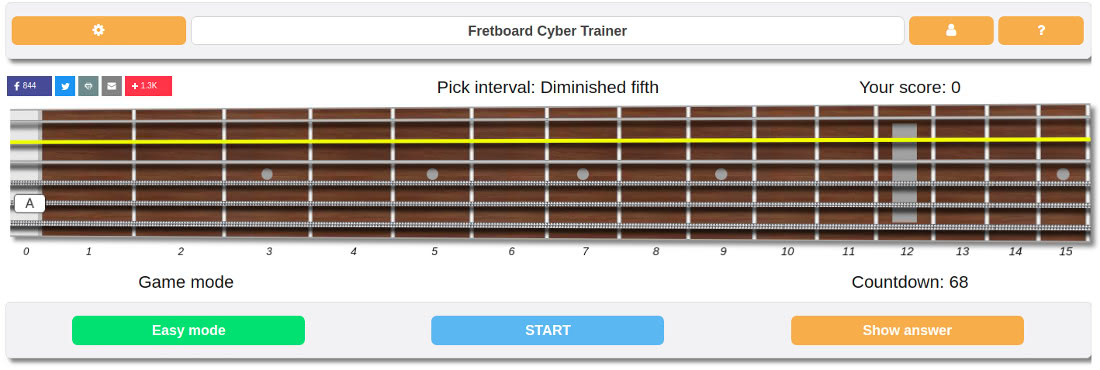
Introducing The Fretboard Intervals Trainer
The Fretboard Cyber Trainer is a guitar learning software that allows you to practice intervals geometry directly on the fretboard . You'll be tested on different interval types, all along the fretboard. Beware, at first, this process is really difficult and if you never practice this topic, it can be a bit frustrating. That's the reason why the tool comes with an easy mode option , in which you can practice at your own pace only a limited set of interval types. With time, little by little, you'll master all the intervals.
Easy Mode, practice one interval type at a time

With the easy mode, you can set which intervals to practice . If you are at the beginning, you should start with octave intervals only, then add the fifths, the fourths and so forth. The important thing is to focus on one interval type at a time , and progress to the next only once you're done with the previous.
Game Mode, only if you have some intervals knowledge

In the game mode, you'll be tested on all the interval types. You'll have 100 seconds in which you have to guess as many as possible correct answers. If your answer is right, you get 1 point, if it's not, your score will be decreased by 1 point. There is a leaderboard with the top players, this helps you stay focused and motivated.
Use the Show Answer Button to learn faster
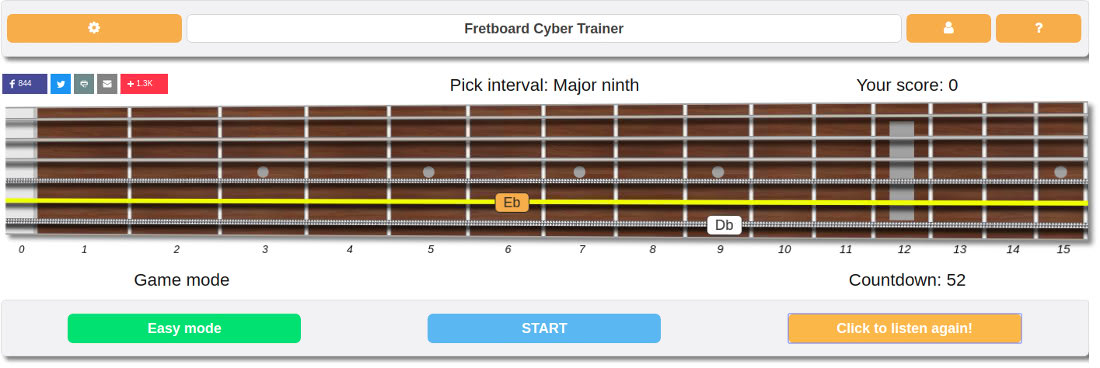
The show answer button reveals the correct answer without any penalty . Use this feature when you have no idea of the right answer and you don't want to give random guesses.
7 Strings Guitars, Bass, Banjo, Mandolin, left-handed view
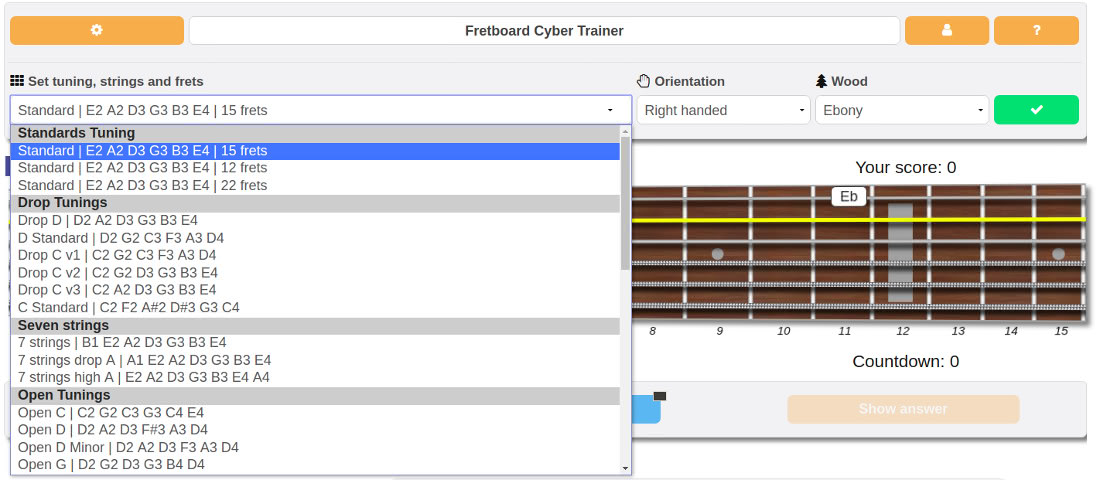
Like with the other guitar learning software available on this site, in the settings panel you can select the tuning you like: alternate tunings, 7 string guitar , mandolin, bass, violin, banjo, whatever. If you don't find a tuning you need, just send us a message and we'll add it. For left-handed guitar players, there's the possibility to change the view to a left orientation .
What are intervals
In music, an interval is a distance between two pitches . Depending on the size of this distance, the intervals have different names: seconds, thirds, fifths, octaves, and so forth, we'll see this later in detail. How all this stuff applies to the guitar fretboard? Well, on the fretboard, an interval is the distance (in pitches) between two frets, simply as that. For example, the interval between the C note on the 3rd fret of the A strings and the G note on the 5th fret of the D string is a perfect fifth .
Why intervals on guitar are not easy at the beginning
One of the problems that beginners experiment in learning fretboard intervals, is the fact that the same note is located on multiple frets . For example, the C note could be found on the 8th fret of the E low string, but also on the 3rd fret of the A string. Having multiple options at first is confusing, but actually, this gives guitarist a great expressive power .
On the contrary, on the piano keyboard , is easier to see intervals because the piano has an horizontal layout , with lower pitches on the left and higher pitches on the right. We already discussed the fretboard layout in the guitar fretboard theory tutorials series, I strongly recommended to check it out.
Intervals types
On the guitar, we can safely express the distance between two pitches in terms of semitones, or half-steps, or frets. These are the same thing with different names.
1 semitone = 1 half-step = 1 fret
Now let's have a look at the main different interval kinds:
2 semitones (e.g. C - D)
4 semitones (e.g. C - E)
5 semitones (e.g. C - F)
7 semitones (e.g. C - G)
9 semitones (e.g. C - A)
11 semitones (e.g. C - B)
12 semitones (e.g. C - C higher)
A good exercise for familiarizing with these intervals is to play them on different strings . Use the C note at the 8th fret of the lower E strings as the starting root, and play the intervals above on different strings. If you don't know the notes of the fretboard, you should use the fretboard notes trainer to memorize them in a short time. Listen carefully to the sound and notice the differences in feeling and colors. Each interval has its own unique sound.
Other Intervals Types
There are some strangeness in classical music theory, and intervals names are one of those. If we raise or lower a given interval by one or 2 steps, we get a new interval type, that, depending on the original step, assumes different names. Let's see the main types in details:
By lowering a Major Second by 1 half-step, we get a Minor Second:
1 semitone (e.g. C - Db)
By lowering a Major Third by 1 half-step, we get a Minor Third:
3 semitones (e.g. C - Eb)
If we lower a Perfect Fourh by 1 half-step, we get a Diminished Fourth. Apparently, there is something strange here. A Diminished Fourth has the same distance as a Major Third (4 semitones), so it has the same sounds. Why then it has a different name? Well, we have just stumbled on an enharmonic , that means the same sound with different names (like C# and Db). This topic is really important for harmony, chords construction and tonic centers; we're not going to discuss this thing here, as it's a complex subject that deserves a full tutorial.
4 semitones (e.g. C - Fb)
Raising a Perfect Fourth by 1 semitone we get an Augmented Fourth
6 semitones (e.g. C - F#)
If we lower a Perfect Fifth by 1 semitone we get a Diminished Fifth. Again, same distance of an Augmented Fourth, but different names.
6 semitones (e.g. C - Gb)
By lowering a Major Sixth by 1 semitone, we get a Minor Sixth.
8 semitones (e.g. C - Ab)
Finally, a Minor Seventh is obtained by lowering a Major Seventh by 1 half-step
10 semitones (e.g. C - Bb)
And a Diminished Seventh is obtained by lowering a Major Seventh by 2 half-step. Yes, same distance of a Major Sixth
9 semitones (e.g. C - Bbb)
How to use Intervals
Once you have guitar intervals under your belt, you might wonder how to apply this knowledge to real music . First of all, congratulations, you've just made a huge step forward in your musicianship. Now you can create chords on the fly, without relying on fixed, brute-force memorized shapes.
For example, suppose you want to play a C major chord . You know that the C major chord is composed of the root, a major third, and a major fifth. Well, with your intervals knowledge you should now able to find the thirds and fifths on any part of the fretboard and create new fingerings, starting from the root. If you need more help on chord structures, check our chords formula page .
FAQ
Why is learning intervals essential for guitarists?
Learning intervals is crucial because the guitar fretboard is strongly based on geometry and visual shapes. Intervals are the foundation of chords construction and understanding them allows you to comprehend the fretboard more deeply, enabling you to build chords and understand music theory more intuitively.
How does the Fretboard Cyber Trainer help me learn guitar intervals?
The Fretboard Cyber Trainer is an interactive software that helps you practice and memorize interval geometry directly on the fretboard. It tests your knowledge of different interval types across the entire fretboard, offering various modes to support your learning process.
What is the difference between 'Easy Mode' and 'Game Mode' in the Fretboard Cyber Trainer?
'Easy Mode' allows you to practice at your own pace, focusing on a limited set of interval types, which is ideal for beginners. You can choose specific intervals to master before moving on. 'Game Mode,' on the other hand, tests you on all interval types within a 100-second time limit, designed for those who already have some interval knowledge and want to challenge themselves.
Why are intervals considered difficult to learn on the guitar fretboard compared to an instrument like the piano?
Intervals can be initially difficult on the guitar because the same note can appear on multiple frets across different strings, which can be confusing. The piano, with its linear, horizontal layout, presents intervals more straightforwardly. However, this multi-option nature on guitar ultimately provides guitarists with great expressive power.
What is the relationship between semitones, half-steps, and frets in guitar intervals?
On the guitar, these terms are interchangeable: 1 semitone equals 1 half-step, which also equals the distance of 1 fret. This means you can measure any interval's distance simply by counting the number of frets between two pitches.
What is an enharmonic interval, and why is it a notable concept in music theory?
An enharmonic interval occurs when two different interval names represent the exact same musical distance or sound. For example, a Diminished Fourth and a Major Third both span 4 semitones. This 'strangeness' in classical music theory means they sound identical but are named differently based on their theoretical context, which is important for understanding harmony and chord construction.
How can learning intervals help me construct chords on the guitar?
Mastering intervals allows you to construct chords 'on the fly' without relying solely on memorized shapes. By knowing the intervallic structure of a chord (e.g., a C major chord is a root, major third, and perfect fifth), you can locate these intervals anywhere on the fretboard relative to a root note, enabling you to create new fingerings and understand chord voicings more deeply.