G m7 Guitar Chord
Chord Diagrams, Interactive Fretboard and Chord Theory
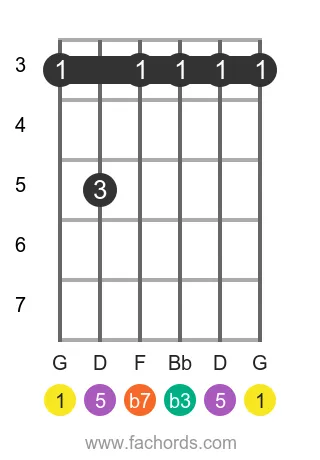
G minor 7th guitar chord is also written as Gm7, Gmin7, G-7 or Gmi7.
Position 1
Movable
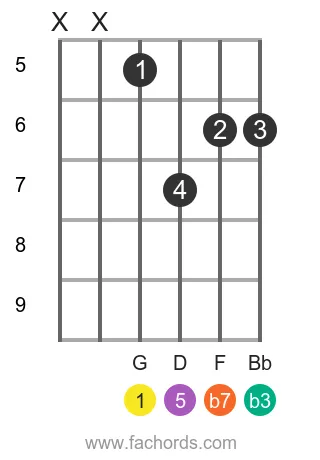
Position 2
Movable
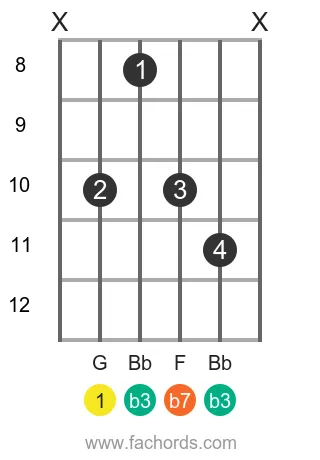
Position 3
Movable
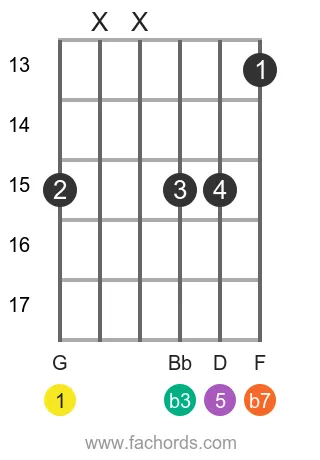
Position 4
Barre
Movable
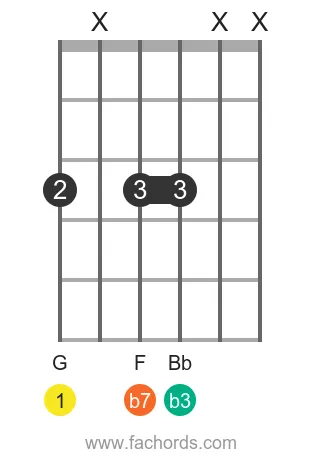
Position 5
Barre
Movable
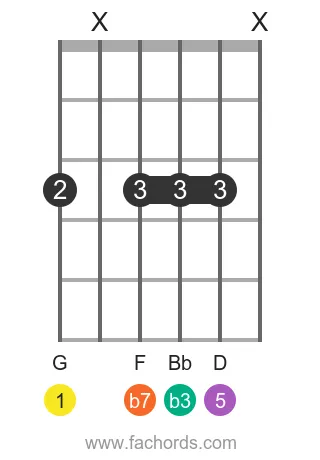
Position 6
Barre
Movable
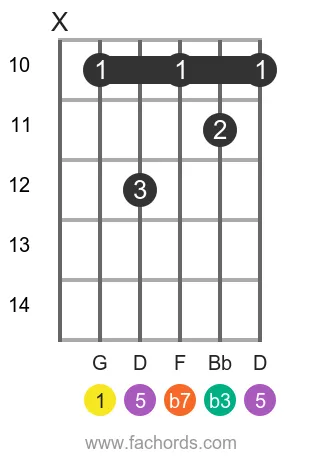
Position 7
Barre
Movable
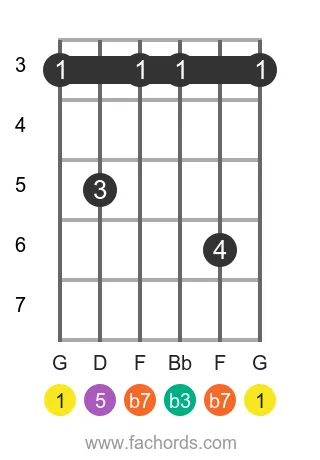
Position 8
Barre
Movable
 Find more shapes in our all guitar chords online library. If you
prefer a printable pdf, download
the Free Guitar Chords Chart Pdf
Find more shapes in our all guitar chords online library. If you
prefer a printable pdf, download
the Free Guitar Chords Chart Pdf
You can also use this accessible Gm7 chord page, with written diagram instructions and screen-reader support for blind users.
Explore G m7 Chord on Guitar: Interactive Lesson
Want a structured chord roadmap instead of jumping between pages?
Go to the full guitar chords tutorial.
The G m7 chord brings a smooth, soulful quality to jazz, blues, and R&B, making it a cornerstone for creating rich harmonies and laid-back grooves. Composed of the notes G, Bb, D, and F, this minor 7th chord is built with the intervals of a Root (1), Minor Third (b3), Perfect Fifth (5), and Minor Seventh (b7). Use our interactive fretboard as your personal exploration lab: play the chord shapes, hear them instantly, and get real-time verification of your accuracy with our innovative mic feedback, ensuring every note you play is correct before you even analyze its structure.
Understanding the construction of a minor 7th chord is key to unlocking its potential for creating sophisticated grooves and navigating modal progressions, particularly in genres like jazz. The characteristic minor seventh interval (b7) adds a distinctive color, making the G m7 perfect for establishing a melancholic yet smooth atmosphere. To deepen your theoretical knowledge, explore our comprehensive guide on chord construction, or learn how to simplify shapes with our tutorial on 3-note 7th chords. Mastering these concepts will not only improve your understanding but also help you improve your chord changes seamlessly.
Below, you'll find a range of G m7 chord diagrams, presented from the simplest to the more challenging voicings, ready for you to experiment with. Each diagram is designed to be played on our virtual fretboard, allowing you to instantly hear how it sounds in different keys and apply the theory you've learned to real musical contexts and songs. Don't just read about it-dive in and start playing these shapes first, then delve into the underlying theory to fully internalize their musical power.
Notes in the G m7 chord:
Formula of the Minor Seventh chord:
Play This Chord With Other Roots
C m7 | D m7 | E m7 | F m7 | G m7 | A m7 | B m7 | C#m7 | D#m7 | F#m7 | G#m7 | A#m7 | Abm7 | Bbm7 | Dbm7 | Ebm7 | Gbm7

Created by
Giancarlo is a musician (teaching guitar since 2000), software engineer, AI consultant and published researcher
FAQ
What are the specific notes that compose the G m7 chord?
The G m7 chord is built from four distinct notes: G, Bb (B flat), D, and F. These are the foundational tones that give the chord its unique sound.
Which intervals define the structure of a G m7 chord?
The G m7 chord is characterized by its intervals relative to the root note (G). These are the 1 (Root), the b3 (Minor Third), the 5 (Perfect Fifth), and the b7 (Minor Seventh).
What makes the G m7 chord a 'minor seven' chord?
The 'minor' quality of the G m7 chord comes from the inclusion of the b3 (Minor Third) interval. The 'seven' aspect is derived from the b7 (Minor Seventh) interval. Together, these intervals establish the chord's distinctive minor seventh sound.
In which musical genres is the G m7 chord commonly used?
The G m7 chord is a versatile and widely used chord found in many musical genres. It is particularly prominent and considered a staple in jazz music, where it frequently appears in chord progressions.
How does playing the G m7 chord on guitar involve more than just knowing its notes?
Playing the G m7 chord effectively on guitar requires understanding its various fretboard patterns. This means knowing how the notes (G, Bb, D, F) are distributed and can be accessed across different positions on the guitar neck, allowing for flexibility and diverse voicings.