Understand and Play the G 7b5 Chord on Guitar
Want a structured chord roadmap instead of jumping between pages?
Go to the full guitar chords tutorial.
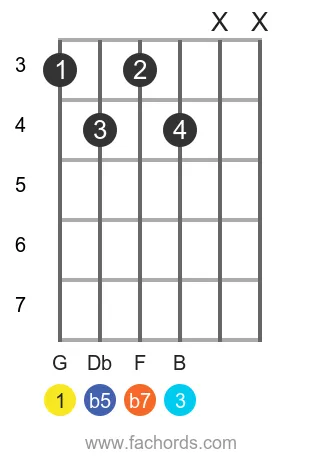
The G 7b5 chord is constructed from specific intervals: the 1 (Root), 3 (Major Third), b5 (Diminished Fifth), and b7 (Minor Seventh). These intervals define its unique character as a member of the Dominant Chord family, giving it a distinctive sound derived from the notes G, B, Db, and F. To precisely analyze and practice this complex chord, our interactive fretboard offers real-time chord and arpeggio playback. You can also verify your playing accuracy instantly with our mic feedback feature.
Understanding the intervals like the diminished fifth is crucial for grasping chords beyond basic triads. The G 7b5, while rooted in the Dominant Chord family, uniquely incorporates an altered fifth, which creates a distinct sonic tension often utilized in jazz and blues. This blend of dominant and diminished qualities makes it a powerful harmonic tool. For a deeper dive into how such complex structures are built, explore our guide on Chord Construction. Additionally, its flattened fifth also draws parallels to Diminished Guitar Chords, showcasing how intervals are shared and repurposed across different chord types.
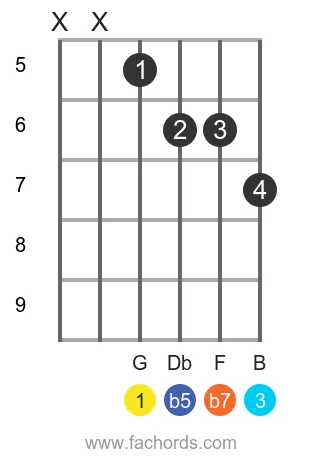
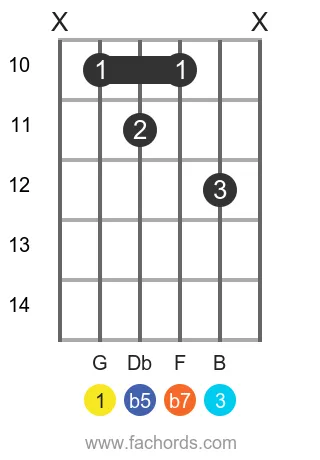
Below, you'll find comprehensive diagrams for the G 7b5 chord, organized from the easiest voicings to the more challenging ones. Take the time to understand the underlying theory behind these shapes, and don't hesitate to experiment with them in various keys and songs. Before diving straight into memorization, use our interactive fretboard to meticulously analyze each voicing. Disciplined practice and thoughtful exploration will solidify your understanding and technique, allowing you to confidently incorporate the G 7b5 into your repertoire.
Notes of the G 7b5 chord:
How to create the Dominant Seventh Flat five chord:
Fingerings for the G7b5 guitar chord
Position 1
Movable
Position 2
Movable
Position 3
Barre
Movable
 Find more shapes in our all guitar chords online library. If you
prefer a printable pdf, download
the Free Guitar Chords Chart Pdf
Find more shapes in our all guitar chords online library. If you
prefer a printable pdf, download
the Free Guitar Chords Chart Pdf
You can also use this accessible G7b5 chord page, with written diagram instructions and screen-reader support for blind users.
FAQ
What does the '7b5' part of the G 7b5 chord name mean?
The '7' in G 7b5 indicates that the chord includes a minor seventh interval (F), which is characteristic of dominant chords. The 'b5' means 'flat 5' or a diminished fifth interval (Db), which is a half step lower than a perfect fifth. These specific intervals (1, 3, b5, b7) define the chord's unique structure and sound.
What are the specific notes that make up the G 7b5 chord?
The G 7b5 chord is composed of four distinct notes: G, B, Db, and F. These correspond to the root (G), major third (B), diminished fifth (Db), and minor seventh (F) intervals, respectively.
How does the diminished fifth (b5) interval contribute to the sound of the G 7b5 chord?
The diminished fifth (b5) interval (Db in the G 7b5) is crucial for creating the chord's distinctive and complex sound. While it maintains its dominant chord identity, the flattened fifth adds a unique tension and a 'touch of the diminished flavor' to its overall character, making it stand out.
Why is the G 7b5 chord considered a 'dominant' chord even with an altered fifth?
The G 7b5 chord remains part of the dominant chord family because it contains the essential dominant intervals: the root (G), major third (B), and minor seventh (F). These three intervals are key to its dominant function and characteristic tension. The flattened fifth is an alteration that adds complexity without changing its fundamental dominant quality.
In what musical styles or genres is the G 7b5 chord commonly used?
Given its unique and complex sound, the G 7b5 chord is often found in blues and jazz music. Mastering and incorporating this chord into your playing can significantly expand your musical vocabulary and enhance your sound, especially when exploring these genres.
What is the relationship between the G 7b5 chord and diminished chords?
Although the G 7b5 chord is a dominant chord, its inclusion of a flattened fifth interval (b5) gives it a unique characteristic. This specific interval creates a sound that has a 'touch of the diminished (dim) guitar chords flavor,' meaning it shares some sonic qualities and tension with fully diminished harmonies, making it quite versatile.
