G 7-sharp-9 Guitar Chord
Chord Diagrams, Interactive Fretboard and Chord Theory
G 7th with sharp 9th guitar chord is also written as G7(#9), G7#9 or G7+9. It is also known as the Hendrix chord.
Position 1
Movable
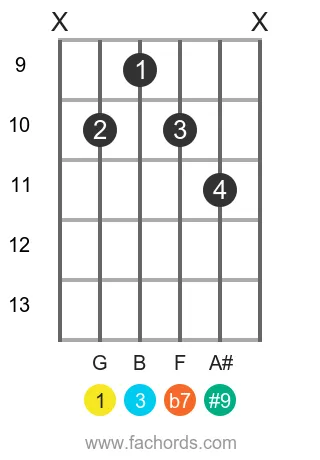
Position 2
Barre
Movable
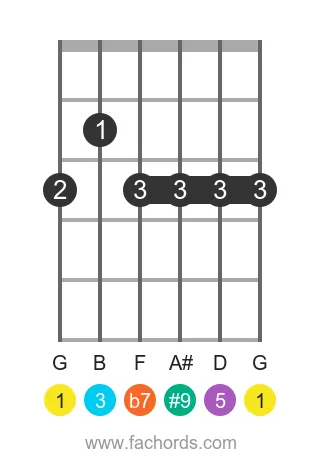
Position 3
Barre
Movable
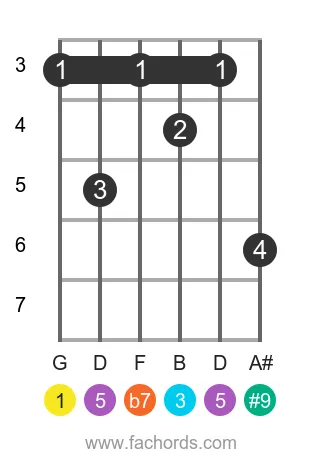
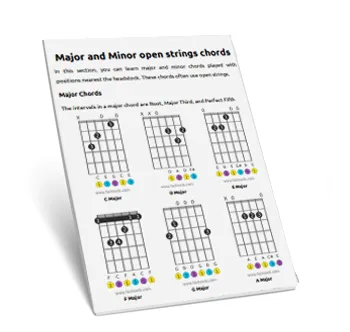
 Find more shapes in our all guitar chords online library. If you
prefer a printable pdf, download
the Free Guitar Chords Chart Pdf
Find more shapes in our all guitar chords online library. If you
prefer a printable pdf, download
the Free Guitar Chords Chart Pdf
You can also use this accessible G7(#9) chord page, with written diagram instructions and screen-reader support for blind users.
Understand and Play the G7(#9) Guitar Chord with Our Tool
Want a structured chord roadmap instead of jumping between pages?
Go to the full guitar chords tutorial.
Understanding the fundamental intervals is key to mastering the G 7(#9) chord. This extended dominant chord is built from the Root, Major Third, Perfect Fifth, Minor Seventh, and Augmented Ninth intervals (1, 3, 5, b7, #9), corresponding to the notes G, B, D, F, and A#. To truly grasp these concepts, utilize our interactive virtual fretboard to visualize each note's position. Practice playing and receive instant real-time mic feedback to verify your accuracy, then listen to the chord's playback to internalize its sound.
The structure of the G 7(#9) chord, with its augmented ninth, adds a distinct color and tension to the dominant chord family, often serving as a gateway to more complex harmonies. Explore its unique interval structure and how it relates to general chord construction. As an extended dominant chord, it extends the principles of a basic dominant chord, offering richer harmonic possibilities. Delve deeper into these extensions by studying Ninth Chords, which provide the theoretical foundation for understanding the #9 alteration.
Below, you'll find comprehensive diagrams showcasing various ways to play the G 7(#9) chord, ranging from simpler voicings to more challenging shapes across different fretboard positions. Each diagram is accompanied by detailed theory, helping you understand how these shapes translate into musical notes and how they function in various keys. Before trying to memorize them, we encourage you to use the interactive fretboard above to methodically practice each voicing. Consistent, disciplined practice with the tool will accelerate your learning and allow you to confidently apply this unique chord in your songs.
G 7(#9) chord Notes:
Formula of the Dominant Seventh Sharp Ninth Added chord:
Play This Chord With Other Roots
C 7(#9) | D 7(#9) | E 7(#9) | F 7(#9) | G 7(#9) | A 7(#9) | B 7(#9) | C#7(#9) | D#7(#9) | F#7(#9) | G#7(#9) | A#7(#9) | Ab7(#9) | Bb7(#9) | Db7(#9) | Eb7(#9) | Gb7(#9)

Created by
Giancarlo is a musician (teaching guitar since 2000), software engineer, AI consultant and published researcher
FAQ
What notes and intervals make up the G 7(#9) chord?
The G 7(#9) chord is composed of five distinct notes: G, B, D, F, and A#. These notes correspond to the following intervals relative to the root (G): the Root (1), Major Third (3), Perfect Fifth (5), Minor Seventh (b7), and Augmented Ninth (#9).
Why is the G 7(#9) considered a Dominant chord?
The G 7(#9) chord belongs to the Dominant Chords family because it contains the essential intervals of a dominant seven chord: the Root (G), Major Third (B), and Minor Seventh (F). These three notes create a strong harmonic tension, which is characteristic of dominant chords and typically seeks resolution.
What creates the 'distinctive, unresolved sound' of the G 7(#9) chord?
The distinctive, unresolved sound of the G 7(#9) chord primarily comes from the combination of its Minor Seventh (b7) and Augmented Ninth (#9) intervals. The b7 interval inherently creates tension, a hallmark of dominant harmony, and the #9 adds a sharp, clashing quality that contributes to its unique and 'unresolved' sonic character.
When is the G 7(#9) chord typically used in music?
The G 7(#9) chord is frequently used in jazz chord progressions due to its rich, tense, and distinctive sound. Learning this chord allows guitarists to add more advanced harmonic color and complexity to their playing, expanding their musical possibilities beyond basic chords.
Is the G 7(#9) chord suitable for beginner guitarists?
No, the G 7(#9) chord is considered more advanced than beginner chords. It requires an understanding of a wider range of intervals, including the Minor Seventh and Augmented Ninth, and often involves more complex fingerings on the fretboard compared to foundational chords.