Master the G 13b9 Chord with Theory & Fretboard Training
Want a structured chord roadmap instead of jumping between pages?
Download the step-by-step Guitar Chord Ebook
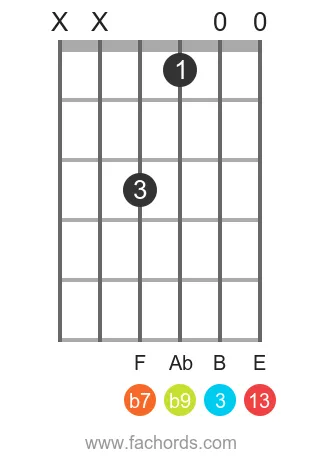
The G 13(b9) chord, a rich member of the Dominant Chord family, is constructed from a distinct series of intervals: 1 (Root), 3 (Major Third), 5 (Perfect Fifth), b7 (Minor Seventh), b9 (Minor Ninth), 11 (Perfect Eleventh), and 13 (Major Thirteenth). This intricate structure results in a chord comprising the notes G, B, D, F, Ab, C, and E. To dissect and understand this harmonic density, our interactive fretboard allows you to visualize every component, offering both chord and arpeggio playback. Practice with real-time mic feedback to meticulously verify your finger placement and ensure every note rings true.
Exploring the intervallic structure of the G 13(b9) reveals its harmonic sophistication, moving beyond basic triads to incorporate extensions like the flat ninth and major thirteenth. Such complex chords are built by carefully stacking intervals, which can seem daunting but provides a deeper understanding of chord theory. For musicians keen to refine their technique, understanding how to construct these extended harmonies is key to unlocking new sonic palettes. This knowledge also proves beneficial when exploring concepts like chord inversions or applying advanced guitar bar chords.
Dive into our comprehensive resource for the G 13(b9) chord, featuring detailed diagrams ranked from easiest to most challenging, alongside practical theory explanations. Apply your newfound skills by exploring how this chord fits into various songs and keys. Utilize the interactive fretboard to practice precisely, ensuring every finger placement is accurate before committing the shapes to memory. Disciplined practice with our tools is the path to true mastery.
G 13(b9) chord Notes:
Tones in the Dominant Thirteen Flat Nine chord:
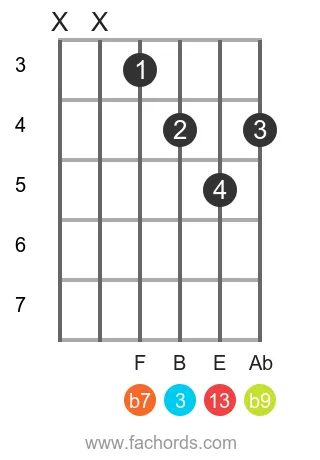
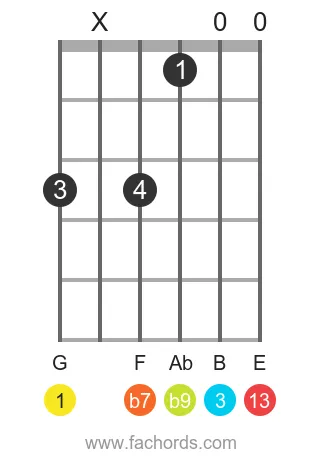
G13(b9) Guitar Chord Fingers Positions
Position 1
Open
Position 2
Movable
Position 3
Open
Position 4
Barre
Movable
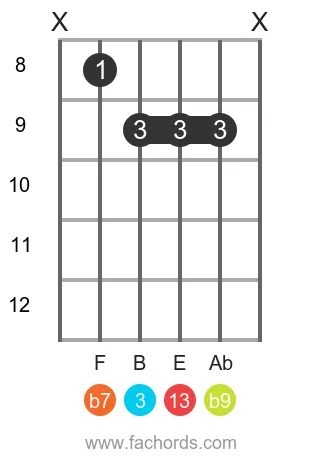
Position 5
Barre
Movable
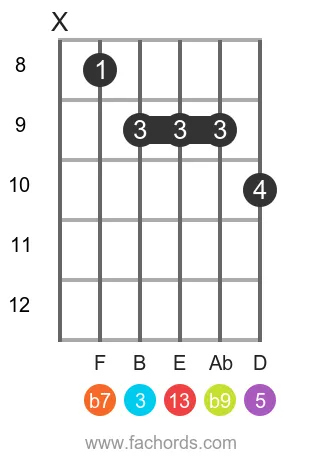
 Find more shapes in our all guitar chords online library. If you
prefer a printable pdf, download
the Free Guitar Chords Chart Pdf
Find more shapes in our all guitar chords online library. If you
prefer a printable pdf, download
the Free Guitar Chords Chart Pdf
You can also use this accessible G13(b9) chord page, with written diagram instructions and screen-reader support for blind users.
FAQ
What makes the G 13(b9) a Dominant Chord?
The G 13(b9) chord belongs to the Dominant Chords family because it features the characteristic dominant seventh interval (b7) along with additional extensions. Dominant chords are recognized for their rich and complex sound, which is a defining trait of the G 13(b9).
What are the specific notes in a G 13(b9) chord?
The G 13(b9) chord is composed of seven distinct notes: G (Root), B (Major Third), D (Perfect Fifth), F (Minor Seventh), Ab (Minor Ninth), C (Perfect Eleventh), and E (Major Thirteenth).
How are the intervals 1, 3, 5, b7, b9, 11, and 13 used to build the G 13(b9) chord?
These intervals represent the specific distances from the root note (G) that define the chord's structure. The G 13(b9) is constructed by stacking these intervals: the 1 (Root), 3 (Major Third), 5 (Perfect Fifth), b7 (Minor Seventh), b9 (Minor Ninth), 11 (Perfect Eleventh), and 13 (Major Thirteenth), giving it its full, harmonically dense sound.
Why is the G 13(b9) chord considered harmonically dense and complex?
The G 13(b9) is considered harmonically dense and complex because it incorporates a large number of notes (seven in total) and advanced extensions beyond the basic triad and seventh, specifically the minor ninth (b9), perfect eleventh (11), and major thirteenth (13). These additions create a rich and intricate sonic texture.
Who might find the G 13(b9) chord useful to learn?
Guitarists at various levels can benefit from learning the G 13(b9) chord. It's particularly valuable for seasoned jazz musicians who frequently use complex voicings, and for beginners looking to expand their chord vocabulary and push their guitar skills into more advanced harmonic territory.