Train Your Ear and Fingers: Play G 13 Chord on Guitar
Want a structured chord roadmap instead of jumping between pages?
Download the step-by-step Guitar Chord Ebook
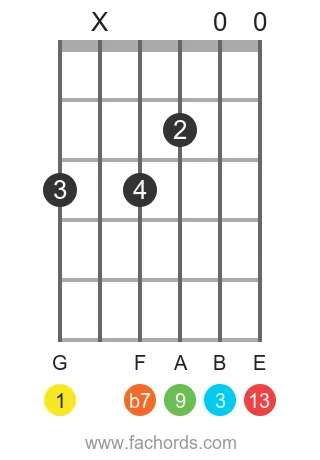
Are you ready to tackle the rich complexities of the G 13 chord? This extended dominant harmony can add sophisticated color to your guitar playing. Immediately test your accuracy by playing into your microphone; our interactive tool provides instant feedback as you explore G, B, D, F, A, C, and E on the virtual fretboard. These notes form the 1 (Root), 3 (Major Third), 5 (Perfect Fifth), b7 (Minor Seventh), 9 (Major Ninth), 11 (Perfect Eleventh), and 13 (Major Thirteenth) intervals, defining this advanced Dominant Chord.
As an extended Dominant Chord, the G 13 chord brings sophisticated harmonic color, building upon the foundational G7 with added upper extensions. This structure, featuring the 9th, 11th, and 13th, is a prime example of advanced chord construction. Understanding its role within the larger dominant chord family is key to unlocking its potential. While it contains the full G, B, D, F, A, C, E, notes, often voicings on guitar imply some of these, especially in ninth chords and beyond. Mastering these complex voicings will help you to improve your chord changes significantly.
Scroll down to find multiple G 13 chord diagrams, presented from the simplest to the more challenging voicings. Each diagram clearly illustrates the notes on the fretboard, enhancing your theoretical understanding. Don't just memorize them; use our interactive fretboard to experiment with these shapes across different keys and integrate them into your favorite songs. Challenge yourself to play along, test your progress, and truly internalize this rich chord.
Notes in the G 13 chord:
How the Dominant Thirteen chord is built:
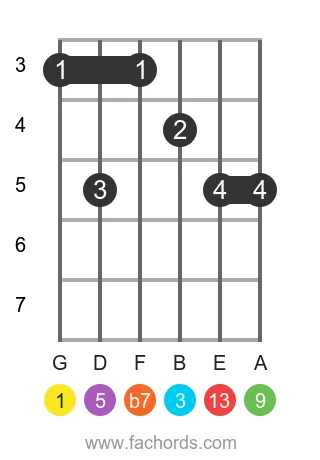
How To Play The G13 chord on guitar
Position 1
Open
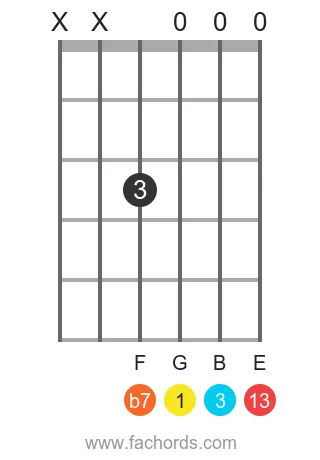
Position 2
Open
Position 3
Movable
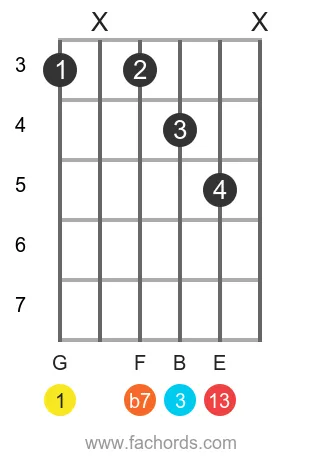
Position 4
Movable
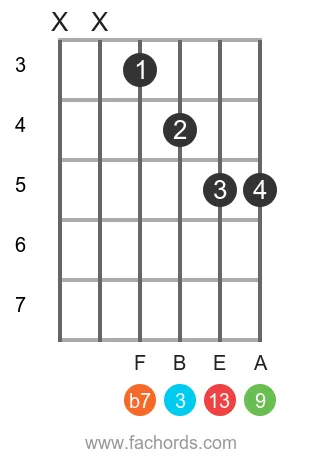
Position 5
Movable
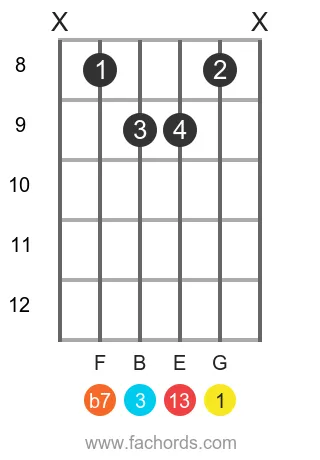
Position 6
Open
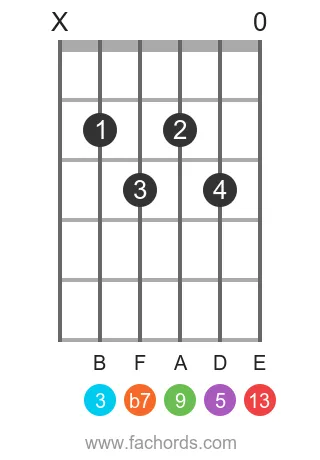
Position 7
Barre
Movable
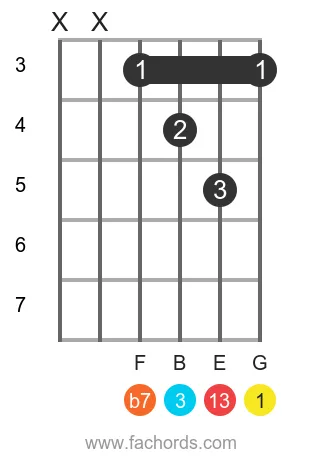
Position 8
Barre
Movable
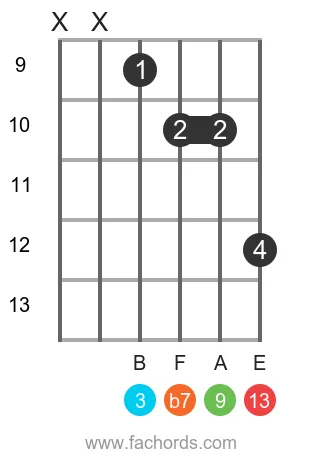
Position 9
Barre
Movable
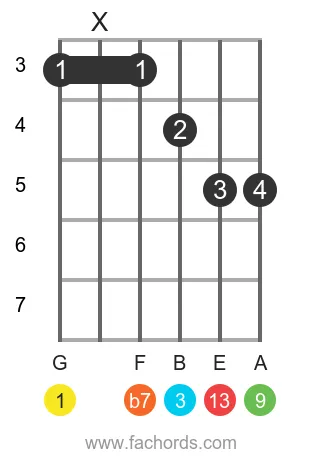
Position 10
Barre
Movable
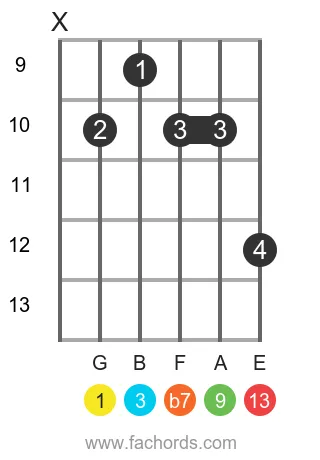
Position 11
Barre
Movable
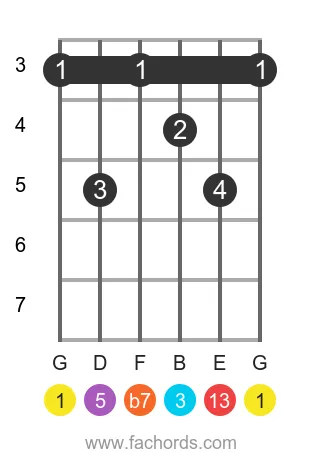
Position 12
Barre
Movable
 Find more shapes in our all guitar chords online library. If you
prefer a printable pdf, download
the Free Guitar Chords Chart Pdf
Find more shapes in our all guitar chords online library. If you
prefer a printable pdf, download
the Free Guitar Chords Chart Pdf
You can also use this accessible G13 chord page, with written diagram instructions and screen-reader support for blind users.
FAQ
What specific notes and intervals make up the G 13 chord?
The G 13 chord is composed of the notes G, B, D, F, A, C, and E. These notes correspond to the following music intervals relative to the root (G): 1 (Root), 3 (Major Third), 5 (Perfect Fifth), b7 (Minor Seventh), 9 (Major Ninth), 11 (Perfect Eleventh), and 13 (Major Thirteenth).
Why is the G 13 chord classified as a 'Dominant Chord'?
The G 13 chord belongs to the Dominant Chords family. Chords in this family are known for their unique tonal color, which distinguishes them and often creates a sense of tension that resolves to another chord.
Is the G 13 chord suitable for beginner guitarists, and where is it typically used?
The G 13 chord is not a beginner's chord; it requires some knowledge of intermediate guitar chords. Once mastered, it's commonly used to add a rich and complex sound, especially in jazz chord progressions.
How will this tutorial help me learn to play the G 13 chord on the guitar?
This tutorial provides chord diagrams and fretboard patterns. These visual aids clearly illustrate how the notes of the G 13 chord are arranged on the guitar fretboard, guiding you on how to form and play the chord.
Since it's a '13th' chord, why does the G 13 chord also include a 'Perfect Eleventh' interval?
A 13th chord, such as the G 13, implies the inclusion of all chord extensions up to the 13th degree. Therefore, it naturally contains the 9th (Major Ninth), 11th (Perfect Eleventh), and 13th (Major Thirteenth) intervals, in addition to the fundamental root, third, fifth, and minor seventh.