G#7b5 Guitar Chord | Play, Hear and Practice Interactively
Want a structured chord roadmap instead of jumping between pages?
Go to the full guitar chords tutorial.
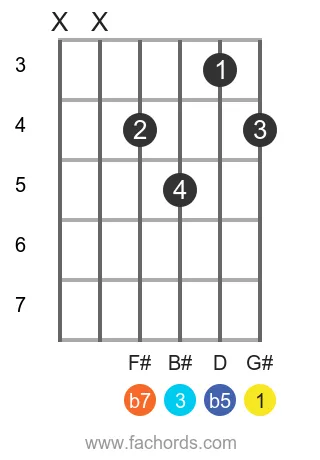
The G#7b5 chord, also known as G# dominant seventh flat five, belongs to the Dominant Chords family. It is built from the notes G#, B#, D, and F#, corresponding to the intervals Root (1), Major Third (3), Diminished Fifth (b5), and Minor Seventh (b7). Explore this unique chord with the interactive fretboard tool at the top of this page, where you can visualize fingerings, hear the chord played as a strum or arpeggio, and get instant feedback on your playing with the real-time microphone feature.
The G#7b5 chord, with its diminished fifth, creates a distinctly tense and often jazzy sound, commonly used to build tension before resolving. To deepen your understanding of chords like this, check out our guide on the Dominant Chord family and dive into the mechanics of Chord Construction. Many common voicings for the G#7b5 involve barre shapes, so if you're working on those, our Guitar Bar Chords tutorial can be very helpful. Once you've learned the fingerings, focus on improving your chord changes for smooth musicality.
Below, you'll discover comprehensive G#7b5 chord diagrams, ranked from beginner-friendly open positions to advanced barre shapes. We also explore the music theory behind this chord, list songs where it shines, and detail the keys where it commonly appears. But before you scroll, make sure to engage with the interactive tool above. Set a comfortable tempo, strum the chord, and let the mic feedback guide your finger placement. This hands-on, real-time practice is the quickest way to master new chords and truly make them your own.
G# 7th with flat 5th guitar chord is also written as G#7b5, G#7(b5) or G#7-5.
Notes in the G# 7b5 chord:
Chord structure of the Dominant Seventh Flat five chord:
G# 7b5 Guitar Chord Diagrams
Position 1
Movable
Position 2
Movable
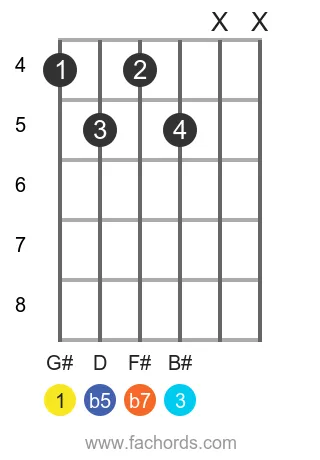
Position 3
Movable
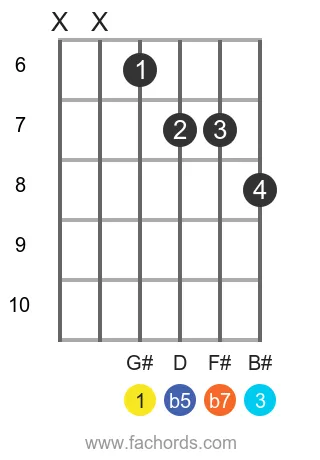
 Find more shapes in our all guitar chords online library. If you
prefer a printable pdf, download
the Free Guitar Chords Chart Pdf
Find more shapes in our all guitar chords online library. If you
prefer a printable pdf, download
the Free Guitar Chords Chart Pdf
You can also use this accessible G#7b5 chord page, with written diagram instructions and screen-reader support for blind users.


Created by
Giancarlo is a musician (teaching guitar since 2000), software engineer, AI consultant and published researcher
FAQ
What does '7b5' signify in the G# 7b5 chord name?
The '7' in G# 7b5 indicates that the chord includes a minor seventh interval. The 'b5' means that the fifth interval from the root is lowered by a half step, making it a diminished fifth. So, it's a dominant seventh chord with a diminished fifth.
What are the specific notes that compose the G# 7b5 chord?
The G# 7b5 chord is made up of the notes G# (Root), B# (Major Third), D (Diminished Fifth), and F# (Minor Seventh).
How do the intervals (1, 3, b5, b7) relate to the notes of the G# 7b5 chord?
For the G# 7b5 chord: the 1st interval is the root note G#; the 3rd interval is the major third, B#; the b5 (diminished fifth) interval is the note D; and the b7 (minor seventh) interval is the note F#.
Why is the G# 7b5 chord classified as a 'Dominant Chord'?
The G# 7b5 chord is a dominant chord because it contains the defining intervals of a major third (B#) and a minor seventh (F#) relative to its root (G#). These intervals create the characteristic tense and unresolved sound typical of dominant chords, even with the diminished fifth alteration.
When would a guitarist typically use a G# 7b5 chord?
Guitarists often use the G# 7b5 chord to create a strong sense of tension and anticipation. Its unresolved sound makes it ideal for leading into a resolution to another chord, a common technique in genres like blues, jazz, funk, and rock.
Why is B# used as the third in the G# 7b5 chord instead of C?
In music theory, intervals are named specifically based on their position in the scale from the root. From G#, the major third is B#. While C is enharmonically equivalent to B#, using B# accurately reflects its intervallic relationship as the third of the G# chord, maintaining theoretical consistency.
