G#7#5 Guitar Chord | Play, Hear and Practice Interactively
Want a structured chord roadmap instead of jumping between pages?
Go to the full guitar chords tutorial.
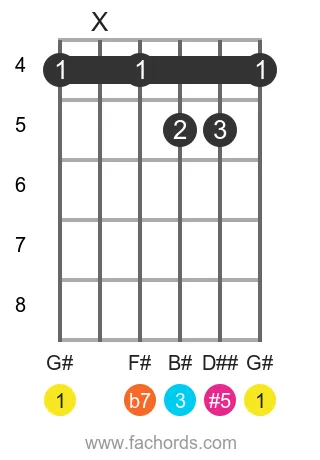
The G# 7(#5) chord, a member of the Augmented Chords family, is composed of the notes G#, B#, D##, and F#, and built from the intervals 1 (Root), 3 (Major Third), #5 (Augmented Fifth), and b7 (Minor Seventh). Use the interactive fretboard tool at the top of this page to explore its fingerings, hear it played as a strum or arpeggio, and get instant feedback on your playing with the real-time microphone feature.
This chord creates a unique, sophisticated sound often found in jazz, adding tension and color. The presence of the augmented fifth and minor seventh gives it a distinct harmonic character. To deepen your understanding of how such complex chords are built, explore our guide on Chord Construction. If you're wrestling with the role of 7th chords, our Dominant Chord tutorial can clarify their function. Once you're able to form this chord, practice smooth transitions using our tips to Improve Chords Change.
Scroll down to find comprehensive G# 7(#5) chord diagrams, ranging from simpler voicings to more advanced shapes, along with practical music theory, common song examples, and the keys where this chord naturally appears. Before you dive into static diagrams, take a moment to engage with the interactive tool above. Use the drum and BPM practice tool to set a rhythm, play the chord, and let the mic feedback guide your hand placement. This active learning approach is the fastest way to truly master the G# 7(#5) and integrate it into your playing.
G# dominant 7th with sharp 5th guitar chord is also written as G#7(#5), G#7#5, G#7+5 or G#aug7.
Notes that compose the G# 7(#5) chord:
Tones in the Dominant Seventh Sharp Fifth chord:
G# 7(#5) Guitar Chord Diagrams
Position 1
Barre
Movable
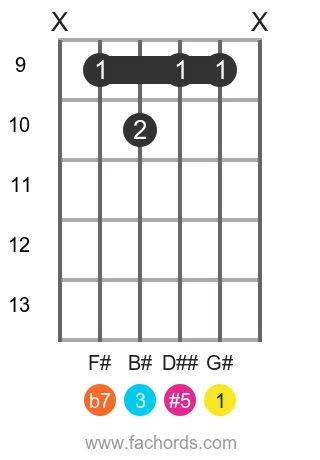
Position 2
Barre
Movable
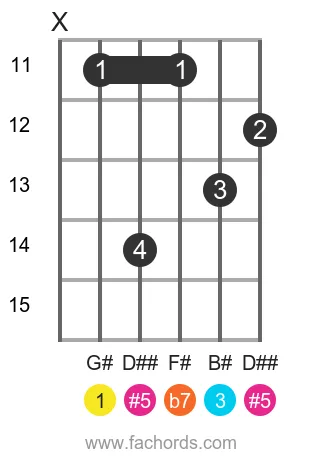
Position 3
Barre
Movable
 Find more shapes in our all guitar chords online library. If you
prefer a printable pdf, download
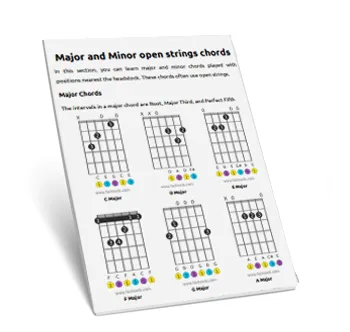
the Free Guitar Chords Chart Pdf
Find more shapes in our all guitar chords online library. If you
prefer a printable pdf, download
the Free Guitar Chords Chart Pdf
You can also use this accessible G#7(#5) chord page, with written diagram instructions and screen-reader support for blind users.

Created by
Giancarlo is a musician (teaching guitar since 2000), software engineer, AI consultant and published researcher
FAQ
What notes make up the G# 7(#5) guitar chord?
The G# 7(#5) chord is composed of the notes G# (Root), B# (Major Third), D## (Augmented Fifth), and F# (Minor Seventh).
What do the numbers and symbols '7' and '(#5)' signify in the G# 7(#5) chord name?
The '7' in G# 7(#5) indicates the presence of a minor seventh interval (b7). The '(#5)' specifically denotes an augmented fifth interval, which is a key characteristic of this chord.
Why is the G# 7(#5) chord classified as an 'Augmented Chord'?
The G# 7(#5) chord is a member of the Augmented Chords family primarily because of its #5 (augmented fifth) interval. This specific interval gives the chord its characteristic augmented quality.
What does the '##' symbol in the D## note of the G# 7(#5) chord mean?
The '##' symbol indicates a double sharp. This means the D note is raised by two semitones from its natural position. It's the correct theoretical spelling for the augmented fifth interval in the context of a G# chord.
What kind of sound does the G# 7(#5) chord produce, and where is it typically used?
The G# 7(#5) chord has a unique, distinct, and sophisticated sound. While it's often found in jazz chord progressions, it can also be effectively used in other musical genres to add a sophisticated flavor.
What are the essential intervals that define the structure of the G# 7(#5) chord?
The G# 7(#5) chord is built from four crucial intervals: the Root (1), a Major Third (3), an Augmented Fifth (#5), and a Minor Seventh (b7). Understanding these intervals is fundamental to comprehending its construction.