Gb 7(b9) Guitar Chord | Play, Hear, and Practice Interactively
Want a structured chord roadmap instead of jumping between pages?
Go to the full guitar chords tutorial.
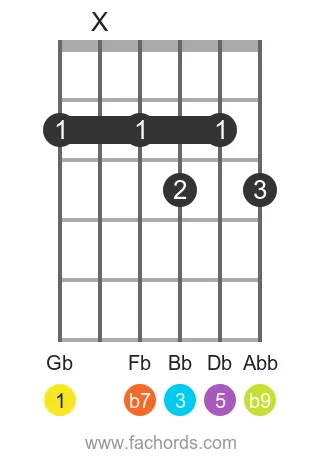
Built on Gb, the Gb7(b9) chord (Gb seventh flat nine) combines a root, a major third, a perfect fifth, a minor seventh and a flat ninth, which gives Gb, Bb, Db, Fb and Abb. Being a dominant chord, it most often pulls toward a minor chord whose root is a fourth above Gb.
There are three voicings listed for this root, and none of them uses an open string. Open F#7(b9) for the same chord under its other spelling. When you improvise over this chord, try the Gb Phrygian Dominant scale, the fifth mode of the harmonic minor scale, which covers all five chord tones.
Strum the shape in front of your microphone and the chord player at the top shows which strings ring and which are muted.
Gb 7th with flat 9th guitar chord is also written as Gb7(b9), Gb7b9 or Gb7-9.
Notes in the Gb 7(b9) chord:
Chord Structure:
Formula: 1 3 5 b7 b9
Gb 7(B9) Guitar Chord Diagrams
Position 1 Barre Movable
Finger Positions
- Mute the A string
- Place your index finger (1) on the fret 2 of the low E, D and B strings at the same time
- Place your middle finger (2) on the fret 3 of the G string
- Place your ring finger (3) on the fret 3 of the high E string
Position 2 Barre Movable
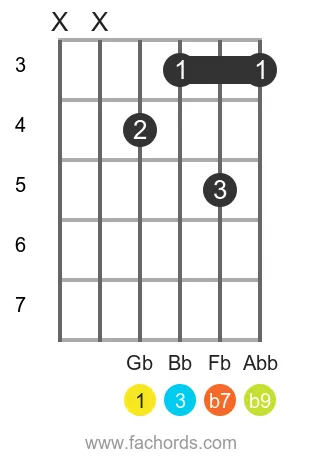
Finger Positions
- Mute the low E string
- Mute the A string
- Place your index finger (1) on the fret 3 of the G and high E strings at the same time
- Place your middle finger (2) on the fret 4 of the D string
- Place your ring finger (3) on the fret 5 of the B string
Position 3 Barre Movable
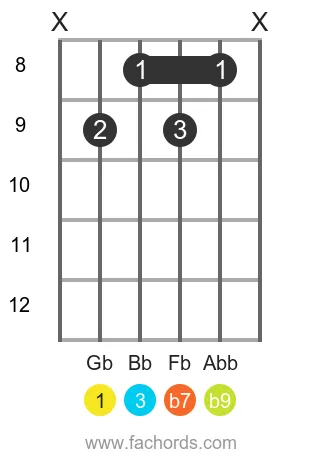
Finger Positions
- Mute the low E string
- Mute the high E string
- Place your index finger (1) on the fret 8 of the D and B strings at the same time
- Place your middle finger (2) on the fret 9 of the A string
- Place your ring finger (3) on the fret 9 of the G string
 Find more shapes in our all guitar chords online library. If you
prefer a printable pdf, download
the Free Guitar Chords Chart Pdf
Find more shapes in our all guitar chords online library. If you
prefer a printable pdf, download
the Free Guitar Chords Chart Pdf

Created by
Giancarlo is a musician (teaching guitar since 2000), software engineer, AI consultant and published researcher
FAQ
Why does Gb7(b9) use both Fb and Abb?
Chord letters stack as G, B, D, F, A. The minor seventh higher than Gb is Fb, which sounds like E. The flat ninth is Abb, which sounds like G natural.
What notes are in the Gb seventh flat nine chord?
Gb, Bb, Db, Fb and Abb. They are the root, a major third, a perfect fifth, a minor seventh and a flat ninth.
Is Gb7(b9) the same chord as F#7(b9)?
Yes, they sound identical. F#7(b9) is spelled F#, A#, C#, E and G, which has no double accidentals, so it is the simpler spelling.
Which scale works over Gb7(b9)?
The Gb Phrygian Dominant scale, spelled Gb, Abb, Bb, Cb, Db, Ebb and Fb, contains all five chord tones. It is the fifth mode of harmonic minor.
How many voicings does Gb7(b9) have?
Three voicings are listed, from the second fret to the ninth fret. All three are barre voicings, and none uses open strings.