Gb11 Guitar Chord | Play, Hear and Practice Interactively
Want a structured chord roadmap instead of jumping between pages?
Download the step-by-step Guitar Chord Ebook

The Gb11 chord is a captivating and richly textured chord, part of the Dominant 11th family. It's built from the notes Gb, Bb, Db, Fb, Ab, and Cb, corresponding to the intervals Root (1), Major Third (3), Perfect Fifth (5), Minor Seventh (b7), Major Ninth (9), and Perfect Eleventh (11). To truly master this complex sound, use the interactive fretboard tool at the top of this page: visualize its fingerings, listen to the chord played as a strum or arpeggio, and get instant feedback on your accuracy with the real-time microphone feature.
Understanding the intricate construction of the Gb11 chord is key to harnessing its expressive potential. As a dominant extension, it adds depth and sophistication to progressions, often creating a sense of anticipation. Delve deeper into the theoretical foundations of dominant chords with our guide to the Dominant Chord family, and explore how these rich voicings are built by stacking intervals in our Chord Construction tutorial. Since 11th chords are extensions of 9th chords, our article on Ninth Chords can provide valuable context. Once you're comfortable with the fingerings, practice smooth chord changes to integrate it seamlessly into your playing.
Below, you'll discover a comprehensive collection of Gb11 chord diagrams, ordered from the easiest open positions to more advanced movable shapes, alongside relevant music theory, songs where this chord shines, and the musical keys in which it frequently appears. But before you explore the static diagrams, we strongly encourage you to spend some time with the interactive tool above. Use the drum and BPM tool to set a practice tempo, strum the chord, and let the mic feedback guide you to perfect finger placement. This active, hands-on approach is the most effective way to truly learn and internalize new chords like the Gb11.
Notes of the Gb 11 chord:
Chord Structure:
Gb Dominant Eleventh Guitar Chord Diagrams
Position 1
Open
Position 2
Barre
Movable
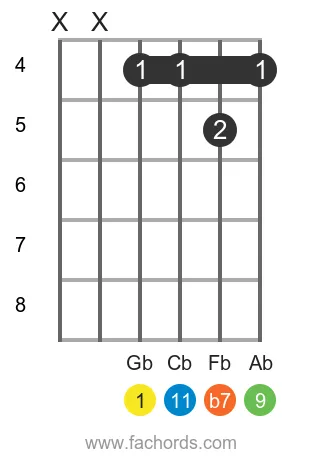
Position 3
Barre
Movable
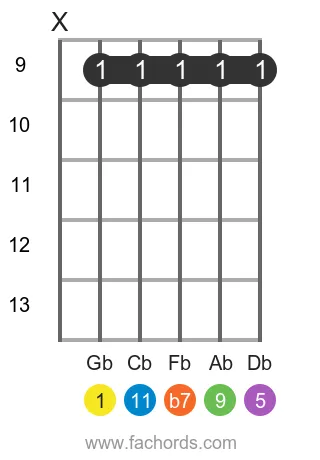
 Find more shapes in our all guitar chords online library. If you
prefer a printable pdf, download
the Free Guitar Chords Chart Pdf
Find more shapes in our all guitar chords online library. If you
prefer a printable pdf, download
the Free Guitar Chords Chart Pdf
You can also use this accessible Gb11 chord page, with written diagram instructions and screen-reader support for blind users.
FAQ
What are the specific notes that make up the Gb11 chord?
The Gb11 chord is composed of six distinct notes: Gb, Bb, Db, Fb, Ab, and Cb. These notes are derived by stacking specific intervals from the root note, Gb.
What are the intervals involved in building a Gb11 chord?
The Gb11 chord is constructed using the following intervals relative to its root (Gb): the Root (1), Major Third (3), Perfect Fifth (5), Minor Seventh (b7), Major Ninth (9), and Perfect Eleventh (11).
Why is the Gb11 chord referred to as a 'dominant' chord?
The Gb11 chord is classified as a dominant chord because of its specific interval structure, particularly the combination of a major third (Bb) and a minor seventh (Fb). This characteristic interval pairing gives it the dominant quality, often creating a sense of tension that can lead to resolution.
Are Fb and Cb the same as E and B when playing the Gb11 chord on the guitar?
Yes, when playing the Gb11 chord on the guitar, Fb is enharmonically equivalent to E, and Cb is enharmonically equivalent to B. While the theoretical names Fb and Cb accurately represent the intervals from the Gb root, you would typically find and play these notes at the fret positions corresponding to E and B.
What makes the Gb11 chord 'versatile and expressive' for guitarists?
The Gb11 chord's versatility and expressiveness stem from its rich and complex harmonic structure. By including the ninth and eleventh intervals in addition to the core dominant seventh, it creates a fuller, more open, and sophisticated sound. This added harmonic density allows it to be used in various musical contexts to introduce depth, color, and emotional nuance.