Learn the F 9 Guitar Chord: Theory and Application
Want a structured chord roadmap instead of jumping between pages?
Go to the full guitar chords tutorial.
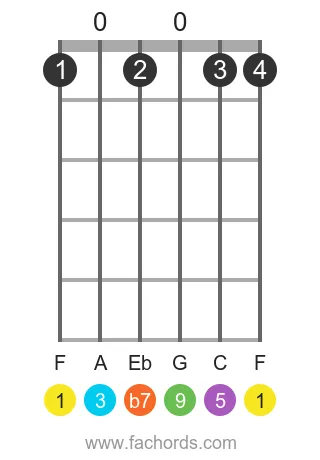
The F 9 chord is constructed from specific intervals, forming a vibrant and expressive chord that belongs to the family of Dominant Chords. It is composed of the notes F, A, C, Eb, and G, built using the intervals 1, 3, 5, b7, and 9 (Root, Major Third, Perfect Fifth, Minor Seventh, and Major Ninth). To truly grasp its sonic identity and perfect your playing, our interactive fretboard offers detailed chord playback and arpeggio demonstrations. Use the real-time mic feedback feature to verify your accuracy, ensuring your fingers hit every note precisely.
The addition of the ninth (G) to the Dominant 7th chord (F7) significantly enhances its harmonic richness, creating an extended harmony that provides a lush, complex sound. This Ninth chord extends beyond the basic triad, offering a sophisticated tonal color often found in jazz and R&B. Understanding how chords are built by stacking intervals, a key aspect of chord construction, is essential for mastering such advanced voicings. Practicing these new shapes will also improve your chord changes across the fretboard.
Beyond the theoretical understanding, applying the F 9 chord in various musical contexts is crucial. Explore its full potential by scrolling down to discover comprehensive diagrams, presented from the easiest to the most challenging voicings. Each diagram will guide you through the fingerings and note placements, helping you integrate this chord into your playing. Use our interactive tools to experiment with its sound, explore its theory in different keys, and discover how it enriches various songs. Disciplined practice with these resources will solidify your grasp of this expressive chord.
Notes of the F 9 chord:
Chord formula for the Dominant Ninth chord:
F Dominant Ninth Guitar Chord Diagrams
Position 1
Movable
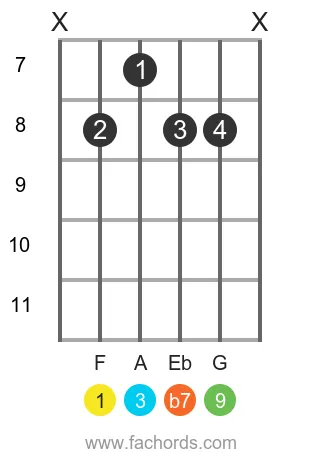
Position 2
Movable
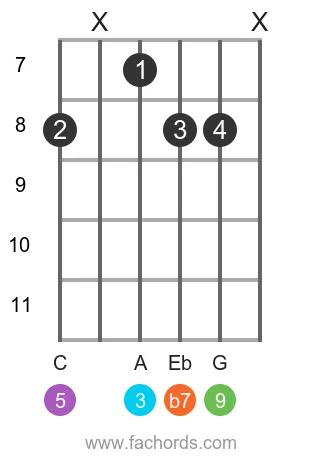
Position 3
Open
Position 4
Barre
Movable
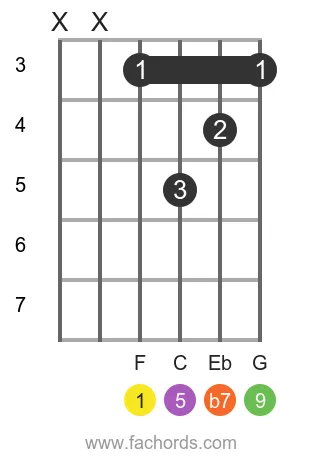
Position 5
Barre
Movable
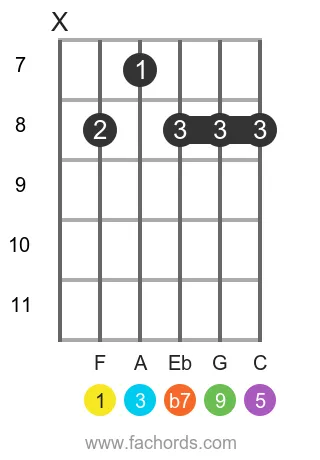
Position 6
Barre
Movable
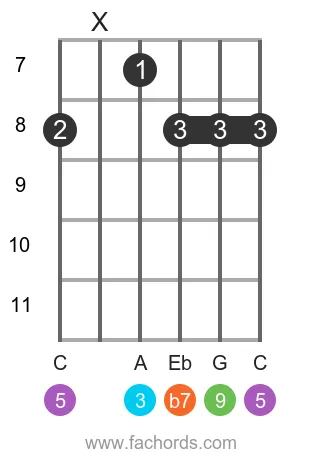
 Find more shapes in our all guitar chords online library. If you
prefer a printable pdf, download
the Free Guitar Chords Chart Pdf
Find more shapes in our all guitar chords online library. If you
prefer a printable pdf, download
the Free Guitar Chords Chart Pdf
You can also use this accessible F9 chord page, with written diagram instructions and screen-reader support for blind users.
FAQ
What notes are included in an F9 guitar chord?
The F9 chord is composed of five distinct notes: F (the Root), A (the Major Third), C (the Perfect Fifth), Eb (the Minor Seventh), and G (the Major Ninth). These notes are built upon specific intervals that give the chord its unique sound.
What makes the F9 chord a 'Dominant Chord'?
The F9 chord is classified as a Dominant Chord because it contains a Minor Seventh interval (Eb in this case), which is a defining characteristic of dominant harmony. The addition of the Major Ninth interval extends this dominant quality, making it a more complex and expressive dominant chord.
What is the role of intervals when learning the F9 chord?
Understanding intervals is crucial for mastering the F9 chord and other advanced chords. Intervals define how the chord is constructed (1, 3, 5, b7, 9) and help you understand the relationship between notes on the fretboard, allowing you to build and recognize the chord more effectively than just memorizing shapes.
Is the F9 chord too advanced for beginner guitarists?
No, the F9 chord is not exclusively for advanced players. Even as a beginner, learning this chord can significantly enhance your guitar skills and understanding of music theory. It introduces you to more complex harmonies and intervals beyond basic major and minor chords.
In what musical styles or situations might I use an F9 chord?
The F9 chord is a versatile and expressive chord that can be incorporated into various genres. It is particularly prominent in jazz, where it frequently appears in jazz chord progressions. Its vibrant sound makes it suitable for adding color and tension to your playing across different musical contexts.