Learn F 7#9 Guitar Chord: Theory and Application
Want a structured chord roadmap instead of jumping between pages?
Go to the full guitar chords tutorial.
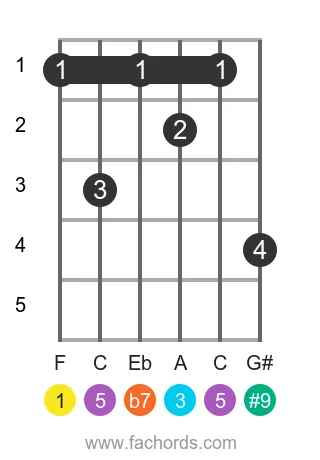
Delve into the precise construction of the F 7(#9) chord. This extended dominant chord, part of the Dominant Chords family, is built from the notes F, A, C, Eb, and G#. Its unique sound is derived from the intervals of a Root, Major Third, Perfect Fifth, Minor Seventh, and a sharp Ninth (1, 3, 5, b7, #9). Utilize our interactive fretboard to visualize these components, and benefit from real-time mic feedback to accurately verify your playing as you explore the chord's sonic character with adjustable playback.
The sophisticated sound of this chord comes from its extended interval structure, particularly the tension created by the #9 against the b7. Understanding how these musical intervals interact is crucial for mastering its application. Our comprehensive Chord Construction tutorial provides a deeper dive into building chords by stacking intervals. You can also explore Understanding Chord Inversions to rearrange these notes and discover new voicings, or delve into other Ninth Chords to expand your harmonic vocabulary.
Below, you'll find detailed chord diagrams and fretboard patterns, progressing from the most accessible shapes to more challenging voicings. Each diagram will reinforce the theoretical concepts discussed and help you apply the F 7(#9) chord in various musical keys and songs. Before diving into static charts, we encourage you to use the interactive fretboard above to internalize the sound and feel of this chord through disciplined practice.
Notes of the F 7(#9) chord:
Tones in the Dominant Seventh Sharp Ninth Added chord:
F Dominant Seventh Sharp Ninth Added Guitar Chord Diagrams
Position 1
Movable
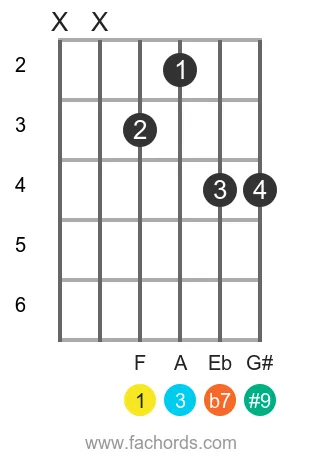
Position 2
Movable
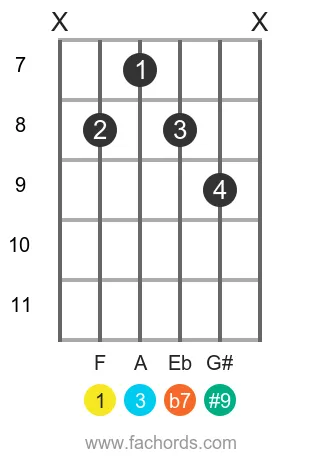
Position 3
Movable
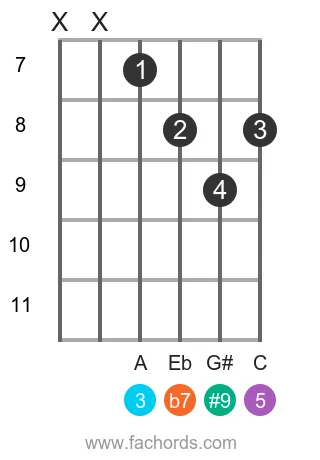
Position 4
Barre
Movable
 Find more shapes in our all guitar chords online library. If you
prefer a printable pdf, download
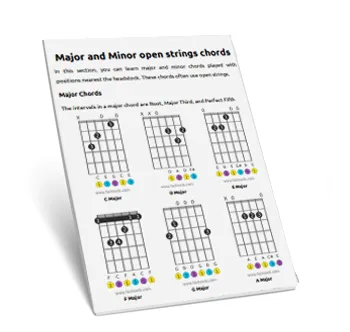
the Free Guitar Chords Chart Pdf
Find more shapes in our all guitar chords online library. If you
prefer a printable pdf, download
the Free Guitar Chords Chart Pdf
You can also use this accessible F7(#9) chord page, with written diagram instructions and screen-reader support for blind users.
FAQ
What are the specific notes and intervals that make up the F 7(#9) chord?
The F 7(#9) chord is composed of the notes F, A, C, Eb, and G#. These correspond to the intervals of the Root (F), Major Third (A), Perfect Fifth (C), Minor Seventh (Eb), and Augmented Ninth (G#) relative to the root F.
Why is the F 7(#9) chord described as having a 'rich and complex sound'?
The F 7(#9) chord achieves its rich and complex sound due to the combination of its specific intervals, particularly the Minor Seventh (Eb) and the Augmented Ninth (G#). These intervals create a distinctive harmonic tension and color that goes beyond simpler chords, adding depth and sophistication to music.
How does the augmented ninth (#9) interval function in the F 7(#9) chord?
The augmented ninth (#9), represented by the G# note in an F 7(#9) chord, adds a unique and often bluesy or jazzy tension to the dominant sound. It creates a subtle dissonance against the root and major third, which contributes significantly to the chord's characteristic 'complex' feel without losing its dominant function.
What is the main difference between an F7 chord and an F 7(#9) chord?
A standard F7 chord contains the Root, Major Third, Perfect Fifth, and Minor Seventh (F, A, C, Eb). The F 7(#9) chord builds upon this by adding the Augmented Ninth (G#). This extra note introduces a distinct layer of harmonic tension and color, making the F 7(#9) a more elaborate and often more expressive dominant chord than a basic F7.
How do chord diagrams and fretboard patterns help in learning the F 7(#9) chord?
Chord diagrams and fretboard patterns are visual tools that show you where to place your fingers on the guitar neck to play the F 7(#9) chord. They help you translate the theoretical understanding of the notes (F, A, C, Eb, G#) and intervals into practical finger positions, making it easier to visualize and execute the chord shape.
What are chord inversions and why are they useful for the F 7(#9) chord?
Chord inversions involve rearranging the order of the notes within a chord, meaning a note other than the root is the lowest-sounding note. For the F 7(#9) chord, learning inversions allows you to play the same chord with different voicings across the fretboard, creating new sonic textures and making transitions smoother between chords in a song.
