F# m6 Guitar Chord
Chord Diagrams, Interactive Fretboard and Chord Theory
F# minor 6th guitar chord is also written as F#m6, F#min6 or F#-6.
Position 1
Movable
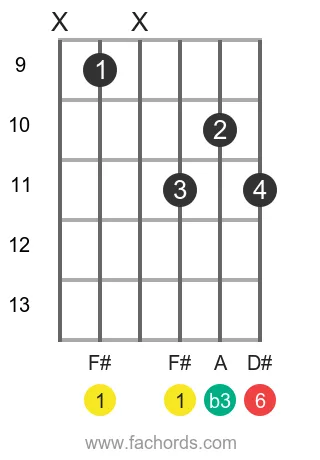
Position 2
Barre
Movable
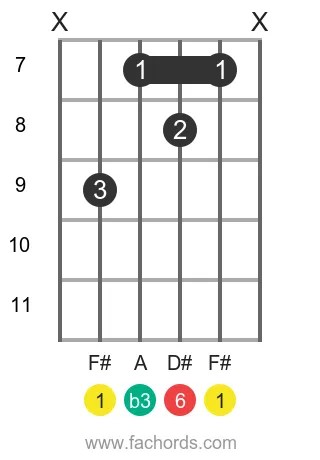
Position 3
Barre
Movable
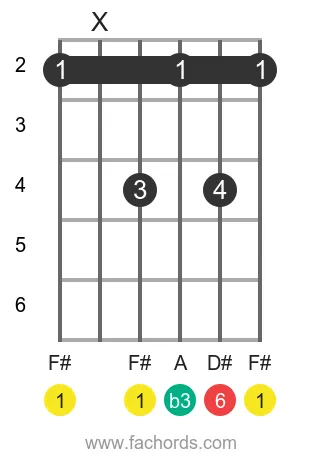
 Find more shapes in our all guitar chords online library. If you
prefer a printable pdf, download
the Free Guitar Chords Chart Pdf
Find more shapes in our all guitar chords online library. If you
prefer a printable pdf, download
the Free Guitar Chords Chart Pdf
You can also use this accessible F#m6 chord page, with written diagram instructions and screen-reader support for blind users.
Explore the F#m6 Guitar Chord: Interactive Practice & Sounds
Want a structured chord roadmap instead of jumping between pages?
Go to the full guitar chords tutorial.
The F#m6 chord brings a beautiful, sophisticated color to your guitar playing, often found enhancing jazz, R&B, and soulful progressions. Belonging to the Minor Sixth family, this expressive sound is constructed from the notes F#, A, C#, and D#, representing the fundamental intervals of Root (1), Minor Third (b3), Perfect Fifth (5), and a distinctive Major Sixth (6). Dive into its sonic possibilities with the interactive fretboard tool at the top of this page. Use it as your personal exploration lab to visualize every fingering, hear the chord played as a strum or arpeggio, and immediately verify your accuracy with the real-time microphone feedback.
Understanding how this unique 'sixth' interval functions is key to mastering its vintage and jazz sweetness. Explore our dedicated tutorial on 6th Chords to delve deeper into this rich chord family. For a broader understanding of how all chords are put together, our Chord Construction guide is invaluable. Since many F#m6 shapes involve barre techniques, if you're struggling, check out our tips for Guitar Bar Chords. Once you've learned the fingerings, learn how to Improve Chord Changes to seamlessly integrate it into your music.
Below, you'll discover a comprehensive collection of F#m6 chord diagrams, ranked from the easiest open positions to more advanced movable shapes. You'll also find essential music theory, popular songs that feature the F#m6, and the musical keys where it commonly appears. Before you explore these static diagrams, take ample time to interact with the tool above. Set your desired tempo with the drum and BPM tool, strum the chord, and let the mic feedback guide your fingers to perfection. Play and experiment first; the theory will follow.
Notes that compose the F# m6 chord:
Chord Formula:
Play This Chord With Other Roots
C m6 | D m6 | E m6 | F m6 | G m6 | A m6 | B m6 | C#m6 | D#m6 | F#m6 | G#m6 | A#m6 | Abm6 | Bbm6 | Dbm6 | Ebm6 | Gbm6

Created by
Giancarlo is a musician (teaching guitar since 2000), software engineer, AI consultant and published researcher
FAQ
What notes make up an F# m6 chord?
The F# m6 chord is composed of four specific notes: F#, A, C#, and D#. These notes are derived from the root, minor third, perfect fifth, and major sixth intervals, respectively.
What do the 'm' and '6' signify in the F# m6 chord name?
In 'F# m6', the 'm' indicates that the chord is a minor chord, meaning it contains a minor third (b3) interval above the root. The '6' refers to the major sixth (6) interval, which is added to the standard minor triad, giving the chord its characteristic sound.
How does the F# m6 chord differ from a standard F# minor chord?
A standard F# minor chord consists of the root (F#), minor third (A), and perfect fifth (C#). The F# m6 chord takes this basic minor triad and adds an additional note: the major sixth (D#). This added interval is what distinguishes the m6 chord and gives it a more complex and richer sound.
What kind of musical sound or feeling does the F# m6 chord create?
The F# m6 chord is described as having a 'beautiful and complex sound.' The inclusion of the major sixth interval creates a distinctive, often sophisticated or melancholic, yet sometimes open and airy quality, which can add significant depth and unique color to musical pieces.
Is the F# m6 considered an advanced chord for guitarists?
Yes, the F# m6 is considered a more advanced chord. While basic major and minor chords are foundational, chords like the m6, with their added intervals, require a deeper understanding of music theory and often more intricate fingerings, making them a good challenge for guitarists looking to expand their skills.
