Play F#9b5 Guitar Chord with Interactive Feedback
Want a structured chord roadmap instead of jumping between pages?
Go to the full guitar chords tutorial.
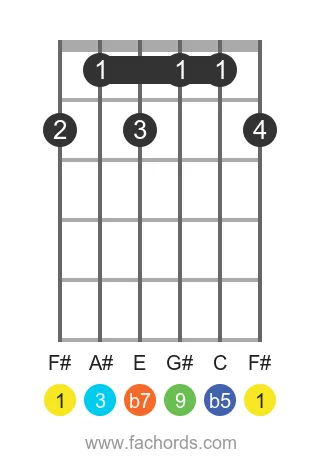
Adding a distinct, often jazzy flavor, the F#9b5 chord is a complex member of the Dominant Chords family that pushes harmonic boundaries. It's constructed from the notes F#, A#, C, E, and G#, representing the intervals Root (1), Major Third (3), Diminished Fifth (b5), Minor Seventh (b7), and Major Ninth (9). Dive into its unique sound using our interactive fretboard tool, where you can visualize every fingering and hear the chord played as a strum or arpeggio. Get immediate verification of your accuracy with real-time microphone feedback as you play.
The unique combination of a dominant ninth with a flattened fifth in the F#9b5 creates a vibrant, often dissonant, sound that resolves beautifully. This blend of extended harmony and diminished character is key to its distinctive musical impact. Explore its construction further with our Chord Construction tutorial, or delve into the broader world of these colorful sounds with our guide to Ninth Chords. Understanding the role of the Dominant Chord family will unlock its full potential, and mastering your chord changes will ensure smooth transitions in any progression.
Scroll down this page to discover detailed chord diagrams, arranged from the simplest open positions to more advanced movable shapes, alongside supporting music theory, song examples featuring the F#9b5, and common keys where it shines. Before analyzing the diagrams, engage with the interactive tool above first. Set your tempo with the drum & BPM tool, then play the chord and let the mic feedback instantly refine your technique. This hands-on exploration is the quickest way to truly understand and internalize new chords.
F# 9th with flat 5th guitar chord is also written as F#9b5, F#9(b5) or F#9-5.
Notes in the F# 9b5 chord:
Chord formula for the Dominant Ninth Flat five chord:
F# 9b5 Guitar Chord Diagrams
Position 1 Barre Movable
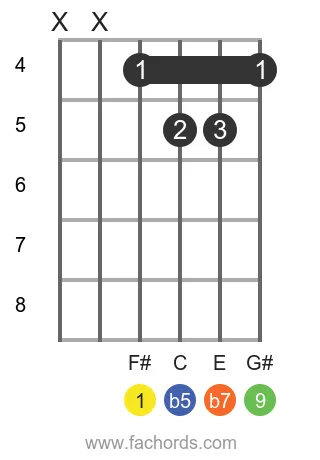
Finger Positions
- Mute the low E string
- Mute the A string
- Place your index finger (1) on the fret 4 of the D and high E strings at the same time
- Place your middle finger (2) on the fret 5 of the G string
- Place your ring finger (3) on the fret 5 of the B string
Position 2 Barre Movable
Finger Positions
- Place your index finger (1) on the fret 1 of the A, G and B strings at the same time
- Place your middle finger (2) on the fret 2 of the low E string
- Place your ring finger (3) on the fret 2 of the D string
- Place your pinky finger (4) on the fret 2 of the high E string
Position 3 Barre Movable
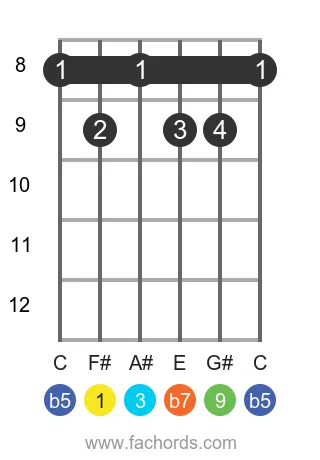
Finger Positions
- Place your index finger (1) on the fret 8 of the low E, D and high E strings at the same time
- Place your middle finger (2) on the fret 9 of the A string
- Place your ring finger (3) on the fret 9 of the G string
- Place your pinky finger (4) on the fret 9 of the B string
 Find more shapes in our all guitar chords online library. If you
prefer a printable pdf, download
the Free Guitar Chords Chart Pdf
Find more shapes in our all guitar chords online library. If you
prefer a printable pdf, download
the Free Guitar Chords Chart Pdf

Created by
Giancarlo is a musician (teaching guitar since 2000), software engineer, AI consultant and published researcher
FAQ
What are the specific notes and intervals that make up an F#9b5 chord?
The F#9b5 chord is composed of the notes F#, A#, C, E, and G#. These correspond to the intervals of Root (1), Major Third (3), Diminished Fifth (b5), Minor Seventh (b7), and Major Ninth (9).
What does the '9' and 'b5' mean in the F#9b5 chord name?
In the F#9b5 chord name, the '9' indicates that a Major Ninth interval is added to the chord. The 'b5' signifies a Diminished Fifth interval, meaning the perfect fifth has been lowered by a semitone, which is a characteristic alteration.
Why is the F#9b5 considered a dominant chord?
The F#9b5 belongs to the Dominant Chords family because it features a major third and a minor seventh (A# and E in relation to F#), which are the defining characteristics of a dominant seventh chord. The '9' and 'b5' are extensions and alterations built upon this dominant seventh structure.
How does the diminished fifth (b5) interval contribute to the sound of the F#9b5 chord?
The diminished fifth (b5) interval provides a unique tension and a complex, often darker or more angular sound to the F#9b5 chord. This alteration creates harmonic richness and can give the chord a strong sense of needing to resolve, which is frequently exploited in various musical contexts.
When is the F#9b5 chord typically used in music?
The F#9b5 chord is often utilized in jazz music. Its complex and tension-filled sound makes it suitable for adding harmonic sophistication, creating interesting voice leading, or functioning as a compelling dominant chord that can lead to various resolutions in jazz progressions.
Why is the F#9b5 considered an intermediate guitar chord?
The F#9b5 is an intermediate chord because it extends beyond basic triads and seventh chords, incorporating both an altered fifth and a ninth extension. This makes its theoretical understanding and practical execution on the guitar fretboard more challenging and intricate compared to beginner chords.
