Explore the F#7b5 Guitar Chord on Our Interactive Fretboard
Want a structured chord roadmap instead of jumping between pages?
Go to the full guitar chords tutorial.
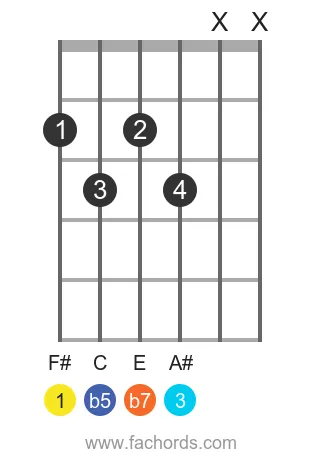
Begin by visualizing the unique geometry of the F#7b5 chord on the guitar fretboard. This member of the Dominant Chords family presents various movable shapes that leverage its characteristic sound. Our interactive fretboard tool allows you to explore every possible fingering, observing the visual layout across the strings. As you play, instant real-time microphone feedback verifies your accuracy, ensuring each note rings true. The F#7b5 is constructed from the notes F#, A#, C, and E, built from the intervals Root (1), Major Third (3), Diminished Fifth (b5), and Minor Seventh (b7), creating its distinct harmonic texture.
The striking Diminished Fifth (b5) within the F#7b5 creates a palpable tension, a harmonic pull that musicians often harness for dramatic resolution, especially prominent in jazz and blues progressions. To truly grasp its construction and function, delve into our comprehensive guide on Chord Construction, and deepen your understanding of its place within the Dominant Chord family. Many voicings of this chord require solid barre techniques; our Guitar Bar Chords tutorial will prove invaluable. Once you can confidently form the chord, dedicate time to improving your chord changes for fluid musicality.
Below, you'll find comprehensive resources for the F#7b5, including chord diagrams organized from the simplest open positions to more advanced movable shapes, detailed music theory insights, popular songs that feature this chord, and a list of keys where it commonly appears. Before you delve into memorizing these diagrams, make sure to utilize the interactive tool above. Set a comfortable tempo with the drum and BPM tool, play the chord, and let the mic feedback instantly confirm your finger placement and sound. Focus on exploring the various shapes and feeling the chord's unique character on the fretboard before committing them to memory.
F# 7th with flat 5th guitar chord is also written as F#7b5, F#7(b5) or F#7-5.
Notes in the F# 7b5 chord:
How to create the Dominant Seventh Flat five chord:
F# 7b5 Guitar Chord Diagrams
Position 1
Movable
Position 2
Movable
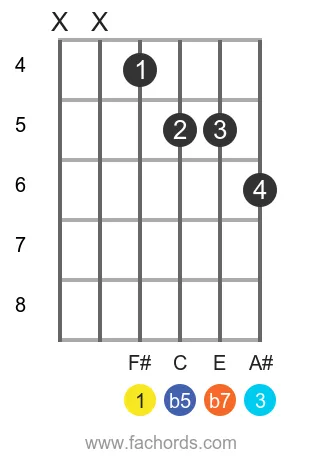
Position 3
Barre
Movable
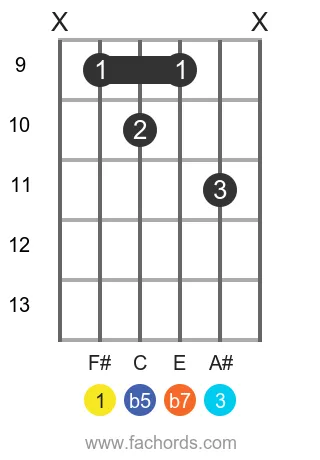
 Find more shapes in our all guitar chords online library. If you
prefer a printable pdf, download
the Free Guitar Chords Chart Pdf
Find more shapes in our all guitar chords online library. If you
prefer a printable pdf, download
the Free Guitar Chords Chart Pdf
You can also use this accessible F#7b5 chord page, with written diagram instructions and screen-reader support for blind users.

Created by
Giancarlo is a musician (teaching guitar since 2000), software engineer, AI consultant and published researcher
FAQ
What defines the F#7b5 chord as a 'Dominant Chord'?
The F#7b5 chord is classified as a dominant chord because it contains the essential intervals of a dominant seventh chord: the root, a major third, and a minor seventh (1, 3, b7). The 'b5' (diminished fifth) is an alteration that adds to its unique character while maintaining its dominant function.
What specific notes make up the F#7b5 chord?
The F#7b5 chord is composed of four distinct notes: F#, A#, C, and E. These notes correspond to its root, major third, diminished fifth, and minor seventh intervals, respectively.
What do the intervals 1, 3, b5, and b7 mean in the context of the F#7b5 chord?
These intervals define the structure of the F#7b5 chord: '1' is the Root (F#), '3' is the Major Third (A#), 'b5' is the Diminished Fifth (C), and 'b7' is the Minor Seventh (E). The 'b5' indicates that the fifth degree of the scale is lowered by a half-step from a perfect fifth.
What kind of sound does the F#7b5 chord have, and where is it commonly used?
The F#7b5 chord has a distinct and unique sound due to its specific interval combination, particularly the diminished fifth. It creates tension and harmonic interest, making it especially prevalent in genres like jazz.
Is the F#7b5 chord suitable for beginner guitarists?
No, the F#7b5 chord is not considered a beginner's chord. Playing it effectively requires some prior experience with guitar and an understanding of more advanced chord structures and intervals.
How can I learn to play the F#7b5 chord on the guitar?
To learn the F#7b5 chord, you will use visual aids such as chord diagrams and fretboard patterns. These tools will clearly show you where to place your fingers on the fretboard to play the correct notes (F#, A#, C, E) that form the chord.